China Galvanized Steel Coil Supplier
ZIVO STEEL supplies hot-dip galvanized steel coil in DX51D, DX52D, SGCC, S250GD and S350GD. This page gives the coating mass with the basis it is measured on, the coil conditions, and everything an EN 10346 or JIS G 3302 order has to state before a quotation can be made.
DX51D, DX52D, SGCC, S250GD, S350GD
Grades
0.12–6.0 mm
Thickness
1–10 t
Coil weight
3 t
Minimum order
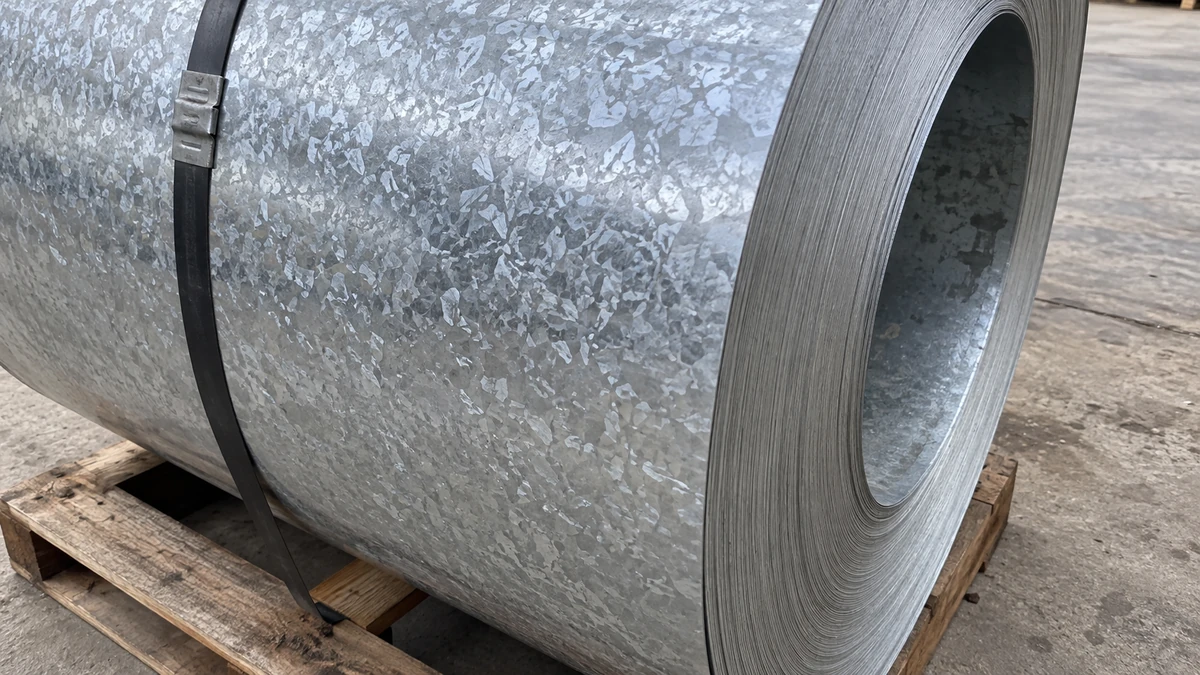
Representative view: hot-dip galvanized coil on a pallet, the zinc surface bright and spangled.
Galvanized Steel Coil From ZIVO STEEL
ZIVO STEEL is a steel supplier, not a mill: galvanized coil is arranged to the specification you send, for every export market except the United States. The grades run from DX51D and DX52D through SGCC to the structural S250GD and S350GD, 0.12 to 6.0 mm thick.
GI coil, galvanised coil, hot-dip galvanized coil and HDG coil all name this same product, and an inquiry written in any of them is answered from the same table. What changes from order to order is the base grade, the coating mass and the basis it is measured on, the spangle, the surface treatment and the coil geometry. Those are the five things this page asks you to fix before a quotation.
Available Specifications
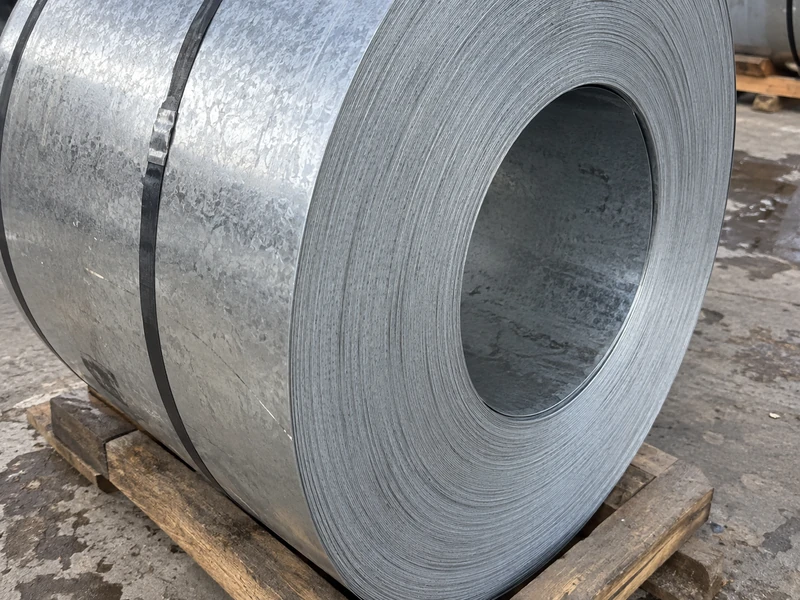
ZIVO STEEL supplies hot-dip galvanized coil in five base grades — DX51D, DX52D, SGCC, S250GD and S350GD — from 0.12 to 6.0 mm thick, each ordered with its own coating mass, coating finish, surface quality and surface treatment. Those are separate fields of the order, not parts of one product name.
Before the numbers, pick the system the order runs in. A coating designation only carries its meaning inside the standard that defines it, and the same coil is written differently in each one.
| Ordering system | How the coating is written | Coating-mass basis |
|---|---|---|
| EN 10346:2015 | The nominal coating mass together with the symbol for the coating type (Z, ZF, ZA, ZM, AZ, AS), the mass expressed in grams per square metre | The total mass of coating given for both surfaces; in an order the number means, for example, 275 = 275 g/m² including both surfaces |
| JIS G 3302 | A coating symbol from that standard's own list, rather than a gram figure carried inside the grade | A minimum coating weight in the triple-spot test, on both sides |
| ASTM A924/A924M | A coating designation shown in the individual product specification | The total coating of both surfaces, except for differentially coated sheet |
DX51D, DX52D, S250GD and S350GD belong to the first route; SGCC belongs to the second. An inquiry written in one system against a drawing written in another has to be reconciled before anything can be priced, so name the standard, the grade and the coating mass together. EN and JIS coating designations are commonly compared, but a comparison is a cross-reference: it requires full specification review and stays subject to purchaser approval.
Coating Mass and Its Basis
A coating figure without its basis is only half a specification. The basis has two halves of its own: which surfaces the figure covers, and how the figure is measured.
Which surfaces. EN 10346:2015 defines coating mass as the total mass of coating given for both surfaces, and under ASTM A924/A924M the coating is always expressed as the total coating of both surfaces, except for differentially coated sheet. So a figure of 275 g/m² is 275 g/m² over the two faces together, and never 275 g/m² on each face.
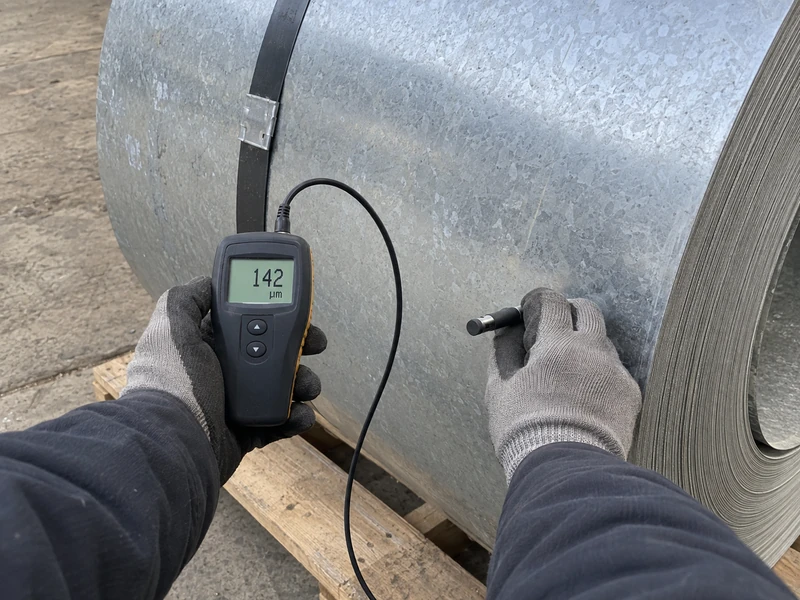
How it is measured. ASTM designations for hot-dip coated sheet set a minimum triple spot test value, which is the average of three edge-center-edge readings on a total-both-sides requirement, alongside a minimum single spot test value and a minimum single side requirement that is normally not less than 40% of the minimum single-spot total-both-sides requirement. JIS G 3302 states its own coating symbols as a minimum coating weight in the triple-spot test on both sides.
Because the total-both-sides, triple-spot designators allow an uneven split of the coating between the two faces, it is not possible to convert them precisely into single-spot, single-side designators, since those specify exact minimums per surface. If your drawing fixes a minimum per face, put it in the inquiry: it is a different requirement from the figure in the table, and it is subject to purchaser approval against the governing standard.
The table carries the grades and coating masses ZIVO STEEL supplies, one combination to a row, with the dimensions recorded against each. A dash means no value is published for that combination and it is fixed when the order is placed.
| Grade | Process | Thickness | Width | Coil ID | Coil weight | Coating |
|---|---|---|---|---|---|---|
| DX51D+Z100 | Hot-dip galvanized | 0.3–3.0 mm | 600–1500 mm | — | — | 100 g/m2 |
| DX51D+Z140 | Hot-dip galvanized | 0.12–4.0 mm | 600–1500 mm | 152 / 254 / 305 / 406 / 508 / 610 mm | 1–10 t | 140 g/m2 |
| DX51D+Z150 | Hot-dip galvanized | 0.12–5.0 mm | 600–1500 mm | — | — | 150 g/m2 |
| DX51D+Z200 | Hot-dip galvanized | 0.3–6.0 mm | 600–1500 mm | — | 1–8 t | 200 g/m2 |
| DX51D+Z275 | Hot-dip galvanized | 0.3–5.0 mm | 600–1500 mm | 508 / 610 mm | 3–5 t | 275 g/m2 |
| DX52D+Z | Hot-dip galvanized | 0.13–6.0 mm | 600–1500 mm | 508 / 610 mm | 3–10 t | Z30-Z275 g/m2 (range only) |
| S250GD+Z275 | Hot-dip galvanized | 0.12–6.0 mm | 600–1500 mm | — | — | 275 g/m2 |
| S350GD+Z | Hot-dip galvanized | 0.12–6.0 mm | 600–1500 mm | — | — | Z30-Z275 g/m2 (range only) |
| Grade | Process | Thickness | Width | Coil ID | Coil weight | Coating |
|---|---|---|---|---|---|---|
| SGCC+Z | Hot-dip galvanized | 0.12–6.0 mm | 1000 / 1200 / 1250 mm | — | 8–10 t | Z30-Z275 g/m2 (range only) |
| SGCC+Z275 | Hot-dip galvanized | 0.13–6.0 mm | 600–1250 mm | — | 3–8 t | 275 g/m2 |
Coating codes, units and test basis: Galvanized Steel Coating Designations.
What to Specify Before a Quotation
A quotation needs the grade, finish, thickness, width, length and quantity. On galvanized coil the finish is not one field but four — coating type and mass, coating finish, surface quality and surface treatment — and each carries its own letter or number in an EN order. ZIVO sales confirms the specification with you before the order and keeps it on file.
- Standard and gradeName the governing standard and the base grade together. The grade on its own does not fix the coating, and the coating on its own does not fix the steel.
- Coating type and massIn EN 10346:2015 the nominal coating mass in combination with the symbol for the coating type (Z, ZF, ZA, ZM, AZ, AS) is used as the coating designation, and the coating mass is expressed in grams per square metre. The number covers both surfaces: 275 means 275 g/m² including both surfaces.
- Coating finish, or spangleThe coating finish is stated by a letter, N or M, separately from the number for the coating mass; in the standard's ordering example M stands for minimized spangle. Spangle is a field you fill in, not something the coating mass decides for you.
- Surface qualityAn EN 10346 order states a letter for the surface quality: A, B or C.
- Surface treatmentAn EN 10346 order also states a letter for the surface treatment: C, O, CO, P, PO or S. SSAB describes these options as chemical passivation (C), oiling (O), chemical passivation and oiling (CO) and unprotected (U). Steel sheet manufacturers use the terms passivation treatment and chemical treatment to mean the same thing, so the order has to say whether chemical treatment is required or not.
- Thickness, and what it includesIn EN 10346:2015 the thickness is the final thickness of the delivered product after coating. Under ASTM A924/A924M the thickness is the total of the base steel and the coating, expressed to 0.001 in. [0.01 mm]. Say which of the two your tolerance is written against.
- Width, coil inner diameter, coil weight, quantityState the width, the coil inner diameter and the coil weight your uncoiler can take, together with the quantity.
- How it reads as one lineAn EN 10346 designation example is DX53D+Z100–M–B–O: steel DX53D with zinc coating, coating mass 100 g/m², minimized spangle (M), surface quality B, surface treatment oiled (O).
Have a Specification Ready?
Send what you already know, such as grade, finish, size or quantity. Inquiries are answered within 2 hours.
Coil Conditions and the Thickness Basis
Check the coil against your uncoiler and your line before the order, and check the thickness basis against your drawing.
- The standard's own thickness window, written with decimal commas. EN 10346:2015 applies in thicknesses of 0,20 mm ≤ t < 3,0 mm and, by agreement at the time of enquiry and order, to t < 0,20 mm or 3,0 mm ≤ t ≤ 6,5 mm. Several of the combinations in the table run above 3,0 mm, so those are placed under that agreement rather than as a matter of course.
- Thickness includes the zinc. In EN 10346:2015 the thickness is the final thickness of the delivered product after coating. Under ASTM A924/A924M the thickness is the total of the base steel and the coating, expressed to 0.001 in. [0.01 mm]. For JIS G 3302 products JFE Steel states that the tolerance is not read on the base metal alone but on the nominal thickness plus the equivalent thickness of the coating.
- Tolerances come from a dimensional standard. An EN 10346 order names EN 10143 as the dimensional standard; SSAB states that the tolerances of its metal coated products are mainly in accordance with EN 10143 and that, if no special instructions are given, products are delivered with the normal tolerances of that standard.
- The tolerance moves with the width, not only the gauge. Two Japanese mills give the same thickness tolerance for cold-rolled-base hot-dip galvanized coil of nominal thickness 0.40 to under 0.60 mm: ±0.06 mm for the three narrower width bands, ±0.07 mm for the next band and ±0.08 mm for the widest band.
0.12–6.0 mm
Thickness across the grades listed
3,0 mm
Above this the standard applies by agreement
508 / 610 mm
Coil inner diameter where a row gives one
1–10 t
Coil weight where a row gives one
Processing and End-Use Notes
Processing can be arranged; partner factories carry it out, and ZIVO sales confirms the specification with you before the order. Skin passing, where it is called for, is light cold-rolling of the product: ISO 3575:2025 gives its purpose as minimizing the appearance of coil breaks, stretcher strains and fluting, controlling the shape and obtaining the required surface finish, and notes that some increase in hardness and some loss in ductility will result.
Slitting
Coil slit into narrower widths. The triple spot test only applies to the original, full-width as-coated sheet, and narrow sheet cut from full-width sheet is subject only to a minimum single spot test, total-both-sides requirement, so slit material is judged on a different basis from the mother coil.
Cutting to length
Coil cut into sheets of a set length.
Spot welding and prepainting
Any type of chromium passivation interferes negatively with the spot weldability of galvanized sheet, so almost all sheet meant for automated spot welding equipment is ordered and produced as non-chemically treated. Where the end use involves spot welding, or coil prepainting, it may be necessary to order the product unpassivated; then there must be absolute certainty that it will not get wet before it is used.
Forming and the coating
The coating thickness may affect other properties of the coated sheet: a large amount of forming may limit the thickness of the coating to avoid loss of coating adhesion, and spot-welding may limit the maximum coating thickness for a given application. ArcelorMittal states that the forming and joining techniques currently used for uncoated steel are also suitable for galvanised steel, but that it is essential to select a coating thickness compatible with the processes envisaged, without compromising the degree of corrosion protection wanted.
Inspection and Documents
What travels with each shipment, and what stands behind the coating figure printed on it.
Under ASTM A924/A924M, metallic-coated steel sheet is produced to various coating designations shown in the individual product specifications and, except for differentially coated sheet, the coating is always expressed as the total coating of both surfaces. Two methods are provided for the coating weight test: the weigh-strip-weigh method and the X-ray fluorescence method. Product furnished under ASTM A653/A653M conforms to the applicable requirements of the latest issue of A924/A924M unless otherwise provided. If your acceptance turns on the method, name the method in the order.
- Shipment documentsEach shipment comes with a mill test certificate (MTC) and a packing list.
- Pre-shipment checksBefore shipment ZIVO checks thickness, width, surface, weight, packing and labels.
- Third-party inspectionThird-party inspection, for example SGS or BV, is accepted; the inspection cost is paid by you.
- Label photosPhotos of coil labels can be provided.
- The specification on fileZIVO sales confirms the specification with you before the order, and the agreed specification is kept on file for the shipment it belongs to.
Surface Protection, Packing and Shipment
Galvanized coil either arrives dry or it arrives stained. The surface treatment is chosen for the voyage and the storage that follow, not only for the process at your end. SSAB states that surface treatments provide only temporary surface protection during transportation and storage, and that white rust tends to form easily on bright, newly coated coils or between tightly packed sheets where condensed water or rainwater collects on the surface and cannot evaporate quickly.
- Passivation. The best way of minimizing the chance of white rust forming during shipment and storage of coils is a very thin and invisible chemical treatment applied on the galvanizing line by the coated sheet manufacturer. Mill-applied passivation treatments minimize the tendency for storage stain; they do not eliminate it where the product meets very adverse conditions.
- Oil. An alternative to passivation treatments is a specially formulated oil containing rust inhibitors, which delays the onset of staining from humidity by preventing moisture from condensing between the laps of a coil. SSAB notes that the temporary corrosion protection provided by oil is especially dependent on storage time, so long storage times should be avoided with oiled products.
- Both together. It is possible to order a product with both chemical treatment and oil; typically that combination gives better white-rust protection than either used separately, and it should be considered where harsh storage conditions are expected.
- Chromium. Due to health, safety and environmental concerns, the use of hexavalent chromium passivation treatments is being discontinued; they are being replaced by treatments in which the chrome is only in the trivalent state, or by products entirely free of chrome. Where your specification excludes hexavalent chromium, write that into the order.
- Unprotected. SSAB describes the EN 10346 surface treatment options as chemical passivation (C), oiling (O), chemical passivation and oiling (CO) and unprotected (U). Unprotected is a deliberate choice, and it carries the storage risk with it.
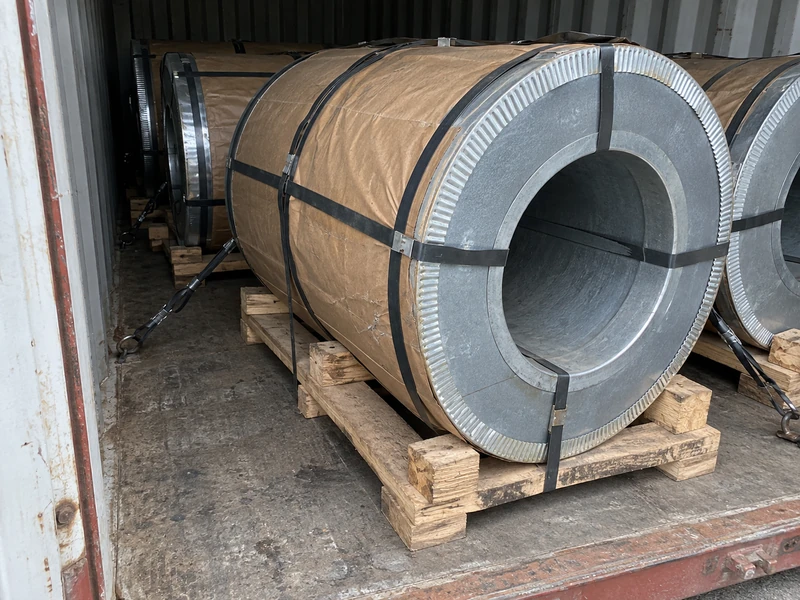
On the way and once it lands: even when the coils are wrapped, ship only in covered, watertight conveyances, and if an uncovered conveyance must be used, wrap the load completely with a tarp and avoid tearing the wrapping paper. Store the coils in a climate-controlled warehouse, use the material promptly and, wherever possible, avoid storing it for extended periods in excess of two months. Do not wrap sheets tightly in plastic: the product should be allowed to breathe by providing air circulation, and a bundle should not be wrapped while the sheets are wet, because that traps moisture and prevents drying. The usual ports of loading are Qingdao and Tianjin, and ZIVO sales confirms the surface treatment with you as part of the specification before the order.
Frequently Asked Questions
For galvanized steel coil the minimum is one coil, at least 3 t. Lead time is confirmed according to the specification and quantity.
Over both surfaces. EN 10346:2015 defines coating mass as the total mass of coating given for both surfaces, and in an order the number means, for example, 275 = 275 g/m² including both surfaces. Under ASTM A924/A924M the coating is likewise always expressed as the total coating of both surfaces, except for differentially coated sheet. A figure written per side is a different requirement and has to be stated as such.
ASTM designations for hot-dip coated sheet set a minimum triple spot test value, which is the average of three edge-center-edge readings on a total-both-sides requirement, a minimum single spot test value, and a minimum single side requirement normally not less than 40% of the minimum single-spot total-both-sides requirement. ASTM A924/A924M provides two methods for the coating weight test: the weigh-strip-weigh method and the X-ray fluorescence method. Ask for the method and the test basis on the certificate, not only the figure.
They belong to different designation systems and have to be named as such. G90 is an inch-pound coating designation of ASTM A653; Z275 is a metric coating designation, used in the SI designation system of ASTM A653M and in EN 10346 orders. The GalvInfo Center gives G90 (0.90 oz/ft²) and Z275 (275 g/m²) as an example of converting the inch-pound designation of ASTM A653 to the SI designation of ASTM A653M, and both are minimum triple-spot averages, total both sides. That conversion sits inside one standard; carrying a designation across standard systems is a cross-reference that requires full specification review and is subject to purchaser approval.
Multiply by 305: 1.00 oz/ft² = 305 g/m². The conversion moves the unit only; it does not move the figure between standard systems, each of which sets its own test basis and sampling rules.
In EN 10346:2015 the thickness is the final thickness of the delivered product after coating. Under ASTM A924/A924M the thickness is the total of the base steel and the coating, expressed to 0.001 in. [0.01 mm]. For JIS G 3302 products JFE Steel states that the tolerance is not read on the base metal alone but on the nominal thickness plus the equivalent thickness of the coating. State which basis your drawing uses before the order.
The theoretical mass in kg/m² is TM = t x 7.85 – CF, where t is the actual sheet thickness in millimetres, 7.85 is the mass in kg of one square metre of steel one millimetre thick, and CF is a coating factor in kg/m².
No. The triple spot test only applies to the original, full-width as-coated sheet, and narrow sheet cut from full-width sheet is subject only to a minimum single spot test, total-both-sides requirement. Slitting and cutting to length can be arranged, and partner factories carry the work out; say at the inquiry stage whether the coating is to be accepted before or after slitting.
They are separate fields of the order. In an EN 10346:2015 order the coating finish is stated by a letter, N or M, separately from the number for the coating mass; in the standard's ordering example M stands for minimized spangle. Name the coating finish you want as well as the mass.
Thickness runs 0.12–6.0 mm across the grades listed. Where a row gives a coil inner diameter it is 152, 254, 305, 406, 508 or 610 mm, and where a row gives a coil weight it falls between 1 and 10 t. The SGCC row also names 1000, 1200 and 1250 mm as its conventional widths. The table on this page carries the values one row at a time; where a row shows a dash, that value is fixed when the order is placed.
By the surface treatment on the coil and by how it travels. The best way of minimizing the chance of white rust forming during shipment and storage is a very thin and invisible chemical treatment applied on the galvanizing line by the coated sheet manufacturer, and ArcelorMittal states that galvanised strips are usually supplied passivated or oiled to temporarily limit that risk. Even when the coils are wrapped, ship only in covered, watertight conveyances; if an uncovered conveyance must be used, wrap the load completely with a tarp. All necessary precautions must then be taken in transport and storage to keep the material dry and to prevent the formation of condensation.
Each shipment comes with a mill test certificate (MTC) and a packing list, and photos of coil labels can be provided. Quotations are priced in US dollars, FOB Qingdao; the usual ports of loading are Qingdao and Tianjin. Payment terms are 30% T/T deposit and 70% balance before shipment.
Tell Us What You Need
Send the product form, grade, finish, thickness, width, length and quantity. Inquiries are answered within 2 hours.
Send Your Inquiry
Name, email and your inquiry are all that is needed. Add a WhatsApp number if you prefer to chat.
- Email: henry@zivosteel.com
- WhatsApp: +86 15668396618
- Address: 2F, Vanke Center, Lixia District, Jinan, Shandong, China
- Hours: Monday to Saturday, 8:00-18:00 (China time)