DX51D Steel
DX51D is the first rung of the cold-forming ladder in EN 10346:2015, classified there as bending and profiling quality. The name covers the steel; the zinc written after it is a separate field. This page sets out what the standard's public text says about the designation, what four mills publish for the grade when they restate that standard, and why the figures in circulation do not agree.
- Designation
- DX51D
- Family
- Non-alloy steel
270 - 500 MPa
Tensile strength Rm, as four mills restate it
No yield requirement
Nothing published fixes a yield strength
0,20 - 3,0 mm
Thickness range of EN 10346:2015
1.0917 / 1.0226
Two material numbers in circulation
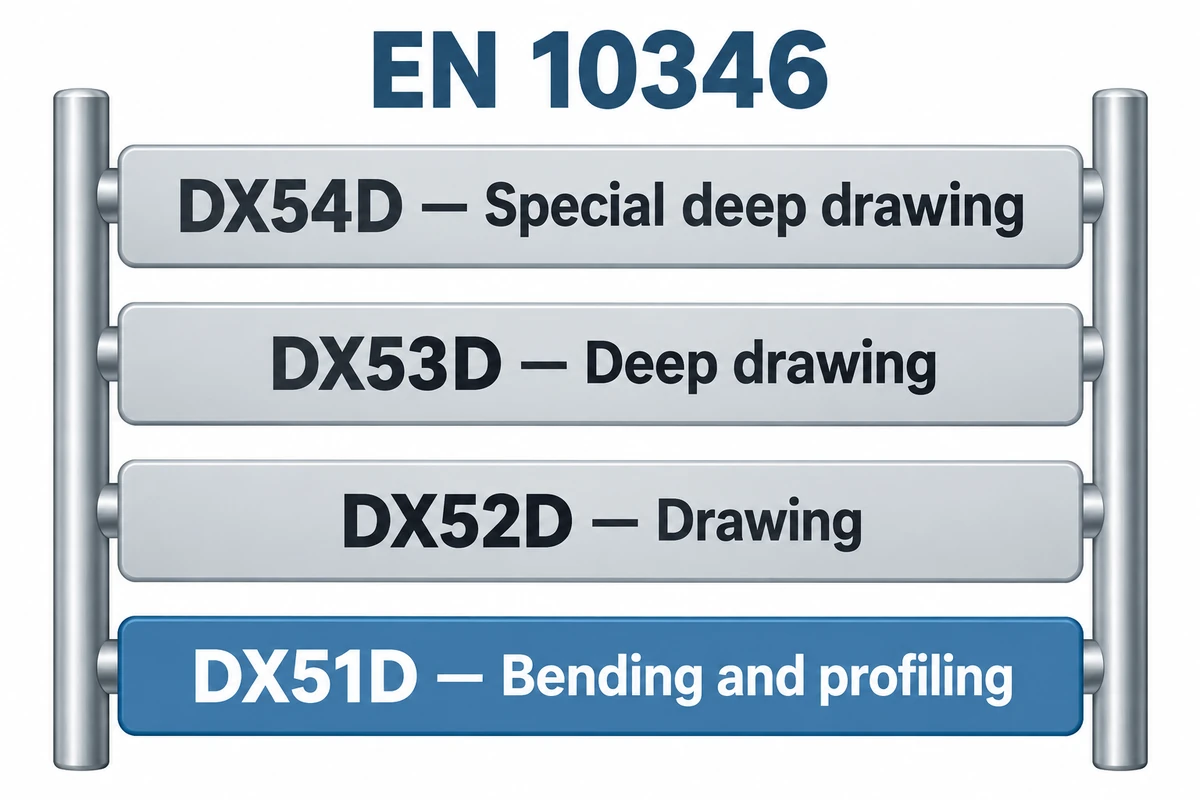
The EN 10346 cold-forming ladder as rungs, DX51D on the first rung as bending and profiling quality.
What DX51D Is
DX51D is a steel name from EN 10346:2015, the European standard for continuously hot-dip coated steel flat products. That standard ranks its low-carbon cold-forming steels by how much forming each one will take, and DX51D sits at the bottom of that range: it is the bending and profiling grade, below DX52D for drawing, DX53D for deep drawing and DX54D for special deep drawing. Restating the same standard, thyssenkrupp Materials Processing Europe calls it a machine folding grade and places it on simple craft forming and the making of simple profile shapes.
Two things the name does not carry belong at the top of a grade page. It does not carry the zinc, because the steel name and the coating symbol occupy separate fields and a coil is only fully described once both are written. And it does not carry a property table of its own: the figures published against DX51D are EN 10346:2015 requirements as mills restate them, which is why every number below is attributed to whoever published it.
Another standard names the same territory in different words. ISO 3575:2025 describes a commercial base-metal quality as one meant for general fabricating with the sheet flat, or for bending and moderate forming. That is a description of work rather than a designation, and it cannot be written on an order in place of this one.
Reading the Designation
EN 10346:2015 borrows its naming systems rather than inventing them. Under that standard the steel name comes from EN 10027-1 and the material number from EN 10027-2 — two parallel schemes, one producing the letters-and-digits name DX51D, the other producing a number of the 1.xxxx form. A drawing may carry either, and a certificate often carries both.
This page does not read the name one character at a time. EN 10027-1 is the document that assigns the characters and it is not on file here, so a letter-by-letter gloss would be a reconstruction rather than a sourced reading. What can be stated is what the name does: it identifies the steel, and its position in the standard's cold-forming ranking is what gives it meaning on an order.
The material number is the part of the name that public sources disagree about. thyssenkrupp Materials Processing Europe files this grade at 1.0917, gives its properties to DIN EN 10346, and lists +Z, +ZF, +ZA, +ZM, +AZ and +AS among the surface finishes it can carry. SteelNumber puts the same grade at 1.0226 and references the 2009 edition instead. The public sample of the 2015 text shows no material number for DX51D at all, so this page treats neither figure as settled and suggests ordering by the steel name, leaving the certificate to carry the number that the edition governing the order assigns.
Whatever follows the name is a separate field again. An EN 10346 order identifies the steel by its name or its number and then adds a symbol naming the hot-dip coating type; the worked example printed in the standard is DX53D+Z (1.0951+Z), in which +Z stands for the zinc. So a string such as DX51D+Z holds a steel and a coating type side by side, and the figure that usually follows the coating symbol is a coating mass, read on the coating standard's basis rather than on the grade's.
Where DX51D Sits in the Grade Ladder
EN 10346:2015 arranges its low carbon steels for cold forming by increasing suitability for cold forming, so the designation is a position rather than a label. Reading down the rungs is how you find out when DX51D has stopped being the right name to write.
| Designation | Quality, as EN 10346:2015 classifies it | Coating note |
|---|---|---|
| DX51D | Bending and profiling quality | — |
| DX52D | Drawing quality | — |
| DX53D | Deep drawing quality | — |
| DX54D | Special deep drawing quality | — |
| DX55D | Special deep drawing quality | Available only with the aluminium-silicon (+AS) coating |
| DX56D | Extra deep drawing quality | — |
| DX57D | Super deep drawing quality | — |
Two things change as you climb. The chemistry tightens: the maxima mills publish for DX52D and the grades above it are lower than the ones they publish for DX51D, and the composition table further down sets both out side by side. And the elongation requirement follows the gauge rather than the grade: SSAB records a decreased minimum elongation on thin material across this whole range of designations, so a part whose acceptance turns on elongation has to be read against its own thickness band and not against the headline figure.
Climbing is a decision about the part. A radius that cracks, a drawn corner, or tooling built around a softer steel are reasons to move up a rung. None of them are reasons to change the zinc, which is specified in its own field either way.
Mechanical Requirements
The requirements for this grade live in EN 10346:2015, and the public sample of that standard does not include its property table. What follows is therefore not the standard's text. It is what four mills publish for DX51D when they restate the standard, laid out one mill to a row so that the agreements and the gaps are both visible. Acceptance is checked against the edition named on the order, never against a page.
| Published by | Yield strength | Tensile strength Rm | Elongation A80, minimum | Reduction on thin material |
|---|---|---|---|---|
| ArcelorMittal, catalogue E20 | No requirement | 270 - 500 MPa | 22 % for 0.7 - 6 mm | ≥ 20 % for 0.5 - 0.7 mm; ≥ 18 % for 0.35 - 0.5 mm; ≥ 15 % for 0.2 - 0.35 mm |
| SSAB, for the Z, ZA and ZF coatings | No requirement | 270 - 500 MPa | 22 % | minus 2 units where 0.50 mm < t ≤ 0.70 mm; minus 4 units where t ≤ 0.50 mm |
| voestalpine, range of supply | No yield range given | 270 - 500 MPa | 22 % | Not stated |
| thyssenkrupp Materials Processing Europe | No maximum given | 270 - 500 MPa | 22 % | minus 2 units where 0.50 mm < t < 0.70 mm; minus 4 units where 0.35 mm < t < 0.50 mm; minus 7 units where t < 0.35 mm |
Every figure in the table is a transverse result and every elongation is A80. Two readings follow from it.
The missing yield value is the defining feature of this rung, not an omission in the sources. None of the four restatements fixes a yield strength for DX51D, so a drawing that relies on one is relying on something the designation does not carry, and the value has to be agreed separately as a requirement of the order.
The thin-gauge rule is where the mills part company. ArcelorMittal prints absolute minima band by band; SSAB and thyssenkrupp print deductions from the headline figure instead, and they do not place the band edges in the same spots — thyssenkrupp adds a third step below 0.35 mm that SSAB's wording does not have, and SSAB closes its bands with ≤ where thyssenkrupp uses <. On thin material, state which wording your acceptance follows.
Have a Specification Ready?
Send what you already know, such as grade, finish, size or quantity. Inquiries are answered within 2 hours.
Chemical Composition
Three mills publish a composition for this grade and the three agree. The figures are maxima in per cent by mass, published by the mill named in the row rather than printed in EN 10346:2015, whose public sample does not carry the table. The analysis basis is the column to read before the numbers, because it says where the sample was taken.
| Published by | Analysis basis | C | Si | Mn | P | S | Ti |
|---|---|---|---|---|---|---|---|
| ArcelorMittal, for DX51D +Z | Not stated in the catalogue table | ≤ 0.180 | ≤ 0.50 | ≤ 1.20 | ≤ 0.120 | ≤ 0.045 | ≤ 0.300 |
| SSAB | Ladle analysis | ≤ 0.18 | ≤ 0.50 | ≤ 1.20 | ≤ 0.12 | ≤ 0.045 | ≤ 0.30 |
| thyssenkrupp Materials Processing Europe | Heat analysis | ≤ 0.18 | ≤ 0.50 | ≤ 1.20 | ≤ 0.12 | ≤ 0.045 | ≤ 0.30 |
Read as a set these are wide ceilings, which is what a grade selected for bending rather than for drawing looks like on paper. A heat can of course come in far below any of them; the figures are limits, not targets, and a certificate showing a low carbon is showing a clean heat.
The same ArcelorMittal table shows what tightening looks like one rung up: DX52D +Z to DX57D +Z carry C ≤ 0.120 %, Mn ≤ 0.60 % and P ≤ 0.100 %. Those are the limits of a different designation, and the section below explains why they are so often printed under this one.
Product Form and Thickness Limits
DX51D is a flat-product name and it exists inside a thickness window. EN 10346:2015 applies in thicknesses of 0,20 mm ≤ t < 3,0 mm and, by agreement at the time of enquiry and order, to t < 0,20 mm or 3,0 mm ≤ t ≤ 6,5 mm; the decimal commas are the standard's own. Outside the first band the name is still written, but the delivery sits under an agreement rather than under the plain scope of the standard, and that is worth knowing before a drawing assumes otherwise.
The figure the window applies to is the coated product. In EN 10346:2015 the thickness is the final thickness of the delivered product after coating, so a nominal thickness is not a base-steel thickness with zinc still to be added; the zinc is already inside the number. A drawing that dimensions the substrate on its own is asking a question this standard does not answer.
How far the dimension may vary belongs to a different standard again. An EN 10346 order names EN 10143 as the dimensional standard, and SSAB states that the tolerances of its metal coated products are mainly in accordance with EN 10143 and that, if no special instructions are given, products are delivered with the normal tolerances of that standard. So the grade name fixes the steel, the coating symbol fixes the zinc, and EN 10143 fixes how far the size may move.
Names in Other Standards
The cross-standard table is the most-visited and least reliable part of any grade page, so this one carries only rows with a source behind them, each with its condition attached. A row here is a cross-reference between vocabularies. It requires full specification review and it stays subject to purchaser approval.
One row reaches across standard systems. ArcelorMittal's brand correspondence table places ASTM A653 CS in the row of DX51D +Z EN 10346, FS with DX52D +Z, DDS with DX53D +Z and EDDS with DX54D +Z. No test basis is given in that table, so what it records is a correspondence between designations and not a match between requirements.
The same table has no JIS column at all, and no source behind this page pairs DX51D with a JIS designation, so no such row is printed here. Where an offer arrives written to another standard, what settles acceptance is the standard named on the certificate, checked requirement by requirement against what the drawing asks for, and approved by whoever owns the specification.
| System | Designation | Standard | Note |
|---|---|---|---|
| EN | DX51D | EN 10346:2015 | The grade's own route. Steel names are allocated in accordance with EN 10027-1. |
| EN material number | 1.0917 | DIN EN 10346 | Listed against DX51D by thyssenkrupp Materials Processing Europe, with the surface finishes +Z, +ZF, +ZA, +ZM, +AZ and +AS. |
| EN material number | 1.0226 | EN 10346-2009 | Filed against the same grade by SteelNumber. Both numbers circulate; this page does not choose between them. |
| ASTM | CS | ASTM A653 | Placed in the DX51D +Z row of ArcelorMittal's brand correspondence table, with no test basis given. A designation-level cross-reference, subject to purchaser approval. |
| ISO | commercial | ISO 3575:2025 | A base-metal quality description rather than a grade name: general fabricating purposes where sheet is used in the flat condition, or bending or moderate forming. |
Figures You Will See Online and Why They Differ
Search this grade and the numbers will not line up. Four kinds of disagreement account for most of it, and each one has a different remedy.
The material number is unsettled, as the designation section above sets out. One mill catalogue files this grade at 1.0917 against a DIN adoption of the standard; a reference database files it at 1.0226 against an older edition; and the public sample of the 2015 text settles the question in neither direction. Write the steel name in the order, and the number printed on the certificate becomes whatever the edition governing that order assigns.
Mill data and standard text are different documents. Every mechanical and chemical figure on this page was published by a mill restating the standard, which is a manufacturer's statement of what it supplies against that standard. Where a page announces what EN 10346 requires, the question to put to it is which clause, because the requirement lives in the standard and the number on the screen may be the mill's.
A carbon maximum of 0.12 % is the most reprinted figure that does not belong here. Three mills publish C ≤ 0.18 % for this grade: ArcelorMittal at ≤ 0.180 %, SSAB at 0.18 % on a ladle analysis and thyssenkrupp on a heat analysis. A page printing 0.12 % under a DX51D heading disagrees with all three of them, and a certificate is written against the grade on the order rather than against that page.
Analysis basis moves a limit without changing its digits. A ladle analysis and a heat analysis are not taken at the same point, so two catalogues can print the same maximum and mean slightly different checks. Where a result sits close to a limit, the basis is the first line to read.
DX51D Coil From ZIVO
This page stops at the grade. The coating steps, the sizes, the way an order string is written and the terms a quotation is made on are set out on the DX51D coil page.
| Product page | Grade | Finish | Thickness | Width |
|---|---|---|---|---|
| DX51D Galvanized Coil | DX51D+Z100 | 0.3–3.0 mm | 600–1500 mm | |
| DX51D Galvanized Coil | DX51D+Z140 | 0.12–4.0 mm | 600–1500 mm | |
| DX51D Galvanized Coil | DX51D+Z150 | 0.12–5.0 mm | 600–1500 mm | |
| DX51D Galvanized Coil | DX51D+Z200 | 0.3–6.0 mm | 600–1500 mm | |
| DX51D Galvanized Coil | DX51D+Z275 | 0.3–5.0 mm | 600–1500 mm |
Frequently Asked Questions
It names the coating, not the steel. An EN 10346 order identifies the steel by its name or its number and then adds a symbol naming the hot-dip coating type; +Z is the zinc one, and the worked example printed in the standard is DX53D+Z (1.0951+Z). A figure written after the coating symbol is a coating mass, read on the coating standard's own basis, and it is not part of the grade name.
When the forming asks for more than the rung provides. EN 10346:2015 classifies DX51D as bending and profiling quality and DX52D as drawing quality, so a drawn feature, a tight radius that cracks, or tooling built around a softer steel is the signal. The chemistry moves with it: in the same ArcelorMittal table, DX52D +Z to DX57D +Z carry C ≤ 0.120 %, Mn ≤ 0.60 % and P ≤ 0.100 %, against wider ceilings for DX51D. The coating is unaffected either way, because it is specified in a field of its own.
Neither one on its own. The public record disagrees — a mill catalogue uses 1.0917 and a reference database uses 1.0226 — and the public sample of EN 10346:2015 shows no number for this grade, while stating that names follow EN 10027-1 and numbers follow EN 10027-2. Put the steel name in the order and let the edition governing it decide what appears on the certificate.
Not in anything published for the grade. ArcelorMittal, SSAB and voestalpine list no yield strength requirement and thyssenkrupp Materials Processing Europe gives no maximum, while all four publish Rm 270 - 500 MPa and a minimum elongation A80 of 22 % tested transverse to the rolling direction. A design that depends on a yield value depends on something the designation does not fix, so the value has to be written into the order as a requirement of its own and confirmed against the edition that governs it.
Nothing on this page carries that decision. The grades are commonly compared, and none of the sources behind this page puts them in one row: ArcelorMittal's brand correspondence table, which does place ASTM A653 CS in the DX51D +Z row, has no JIS column in it at all. Moving an order between standard systems is a cross-reference, it requires full specification review and it stays subject to purchaser approval, and what settles acceptance afterwards is the standard named on the certificate rather than any comparison table.
Sources
- EN 10346:2015 Continuously hot-dip coated steel flat products for cold forming – Technical delivery conditions (public sample: foreword, scope, terms, classification, ordering information)
- ISO 3575:2025 Continuous hot-dip zinc-coated and zinc-iron alloy-coated carbon steel sheet of commercial and drawing qualities (public sample)
- Industry catalogue E20 – Hot dip galvanised steels
- Metal coated formable steels, EN10346:2015 – DX51D, DX52D, DX53D, DX54D, DX56D, DX57D
- Hot-dip galvanized steel strip – Range of supply (November 2024)
- DX51D | 1.0917 – low-carbon steel for cold forming, properties according to DIN EN 10346
- DX51D (1.0226) – chemical composition, mechanical properties, standards
Tell Us What You Need
Send the product form, grade, finish, thickness, width, length and quantity. Inquiries are answered within 2 hours.
Send Your Inquiry
Name, email and your inquiry are all that is needed. Add a WhatsApp number if you prefer to chat.
- Email: henry@zivosteel.com
- WhatsApp: +86 15668396618
- Address: 2F, Vanke Center, Lixia District, Jinan, Shandong, China
- Hours: Monday to Saturday, 8:00-18:00 (China time)