Galvanized Steel Thickness & Gauge Guide
A gauge number is a range rather than a specification, and two gauge systems are in circulation for the same numbers. This guide sets out the difference between them, answers whether a quoted thickness includes the zinc coating, gives the tolerance basis in each standard system, and shows how theoretical weight per square metre is worked out.
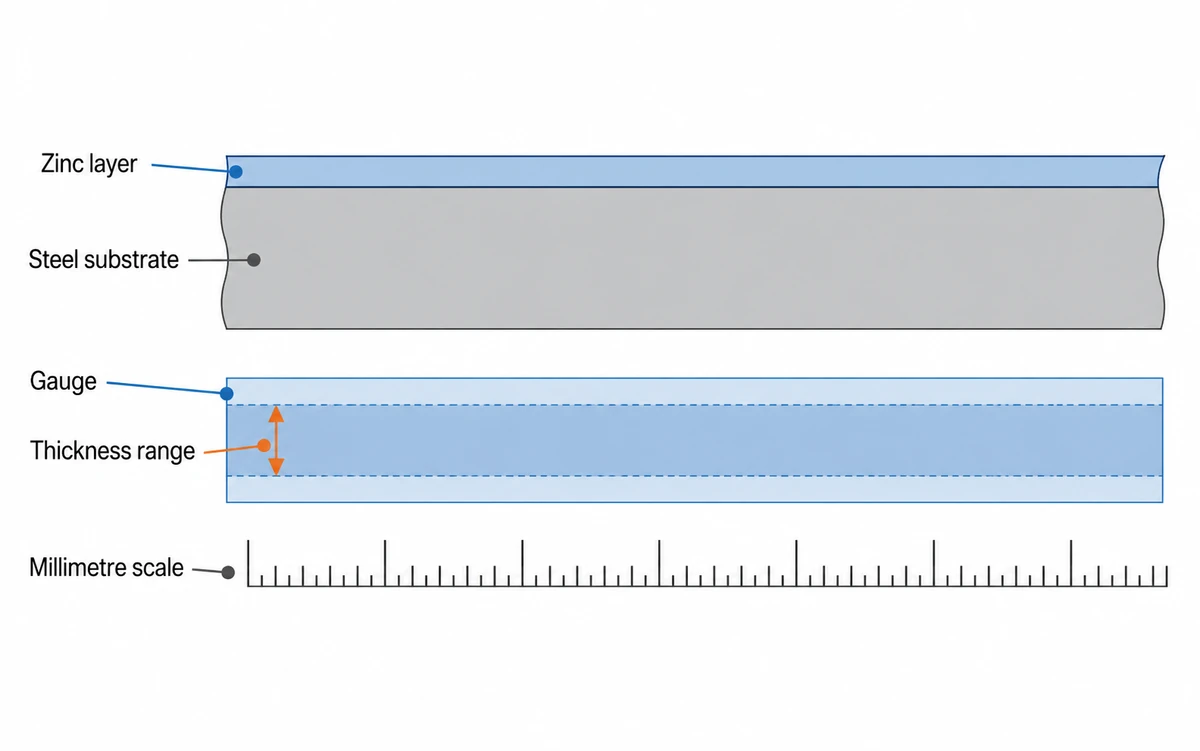
A gauge number as a band of thickness rather than one value, with the millimetre scale under it and the zinc layer on top.
Gauge Is a Range, Not a Thickness
A gauge number is not a thickness specification. Gauge numbers were never regulated and did not refer to only one thickness, but instead represented a thickness range within the allowable weight tolerance for each gauge number. Two charts published by two suppliers can therefore disagree about the same number and both be defensible, which is why a gauge argument between a drawing and a mill rarely has a winner.
There is one statutory table, and it does not cover coated coil. United States law establishes a standard gauge for sheet and plate iron and steel, and in its table gauge number 16 is 1/16 inch, .0625 inch or 1.5875 mm. That table was written for uncoated sheet and plate iron and steel, so it answers a narrower question than the one a galvanized inquiry usually asks.
An order written in gauge alone therefore has a gap in it. Put a decimal thickness on the order, in millimetres or in inches, say which standard the tolerance is read against, and keep the gauge number in the message as a pointer back to the drawing rather than as the specification itself.
Two Gauge Systems, One Set of Numbers
The reason two gauge charts disagree is that two systems are in circulation and they measure different things.
The Manufacturers' Standard Gauge (MSG) for steel sheets was developed with a definite thickness fixed against each gauge number. In the standard gauge system the density of steel is taken as 489.6 lbs/ft³, or 40.80 lbs/ft² per inch of thickness, while a figure of 41.820 lb/ft² per inch is the one commonly used in practice to express the relationship between weight and thickness for steel sheet. MSG describes bare steel.
The Galvanized Sheet Gauge (GSG) is the older system, used primarily by the trades consuming non-structural galvanized steel, and it is a measure of the zinc coated sheet thickness. It was developed in the early days of galvanizing, when zinc thicknesses were thicker than today. Historically galvanized sheet was sold by weight per square foot on that system, and the decimal thicknesses in it were equal to the steel sheet Manufacturers' Standard Gauge but with a 0.0037 inch allowance for a relatively thick zinc coating of 1.25 oz/ft² on each surface.
That allowance is the entire discrepancy: the same gauge number stands for a thicker sheet in the galvanized system than in the uncoated one, and the coating it allows for is heavier than most coatings ordered today. Underneath the two systems sits the distinction that survives into every modern order. CSSBI defines base steel thickness as the thickness of the sheet steel material without any coatings, and coated thickness as the thickness of the steel sheet including any metallic coatings, meaning zinc or aluminum-zinc alloy, and paint coatings. Every thickness figure belongs to one of those two and to nothing in between.
What Can Be Converted, and From What
A full gauge-to-millimetre table for galvanized sheet needs a primary source. The two that would carry it — the Canadian Sheet Steel Building Institute's fact sheet on sheet steel gauges and the appendix of the ASTM product specification — are not available to this page, and a distributor's chart is a secondary restatement rather than an authority. So this guide publishes the relations and the one statutory row it can stand behind, and leaves the rest of the table to the chart your drawing was made against.
| What it fixes | Value as published | Source |
|---|---|---|
| Galvanized Sheet Gauge against Manufacturers' Standard Gauge | The GSG decimal thickness is the MSG thickness plus a 0.0037 inch allowance, for a zinc coating of 1.25 oz/ft² on each surface | GalvInfo Center, citing CSSBI |
| Statutory gauge, number 16, uncoated sheet and plate | 1/16 inch, .0625 inch, 1.5875 mm | 15 U.S.C. § 206 |
| Steel density in the standard gauge system | 489.6 lbs/ft³, or 40.80 lbs/ft² per inch | CSSBI |
| Weight-to-thickness figure used in practice | 41.820 lb/ft² per inch | CSSBI |
| Theoretical mass of galvanized sheet | TM = t x 7.85 – CF, in kg/m² | GalvInfo Center |
| Whether a gauge number is a single value | No: it represents a thickness range within the allowable weight tolerance for that number | GalvInfo Center |
Read the first row as the reason a gauge argument starts and the last two as the way out of it. Where the drawing gives a gauge number, take the thickness that drawing's own chart assigns to it, record which chart that was, convert it to millimetres and put the decimal figure on the order. The weight then follows from the thickness rather than from the gauge, which is the only part of the chain nobody can dispute.
Does the Thickness Include the Zinc?
Three standard systems answer that question in three different shapes, and the shape is what decides how a tolerance gets checked.
ASTM A924/A924M puts the requirement on base steel and coating taken together, for coils and for cut lengths alike, and writes it to 0.001 in. [0.01 mm]. One figure, zinc included.
EN 10346:2015 arrives at the same place from the delivery side: what it governs is the final thickness of the product as delivered, after coating. What leaves the line is what gets measured.
JIS treats it as an addition rather than as a single figure. For JIS G 3302 products JFE Steel states that the tolerance does not rest on bare base metal alone, since it covers the nominal thickness together with what the catalogue calls the equivalent coating thickness. Nippon Steel likewise states that thickness tolerances are applied to the total values of nominal plate thickness and corresponding coating thickness, and that thickness shall be measured at a spot at least 25 mm inside the edge. JFE publishes the added figure as 0.026 mm for Z12, 0.034 mm for Z18 and 0.054 mm for Z27, as manufacturer data, without explaining how it is derived.
The practical consequence is one sentence in an inquiry. State whether your thickness is base steel or coated, and which standard's tolerance it is read against. A tolerance agreed on one basis and measured on another is a rejection waiting for a ship to arrive.
Have a Specification Ready?
Send what you already know, such as grade, finish, size or quantity. Inquiries are answered within 2 hours.
Thickness Ranges and Tolerances
Two questions decide a thickness tolerance: which range the product standard covers at all, and which dimensional standard the tolerance itself comes from.
| Item | What is published | Source |
|---|---|---|
| EN thickness range | From 0,20 mm up to but not including 3,0 mm | EN 10346:2015, clause 1 |
| Outside that range | Below 0,20 mm, or from 3,0 mm up to and including 6,5 mm, where the enquiry and the order agree it | EN 10346:2015, clause 1 |
| EN dimensional standard | EN 10143. SSAB places its metal coated products mainly under that standard and, where an order carries no special instruction, ships them to its normal tolerances | EN 10346 order and SSAB |
| One JIS tolerance row, as an illustration | Cold-rolled base, nominal thickness from 0.40 mm to under 0.60 mm: 0.06 mm either way across the three narrowest width bands, 0.07 mm on the next and 0.08 mm on the widest | Nippon Steel and JFE catalogues, which publish the same row |
The decimal commas in the EN rows are the standard's own notation rather than a typing error, and they are worth copying faithfully into an order that quotes the clause.
Note also what the last row is and is not. Two mills publishing one and the same set of figures is good evidence that both restate a real table, but neither the EN 10143 tolerance tables nor the JIS ones are available to this page, so a single row is shown to illustrate something a gauge chart never shows: the band widens with the strip width, not only with the gauge. The tables themselves stay with the standards, and the tolerance that governs an order is the one named on it.
Theoretical Weight per Square Metre
The theoretical mass of galvanized sheet in kg/m² is TM = t x 7.85 – CF, where t is the actual sheet thickness in millimetres, 7.85 is the mass in kg of one square metre of steel one millimetre thick, and CF is a coating factor in kg/m².
The worked example published with the formula runs as follows: galvanized sheet 0.50 mm thick with a Z275 coating has a coating factor of 0.029 kg/m², so TM = 0.50 x 7.85 – 0.029 = 3.896 kg/m².
Two points about the shape of it. The t in the formula is the actual sheet thickness with the coating included, which is why the coating factor is subtracted rather than added: zinc is lighter per unit of thickness than the steel it stands in for. And the size of that correction can be judged from the conversion behind it — for galvanized and galvannealed sheet the relationship between coating mass and thickness, based on a zinc density of 7140 kg/m³, is 1.00 oz/ft² = 0.00168 in = 305 g/m² = 0.0427 mm, while a G90 coating contributes about 1.6 mils (0.0016 inches, or about 42 microns) to the total thickness of the coated sheet.
This is a calculation method published by the GalvInfo Center. It is not a weight ZIVO STEEL guarantees on a coil, and it does not stand in for the weight recorded on the packing list.
Ordering in Millimetres From a Gauge Drawing
A quotation needs the grade, finish, thickness, width, length and quantity. When the drawing is written in gauge, the thickness line is the one that has to be rebuilt before anything else can be priced.
- Take the thickness from the drawing's own chartGauge numbers were never regulated and did not refer to only one thickness, but to a range of thicknesses, so the number on its own does not carry a value. Use the chart the drawing was made against and record which chart that was. The one statutory table, United States law's standard gauge for sheet and plate iron and steel, gives gauge number 16 as 1/16 inch, .0625 inch or 1.5875 mm, and it covers uncoated sheet and plate.
- Write a decimal thicknessPut the thickness on the order in millimetres or in inches, to the decimal place the governing standard uses. The gauge number can stay in the message as a reference back to the drawing; it is not the specification and it should not be the only figure anyone works from.
- Say whether the figure includes the coatingASTM A924/A924M measures base steel and coating together and writes the requirement to 0.001 in. [0.01 mm]; EN 10346:2015 governs the product as it is delivered, coating included. One sentence in the inquiry settles which of the two your figure belongs to.
- Name the dimensional standardEN 10143 is the dimensional standard an EN order points to, and where nothing special is asked for, SSAB ships to that standard's normal tolerances. A tighter band is a request that has to be made and agreed, never an assumption to carry into production.
- Check what the certificate will reportAsk which thickness the certificate will show and on which basis, so the figure on the document can be compared with the figure on the order without a conversion standing between them.
- Get it written down before the orderThe specification is confirmed by ZIVO sales together with you before the order, and the confirmed specification is kept on file, so a thickness basis agreed by e-mail does not quietly change between the quotation and the certificate.
The Coating Adds Thickness and Weight
Zinc is thin, but on a light gauge it is a measurable share of what a caliper reads, and it is the reason the two gauge systems ever separated.
A G90 coating contributes about 1.6 mils (0.0016 inches, or about 42 microns) to the total thickness of the coated sheet; equally applied to both sides, that is about 0.0008 inches (21 microns) of zinc on each surface. The American Galvanizers Association lists the same designation as a coating weight of 0.90 oz/ft² total both sides with a coating thickness of 0.77 mils on one side, and G60 as 0.60 oz/ft² with 0.51 mils.
On the EN side the figures are published by the mills as typical values. ArcelorMittal's catalogue lists Z275 as a coating weight of 275 g/m² double sided with a typical coating thickness of 20.0 µm per side, and gives Z100 at 7.0, Z140 at 10.0, Z200 at 14.0, Z225 at 16.0, Z350 at 25.0, Z450 at 31.0 and Z600 at 42.0 µm per side. SSAB gives Z275 as a minimum total coating mass of 275 g/m² on both surfaces with a guidance value of 20 µm typical coating thickness per surface. Those are manufacturer data and guidance values, useful for planning a caliper reading and not limits to reject a coil against.
The arithmetic behind all of them is the same. For galvanized and galvannealed sheet the relationship between coating mass and thickness, based on a zinc density of 7140 kg/m³, is 1.00 oz/ft² = 0.00168 in = 305 g/m² = 0.0427 mm, taken as one layer. A designation written over both surfaces halves into a per-side thickness only where the coating is split equally between the two faces, and each of those figures is read on the basis of the standard that published it.
Frequently Asked Questions
It depends which table you are reading, which is the honest answer rather than an evasive one. United States law establishes a standard gauge for sheet and plate iron and steel and gives gauge number 16 as 1/16 inch, .0625 inch or 1.5875 mm, but that table covers uncoated sheet and plate. Trade gauge numbers for galvanized sheet were never regulated and refer to a range of thicknesses rather than one, and the Galvanized Sheet Gauge sets its decimal thicknesses equal to the Manufacturers' Standard Gauge plus a 0.0037 inch allowance for the zinc. Take the value from the chart your drawing was made against, convert that value, and order the decimal figure.
On coated thickness in the EN and ASTM systems, and as a sum in the JIS system. EN 10346:2015 takes it as the final thickness of the product as delivered, after coating. ASTM A924/A924M measures base steel and coating together and writes the requirement to 0.001 in. [0.01 mm]. For JIS G 3302 products JFE Steel states that the tolerance does not rest on bare base metal alone, since it covers the nominal thickness together with the equivalent coating thickness the catalogue publishes against each coating designation. CSSBI's two terms are the ones worth using in an inquiry: base steel thickness is the sheet steel without any coatings, coated thickness includes the metallic and paint coatings.
Work it from the thickness rather than from the gauge. The theoretical mass in kg/m² is TM = t x 7.85 – CF, where t is the actual sheet thickness in millimetres, 7.85 is the mass in kg of one square metre of steel one millimetre thick and CF is a coating factor in kg/m². The published worked example: galvanized sheet 0.50 mm thick with a Z275 coating has a coating factor of 0.029 kg/m², so TM = 0.50 x 7.85 – 0.029 = 3.896 kg/m². It is a calculation method, not a guaranteed shipping weight.
Because two systems are in use and they measure different things. The Manufacturers' Standard Gauge describes bare steel. The Galvanized Sheet Gauge is a measure of the zinc coated sheet thickness, and its decimal thicknesses were set equal to the Manufacturers' Standard Gauge but with a 0.0037 inch allowance for a relatively thick zinc coating of 1.25 oz/ft² on each surface. On top of that, gauge numbers represented a thickness range within the allowable weight tolerance for each number rather than a single value. The Galvanized Sheet Gauge is the older of the two, used primarily by the trades consuming non-structural galvanized steel, and it dates from the early days of galvanizing when zinc thicknesses were thicker than today.
Sources
- GalvInfoNote 1.1: Understanding Coating Weight Designations for Zinc-Based Coatings on Steel Sheet (Rev 4.0, Dec 2020)
- Sheet Steel Gauges – What They Mean (CSSBI blog, Dec 2014; summary of Fact Sheet 10)
- 15 U.S. Code § 206 – Standard gauge for sheet and plate iron and steel
- GalvInfoNote 1.10: Useful Galvanized Sheet Metrics (Rev 1.1, Dec 2017)
- EN 10346:2015 Continuously hot-dip coated steel flat products for cold forming – Technical delivery conditions (public sample: foreword, scope, terms, classification, ordering information)
- ASTM A924/A924M-22a Standard Specification for General Requirements for Steel Sheet, Metallic-Coated by the Hot-Dip Process (abstract and scope page)
- Metal coated formable steels, EN10346:2015 – DX51D, DX52D, DX53D, DX54D, DX56D, DX57D
- Hot Dip Galvanized Steel Sheet catalog (Cat. No. B1E-004-11)
- DURGRIP™ hot-dip galvannealed steel sheets catalog (U019en)
- Industry catalogue E20 – Hot dip galvanised steels
- Continuous Sheet Galvanizing ASTM A653 (G60, G90) vs. Batch Hot-dip Galvanizing ASTM A123 (2010)
Tell Us What You Need
Send the product form, grade, finish, thickness, width, length and quantity. Inquiries are answered within 2 hours.
Send Your Inquiry
Name, email and your inquiry are all that is needed. Add a WhatsApp number if you prefer to chat.
- Email: henry@zivosteel.com
- WhatsApp: +86 15668396618
- Address: 2F, Vanke Center, Lixia District, Jinan, Shandong, China
- Hours: Monday to Saturday, 8:00-18:00 (China time)