How to Read a Mill Test Certificate
You verify a mill test certificate by checking the heat number on the report against the tags on the material and by comparing the specifications on the report to your engineering requirements. The EN 10204 inspection document type tells you whether the certificate was validated by the manufacturer or also by an independent third party.
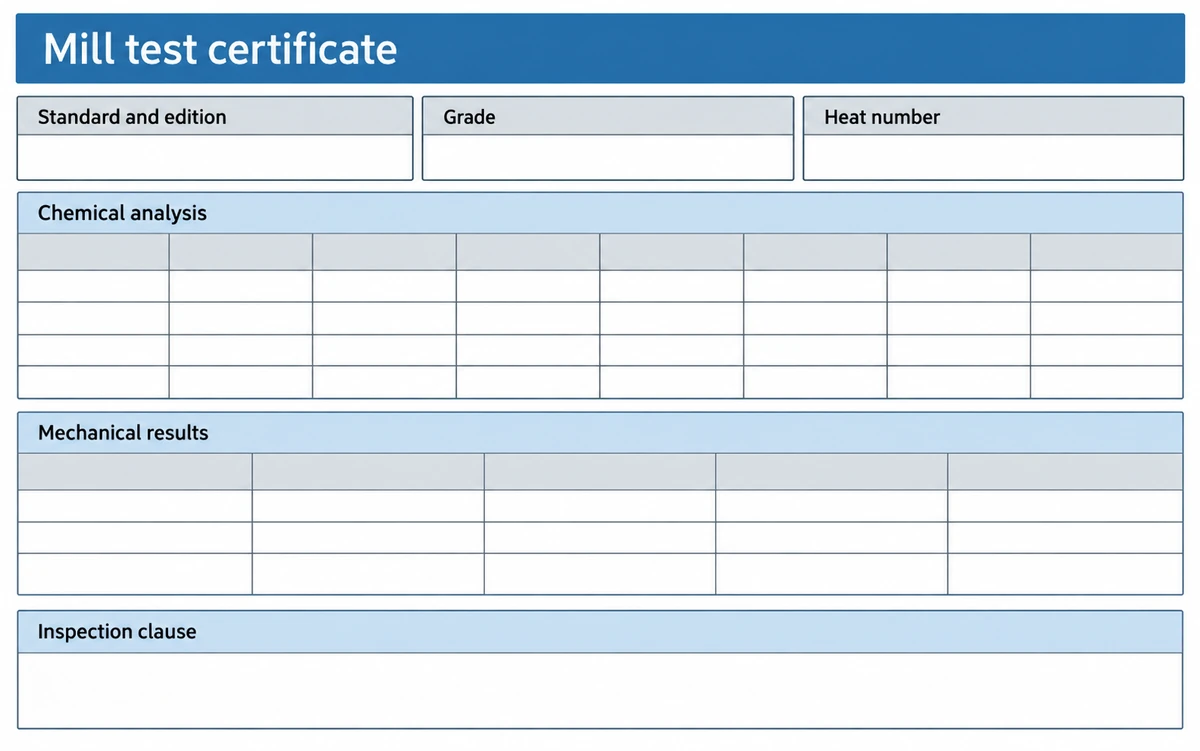
A mill test certificate as labelled blocks: standard and edition, grade, heat number, chemical analysis, mechanical results and the inspection clause.
Mill Test Certificate Basics
A Mill Test Report (MTR), also known as a mill certificate or material test report, is a quality assurance document provided by the steel mill that produced the material. It certifies that the steel meets specific standards and properties and serves as a formal record of its chemical and mechanical properties.
The Mill Test Certificate (MTC) contains all specifications of the steel product, including weight, dimensions, chemical composition, mechanical strength, heat treatment status, test results, and traceability. When you receive the certificate, check these fields against the order and the delivered steel.
- Stainless steel coilSelect the grade and finish for your specification.
- Carbon steel coilSelect the rolling route and delivery condition for your specification.
- Galvanized steel coilSelect the coating route and designation for your specification.

EN 10204 Inspection Document Types
BS EN 10204:2004 specifies the types of inspection documents supplied to the purchaser for metallic products, applies to plates, sheets, bars, tubes, forgings and castings whatever their method of production, and the 2004 revision simplified the range to 2.1, 2.2, 3.1 and 3.2 only. Type 2.3 was deleted, Type 3.1 replaces 3.1B, and Type 3.2 replaces 3.1A, 3.1C and 3.2. Of the four certificate types, 3.1 and 3.2 are the most widely used in steel products.
| Type | Document name | Content | Validation |
|---|---|---|---|
| 2.1 | Declaration of compliance with the order | Statement of compliance with the order | Manufacturer |
| 2.2 | Test report | Statement of compliance with the order with indication of results of nonspecific inspection | Manufacturer |
| 3.1 | Inspection certificate 3.1 | Statement of compliance with the order with indication of results of specific inspection | Manufacturer's authorized inspection representative, independent of the manufacturing department |
| 3.2 | Inspection certificate 3.2 | Statement of compliance with the order with indication of results of specific inspection | Manufacturer's authorized inspection representative independent of the manufacturing department and either the purchaser's authorized inspection representative or the inspector designated by the official regulations |
Type 3.1 reports actual test results from the material in the lot from which the steel products were supplied, formally referred to as specific testing, and is endorsed only by the manufacturer's own representative who must be independent from the manufacturing process. The Type 3.2 certificate is similar to Type 3.1, but has additionally been countersigned and verified by an independent third party to validate the material by way of a verification test.
Fields on a Mill Test Report
Check each field below against the delivered steel and the purchase order. The certificate records the heat number, chemical composition, mechanical properties, standards and grade, dimensions and finish, and the authorized mill representative's signature.
Heat number
Confirm the heat number is present and traceable back to the original mill heat; it may appear as a lot number.
Chemical composition
Verify each element percentage, such as carbon, manganese, and chromium, falls within the required range for the specified grade.
Mechanical properties
Check tensile strength, yield strength, elongation, and hardness values; these indicate the material's strength, ductility, hardness, and elasticity for the end use.
Standards and grade
Review the specifications met and standards such as ASTM A1011, A36, or A240, and confirm the grade listed.
Dimensions and finish
Check size, thickness, width, and finish, plus the alloy and temper if listed; this helps you verify the product matches the purchase order.
Signature
Confirm the certificate is signed by an authorized mill representative, certifying its accuracy and compliance.
Order-specific details
Check any additional details that the order specifies.
Matching the Document to the Coil
Use these checks when a delivered coil is matched to its mill test certificate.
Heat number
Always check the heat number on the mill test report against the heat number on the tags fixed to the delivered material.
Specification check
Before processing, compare the specifications on the mill test report with your engineering requirements.
3.1 test scope
For an inspection certificate 3.1, confirm that the test unit and the tests to be carried out are those defined by the product specification, the official regulation and corresponding rules and/or the order.
Transferred strip results
When a 3.1 certificate carries results from incoming strip, check that they are relevant results obtained by specific inspection on that strip, such as chemical composition or mechanical properties from the strip vendor's Material Test Reports.
Questions to Ask About 3.2 Certificates
Confirm the document chain before the order when an EN 10204 Type 3.2 certificate is part of the requirement.
- Confirm the certificate typeAsk the supplier to state whether the document is an EN 10204 Type 3.2 Inspection Certificate, which is similar to the Type 3.1 certificate but has additionally been countersigned and verified by an independent third party to validate the material by way of a verification test.
- Confirm the 3.1 basis documentAsk whether the manufacturing mill will prepare a 3.1 type certificate to present to the outside inspector to use as a basis for preparing the independent 3.2 certificate.
Tell Us What You Need
Send the product form, grade, finish, thickness, width, length and quantity. Inquiries are answered within 2 hours.
Send Your Inquiry
Name, email and your inquiry are all that is needed. Add a WhatsApp number if you prefer to chat.
- Email: henry@zivosteel.com
- WhatsApp: +86 15668396618
- Address: 2F, Vanke Center, Lixia District, Jinan, Shandong, China
- Hours: Monday to Saturday, 8:00-18:00 (China time)