Galvanized Steel Spangle
Spangle is the crystal pattern you can see on hot-dip galvanized steel, and it is a field of its own on an order rather than something the coating mass decides. This guide gives the three types as each standard defines them, how the pattern forms, and what an inspection can and cannot hold a coil to.
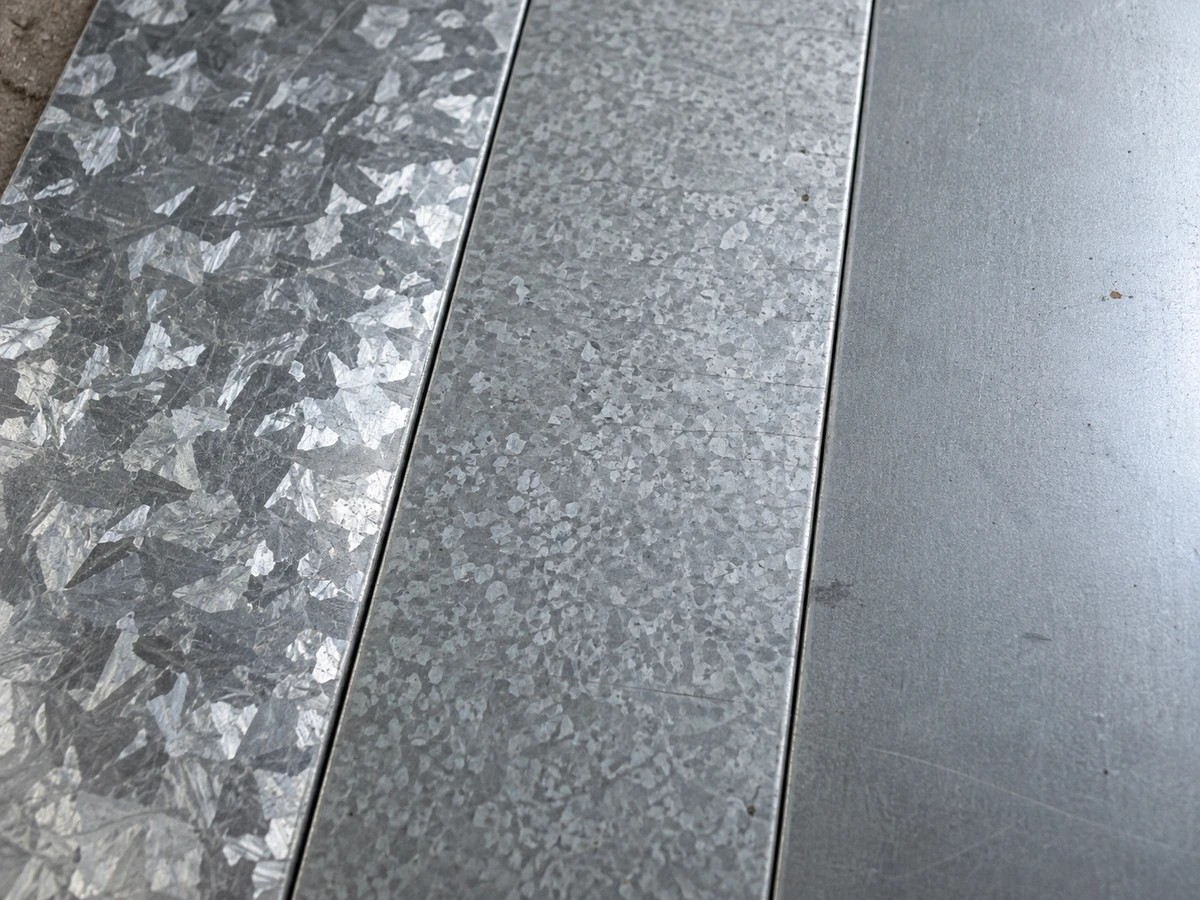
Representative view: regular, minimized and spangle-free zinc surfaces side by side, the crystal pattern fading across the three.
What Spangle Is
Spangle is an appearance, not a property that can be read off a certificate. When the word spangle is used to describe the surface appearance of galvanized steel sheet, it means the typical snowflake-like or six-fold star pattern that is visible to the unaided eye: zinc crystals, frozen where they grew.
It is also a requirement with no numbers in it. There are no quantitative specifications that regulate the size, meaning the diameter, of galvanize spangles, and spangle size terminology is qualitative. That single fact shapes everything below — how the types are defined, how an order names one, and what an inspection is entitled to reject.
How Spangle Forms
The pattern is decided in the seconds after the strip leaves the bath, by how many crystals start and how far each one is allowed to grow. Bath chemistry is what moves that balance, which is why the same coating mass can arrive looking entirely different from two lines.
The coating freezes
Spangles develop when the molten zinc adhering to the steel sheet is cooled below the melting point of zinc, which is approximately 787 °F [419 °C]. Everything after that is a question of crystal count and crystal size.
Lead produced the classic pattern
In galvanize coatings on steel sheet, the most common reason for the well-defined dendritic growth pattern — the large spangle people picture when they hear the word — was the presence of lead in the coating.
It worked by leaving room
Lead, by inhibiting nucleation, effectively increases the spaces between neighboring nuclei, allowing larger spangles to form. Fewer starting points, more room for each crystal, a bigger visible star.
Antimony took its place
Some galvanized sheet manufacturers that wish to market a spangled product use lead-free zinc but add a small amount of antimony to the zinc coating bath. Antimony influences spangle formation in a similar fashion to lead, and the amount of antimony in the coating bath is typically about 0.03 to 0.10%.
Spangle-free is a lead limit
The lead level in zinc used to produce spangle-free product is a maximum of 0.007% (70 ppm), and often less than 0.005% (50 ppm). The appearance is the visible side of a bath chemistry decision.
And the specification moved with it
ASTM A653/A653M has been revised to restrict the lead level of the zinc used to coat the sheet to a maximum of 0.009% (90 ppm), so spangled product that meets this specification must now be made using only antimony.
Regular, Minimized and Spangle-Free
Three terms do most of the work on an order, and each standard system defines them in its own words. The rows below carry the definitions as they are recorded, with the source named on every line.
| Term | Definition as published | Source |
|---|---|---|
| Regular spangle | Zinc-coated steel sheet with a visible multifaceted zinc crystal structure, where the cooling rate is uncontrolled, which produces a variable grain size | ASTM A653/A653M, as quoted by the GalvInfo Center |
| Minimized spangle | Zinc-coated steel sheet in which the grain pattern is visible to the unaided eye and is typically smaller and less distinct than the pattern visible on regular spangle; the zinc crystal growth is arrested by special production techniques, or inhibited by a combination of coating bath chemistry plus cooling | ASTM A653/A653M, as quoted by the GalvInfo Center |
| Spangle-free | Zinc-coated steel sheet with a uniform finish in which the surface irregularities created by spangle formation are not visible to the naked eye; the finish is produced by a combination of coating bath chemistry, or cooling, or both | ASTM A653/A653M, as quoted by the GalvInfo Center |
| Normal coating | A coating formed as a result of unrestricted growth of zinc crystals during normal solidification; it has a metallic lustre, but it can be variable in appearance and not suitable for decorative painting | ISO 3575:2025, clause 3.11 |
| Minimized spangle | A finish obtained by restricting normal spangle formation during the solidification of the zinc; this product can have some lack of uniformity in surface appearance within a coil, or from coil to coil | ISO 3575:2025, clause 3.12 |
Two things the table deliberately does not say. Spangle-free does not mean grain-free: lead-free coatings still have a grain pattern that is, at best, barely visible to the unaided eye, with spangles typically about 0.5 mm in diameter and clearly visible at 5 to 10X magnification. And the size bands that circulate in trade copy are not requirements — the GalvInfo Center's suggested size ratings, in which spangle-free means spangles of 0.5 mm or less across, are that organisation's own rating scale.
The EN system names the finish with a letter rather than a word. SSAB describes its zinc (Z) coating as consisting almost entirely of zinc and lead free, resulting in a finely crystallized zinc spangle, and states that the small spangle coating is designated by the letter M.
Skin Pass and Surface Quality
Skin passing is a separate operation from anything the coating bath does, and keeping the two apart saves an argument later. ISO 3575:2025 defines skin pass as light cold-rolling of the product, whose purpose is one or more of the following: to minimize the appearance of coil breaks, stretcher strains and fluting; to control the shape; and to obtain the required surface finish. Some increase in hardness and some loss in ductility will result from skin passing, so it is asked for deliberately rather than added out of habit.
In the EN system the result of that pass shows up as a surface quality letter. SSAB states that surface quality B, the improved surface, is obtained by skin passing and has a matte appearance, while surface quality A, the normal surface, has a shiny appearance. The letter therefore describes what was done to the surface, and the spangle letter describes what the coating looks like underneath it.
What a skin pass can achieve depends on that spangle. Large spangles are thickest at their centers and thinnest at their edges; the grain boundaries are depressed, and they are difficult to smooth by subsequent temper passing, whereas coatings with small spangles can be smoothed more easily. Spangle-free coatings, when combined with temper rolling by the galvanized sheet producer, can very easily be made extra smooth, and the coating can then be painted to give a very smooth finish. A pronounced spangle and a perfectly flat painted surface are therefore two requests that pull against each other, and the order has to choose between them rather than assume both.
Have a Specification Ready?
Send what you already know, such as grade, finish, size or quantity. Inquiries are answered within 2 hours.
Spangle and Coating Mass Are Different Fields
A heavier coating does not buy a larger spangle, and a light coating does not force a small one. They are two fields of the same order line. In an EN 10346:2015 order the coating finish is stated by a letter, N or M, separately from the number for the coating mass, and in the standard's ordering example M stands for minimized spangle. Under the same standard, hot-dip zinc coated products with pronounced spangle are an option that has to be specified by the purchaser — left unwritten, it has not been ordered.
One sourced connection does run between appearance and mass, and it runs the other way round. When producing a heavier coating mass, 100 g/m² per side and higher, with a lead- and antimony-free bath, there is a tendency for the coating to develop very visible sags and ripples, more so near the edges of the sheet. That is a process limitation on appearance at heavy coating masses, not a rule by which mass selects spangle.
Two limits on what this page will claim. There are no quantitative specifications that regulate the size of galvanize spangles, so nobody can promise a spangle diameter, and a promise of that kind should be read as sales language rather than specification. And no approved source on file states, in either direction, that spangle does or does not affect corrosion resistance, so this page says only what the standards say: the two are separate fields and each one is specified on its own.
One coating type removes itself from the question. ISO 3575:2025 notes that zinc-iron alloy-coated steel sheet, designated ZF, is not spangled, is normally dull in appearance and, for some applications, can be suitable for immediate painting without further treatment, except normal cleaning.
How to Specify Spangle on an Order
Spangle is written into an order in the vocabulary of the standard that order runs to. Choose the standard first, then the wording that belongs to it.
- EN 10346: one letter in the stringAn EN 10346 order states a letter for the coating finish (N or M), alongside a letter for the surface quality (A, B or C) and a letter for the surface treatment (C, O, CO, P, PO or S). In the standard's designation example DX53D+Z100–M–B–O, the M is minimized spangle, the B the surface quality and the O oiled.
- EN 10346: pronounced spangle is an optionUnder EN 10346:2015, hot-dip zinc coated products with pronounced spangle are an option that has to be specified by the purchaser. Where the appearance is part of what the finished part has to deliver, it belongs in writing and not in a phone call.
- ASTM A653/A653M: three defined termsOrder in the standard's own words. Regular spangle is sheet with a visible multifaceted zinc crystal structure produced by an uncontrolled cooling rate. Minimized spangle is a grain pattern still visible to the unaided eye but typically smaller and less distinct. Spangle-free is a uniform finish in which the surface irregularities created by spangle formation are not visible to the naked eye.
- ISO 3575: normal coating or minimized spangleISO 3575:2025 uses normal coating for the finish produced by unrestricted growth of zinc crystals during normal solidification, noting it can be variable in appearance and not suitable for decorative painting, and minimized spangle for a finish obtained by restricting that growth, noting it can have some lack of uniformity in appearance within a coil, or from coil to coil.
- JIS: ask the mill, do not copy a chartThe JIS spangle symbols on file here come only from a superseded edition of that standard and have not been checked against the current one, so this page does not print them. Ask the mill to state the symbol it will certify against, together with the edition the certificate will name.
Inspection Considerations
An appearance requirement is only enforceable if it was written down in a form two parties can both read. These are the points worth settling before the coil is made, not after it has landed.
- There is no figure to measure againstThere are no quantitative specifications that regulate the size, meaning the diameter, of galvanize spangles, and spangle size terminology is qualitative. Acceptance therefore rests on a sample panel or a written appearance description agreed before the order, never on a gauge reading.
- Published size bands are suggestionsThe GalvInfo Center's suggested size ratings, in which spangle-free means spangles of 0.5 mm or less across, are a rating scale published by that organisation. Quoting it in an inquiry is reasonable; presenting it as a requirement of a standard is not.
- Heavy coatings can carry sags and ripplesWhen producing a heavier coating mass, 100 g/m² per side and higher, with a lead- and antimony-free bath, there is a tendency for the coating to develop very visible sags and ripples, more so near the edges of the sheet. Where a heavy coating and a clean appearance are both required, say so while the inquiry is still open.
- Large spangles cannot be flattened afterwardsLarge spangles are thickest at their centers and thinnest at their edges; the grain boundaries are depressed and difficult to smooth by subsequent temper passing, whereas coatings with small spangles can be smoothed more easily. A smoothness complaint against a large-spangle coil is usually a specification question rather than a process fault.
- Passivation changes what happens nextIt is very difficult to obtain good paint adherence on new zinc-coated surfaces passivated with chromate solutions; where possible, the sheet should be allowed to weather for at least 12 months before field painting, or be pretreated. If the coil is to be painted after delivery, that decision has to be taken together with the appearance one.
Choosing for Painting and Prepainted Base
Two things about painting are sourced well enough to state. Spangle-free coatings, when combined with temper rolling by the galvanized sheet producer, can very easily be made extra smooth, and the coating can then be painted to give a very smooth finish — so a flat painted surface starts from a suppressed spangle, not from a heavier coating. Working against that, large spangles are thickest at their centers and thinnest at their edges, and their depressed grain boundaries are difficult to smooth by subsequent temper passing.
One further point decides what is possible after delivery. It is very difficult to obtain good paint adherence on new zinc-coated surfaces passivated with chromate solutions; where possible, the sheet should be allowed to weather for at least 12 months before field painting, or be pretreated. A coil ordered passivated and painted on arrival is a sequence that has to be planned, not improvised.
Beyond those points, a recommendation list by application — this spangle for appliances, that one for roofing — has no approved source behind it, so this page does not publish one. Describe in the inquiry what the surface has to do after delivery, and the appearance field can be chosen against that instead of against a habit.
Sources
- GalvInfoNote 2.6: The Spangle on Hot-Dip Galvanized Steel Sheet (Rev 2.1, Dec 2017)
- ISO 3575:2025 Continuous hot-dip zinc-coated and zinc-iron alloy-coated carbon steel sheet of commercial and drawing qualities (public sample)
- EN 10346:2015 Continuously hot-dip coated steel flat products for cold forming – Technical delivery conditions (public sample: foreword, scope, terms, classification, ordering information)
- Metal coated formable steels, EN10346:2015 – DX51D, DX52D, DX53D, DX54D, DX56D, DX57D
- GalvInfoNote 2.11: Preparing Galvanize for Field Painting (Rev 1.3, Dec 2017)
Tell Us What You Need
Send the product form, grade, finish, thickness, width, length and quantity. Inquiries are answered within 2 hours.
Send Your Inquiry
Name, email and your inquiry are all that is needed. Add a WhatsApp number if you prefer to chat.
- Email: henry@zivosteel.com
- WhatsApp: +86 15668396618
- Address: 2F, Vanke Center, Lixia District, Jinan, Shandong, China
- Hours: Monday to Saturday, 8:00-18:00 (China time)