Q235B vs S235JR
One of these designations belongs to a Chinese national standard and the other to a European one, and neither is defined anywhere outside its own document. This page compares what can actually be checked - the standards, their editions, their published scope and what settles acceptance - states plainly what the free record does not settle, and never writes one as the other.
Scope of this comparison
Hot rolled carbon structural steel. The comparison runs between documents, editions and published scope, not between requirement values: neither grade standard's text is on file here, so no chemistry, mechanical, impact or tolerance row appears on either side. Every row is a cross-reference, it requires full specification review and it stays subject to purchaser approval.
GB/T 700:2006
Where the first designation is defined
EN 10025-2:2019
Where the second designation is defined
Purchaser approval
What a change of designation still needs
Both routes supplied
Quoted separately, never as one line
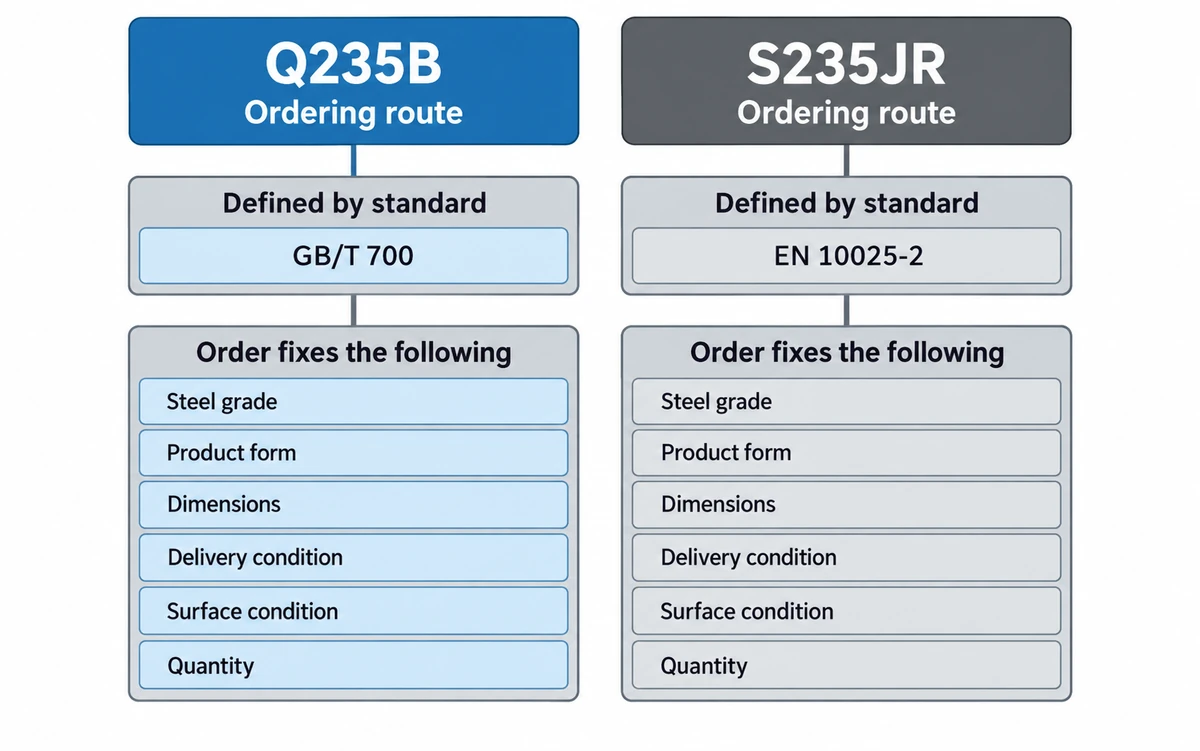
Q235B and S235JR as two ordering routes, each with the standard that defines it and the fields an order fixes under it.
The Conditional Answer
Q235B sits in GB/T 700:2006, the Chinese national standard for carbon structural steels. S235JR sits in EN 10025-2:2019, whose full title is Hot rolled products of structural steels: technical delivery conditions for non-alloy structural steels. Both name a hot rolled structural steel. Neither is defined anywhere outside its own document, and that is the fact the rest of this page turns on.
So the honest answer to the question in the heading of this page is a conditional one. The two are commonly compared, and running the comparison is sensible work. Treating the result as settled is not: a cross-reference records that two names occupy similar positions in two systems, and it says nothing about whether the requirements behind them line up for the part you are making.
What is left is a procedure rather than a verdict. Read the requirements acceptance actually rests on, in the editions the two orders would name. Record every place where one side has something the other has not, because those places are the finding rather than the exception. Then take the result to whoever owns the specification, because writing one designation where the other was named requires full specification review and stays subject to purchaser approval.
What Is Being Compared
Some ground is genuinely shared, and naming it first keeps the rest of the page honest. Both designations name a hot rolled structural steel. Both are ordered with a standard code and an edition written beside the grade. And on both routes the certificate is read against that pair rather than against the grade name on its own.
What differs before a single requirement is opened is how each system is layered. On the GB side the grade sits in GB/T 700:2006, the hot rolled flat form is covered by a product standard of its own, GB/T 3274:2017, and the dimensions, shape, weight and permissible deviations come from a third document, GB/T 709:2019. On the EN side the grade standard carries its technical delivery conditions in its own title and text, while tolerances on dimensions and shape belong to EN 10051:2024, whose free abstract stops at a maximum width of 2 200 mm and a maximum thickness of 25 mm and excludes strip narrower than 600 mm, patterned steels, cold-rolled sheet, coated products and stainless steels. BSI also records that EN 10025-2:2019 does not apply to structural hollow sections or tubes.
Neither arrangement ranks above the other, and neither is a rule for reading one across to the other. What the difference does mean is that an order naming a single document on the GB side has specified less than an order naming a single document on the EN side, and that the documents left out are the ones nobody argues about until something gets measured.
What this page will not do: rank the two, price one against the other, hand over a conversion table, or decide anything about your part. Where a requirement exists on one side and has no counterpart on the other, that asymmetry is written down as an asymmetry.
Side by Side
| Attribute | Q235B | S235JR | Basis |
|---|---|---|---|
| Grade standard and edition | GB/T 700:2006, Carbon structural steels | EN 10025-2:2019, Hot rolled products of structural steels: technical delivery conditions for non-alloy structural steels | Written on the order beside the grade; the certificate is read against the pair |
| What the issuing body showed on 2026-09-20 | Current, issued 2006-11-01, effective 2007-02-01 | Current and under review as the British adoption, superseding the 2004 edition, which is withdrawn | The national standards platform on one side, the BSI product page on the other; two bodies, two records |
| Where the naming rule lives | GB/T 221:2008, the national standard for writing an iron and steel product designation | In the EN system's own designation standards, which are not restated here | A separate free document on one side; on the other, nothing free enough to quote, so the page leaves it to the standard |
| Product standard for the hot rolled flat form | GB/T 3274:2017, hot-rolled plates, sheets and strips of the carbon structural and high strength low alloy families | Carried inside the grade standard, whose title is its technical delivery conditions | One document more on the GB side; an order naming only the grade has not named the product form |
| Dimensions and tolerances | GB/T 709:2019, dimension, shape, weight and tolerance for hot-rolled steel strip, plate and sheet | EN 10051:2024, tolerances on dimensions and shape for continuously hot-rolled strip and plate or sheet cut from wide strip | Named from the same system as the grade standard; a tolerance class is never read across from one to the other |
| Scope bounds in the free record | None published: the platform offers no online reading of the grade standard | The grade standard does not apply to structural hollow sections or tubes; the tolerance standard gives a maximum width of 2 200 mm and a maximum thickness of 25 mm and excludes strip under 600 mm | An asymmetry in what each issuing body publishes free, not a difference between the two steels |
| Chemistry, mechanical and impact requirements | In GB/T 700:2006, whose text is not on file here | In EN 10025-2:2019, whose text is not on file here | Neither requirement text is held, so neither side is written; a value is never taken from one side to fill the other |
| What settles acceptance | The edition named on the order and the measured results reported against it | The edition named on the order and the measured results reported against it | The one line of this table that reads the same on both routes, and the only one that can be relied on without the standards in hand |
Have a Specification Ready?
Send what you already know, such as grade, finish, size or quantity. Inquiries are answered within 2 hours.
What the Free Record Does Not Settle
The table above compares documents because documents are what can be checked. The requirement texts cannot be, and a comparison page that quietly skips past that is a large part of why this particular pairing gets asserted as a fact.
On the GB side the obstacle is stated by the issuing platform itself. On 2026-09-20 GB/T 700:2006 was listed as current with no online preview and no download offered, and in their place a notice: the standard adopts standards of international bodies such as ISO and IEC, and because of copyright the system does not provide an online reading service for it. Other standards on the same platform, GB/T 221:2008 among them, offer both. The grade standard is the one that does not.
On the EN side the obstacle is ordinary and commercial. EN 10025-2:2019 is a paid document and what is published free is a catalogue entry. That entry fixes the edition, the status, the committee and the scope exclusions, and nothing further. It is also not entirely tidy: the two BSI pages for this edition give different publication dates for it, which is why no publication date for it appears anywhere on this page.
So every figure a reader might want out of a side-by-side table sits behind a paywall on one side and a copyright notice on the other. A page printing those figures anyway is not comparing the standards. It is copying a page that copied a page, and there is no document at the end of the chain. Where acceptance turns on a value, buy the standard, or ask for the clause and the edition the factory's certificate will report against.
Before an Order Changes Route
An offer written in the designation your drawing does not carry is a proposal to move the order onto another standard. It is often a reasonable proposal. It is worked through in this order, and the order matters more than any single item in it.
- Ask which document the certificate will nameOne standard, one edition, on the face of it. That single line decides how every figure below it is read and it is the only line a factory can be held to afterwards. Each shipment comes with a mill test certificate (MTC) and a packing list, and what is supplied is the mill original rather than a retyped summary.
- Compare only what acceptance rests onNot the whole standard. Take the handful of requirements the part would actually fail on, read each against its counterpart in the other document, and write down every one that has no counterpart at all. Those notes are the output of the exercise.
- Carry the surface condition across by handThe surface a hot rolled coil arrives in travels with the ordering route rather than with the grade name, so a change of designation leaves it untouched and unexamined. State it again in plain words in the new order, because nothing else will.
- Take the tolerance standard from the same systemGB/T 709:2019 on one route, EN 10051:2024 on the other. A tolerance written against one of them is not read the same way against the other, and the second one's own free scope stops at a maximum width of 2 200 mm and a maximum thickness of 25 mm.
- Write in whatever applies only by agreementA requirement that comes automatically on one route may apply on the other only where it is agreed at the time of enquiry and order. Wherever that is the case it becomes a line of the order, or it does not get measured at all.
- Get the approval in writingWhere the designation came from a project, an end client or your own drawing office, the change belongs to them to approve. An offer accepted in an e-mail is not an approved change of specification. What is agreed with ZIVO sales before the order is kept on file, so the approval, the order and the certificate can later be read as one set.
- Prove it before the whole quantityA trial coil answers what a table cannot. ZIVO checks thickness, width, surface, weight, packing and labels before shipment, and inspection by a third party such as SGS or BV is accepted at your cost. Settle in advance what a rejection looks like as well: quality problems found after delivery are handled from written feedback with photos, followed by a resolution.
- The first route is still a routeWhere the checks above do not all come out clean, nothing obliges the order to move at all: it can be written the way the drawing already names it. Both of the routes on this page are supplied, which is usually the cheapest way to end the discussion.
Where ZIVO Stands on Each Route
ZIVO STEEL is a steel supplier rather than a mill, and it holds a position on each of these two routes. They are quoted separately, each against the standard it names. One order line carrying both designations is not one of the positions.
- Product
Q235B Coil
Q235B hot-rolled coil can be enquired for on its GB route. Give the required form, thickness, width, coil geometry and test basis; ZIVO confirms the offered combination per order.
- Product
S235JR, on the EN route
S235JR hot-rolled coil is a separate EN route. Its exact dimensions, condition and inspection basis are confirmed per order; a Q235B range or certificate cannot be transferred to it. The route currently appears on the hot-rolled coil family page.
- Product
Hot Rolled Coil
The route both designations are rolled on, with the surface conditions and the order fields every grade on it shares.
Frequently Asked Questions
Not on the strength of the two names. They are commonly compared, and a cross-reference between designation systems settles nothing on its own: acting on one requires full specification review against the editions the orders name, and it stays subject to the approval of whoever owns the specification. ZIVO supplies both routes, so on most enquiries the cleaner answer is to order the designation the drawing already carries and leave the review for a case where it is actually needed.
They are set by different documents, so they are read from the document that defined them. On the GB side how a designation is written is fixed by GB/T 221:2008 and what the quality letter requires is fixed by GB/T 700:2006. On the EN side both jobs belong to the EN system's own standards. This page does not restate either reading, because neither has been taken from the standard's own text and recorded here, and a letter explained from memory is how a specification quietly changes meaning between two e-mails.
Because neither standard's requirement text is on file. GB/T 700:2006 is listed as current on the national standards platform with no online preview and no download, the page stating instead that copyright prevents an online reading service; EN 10025-2:2019 is a paid document whose free record is a catalogue entry. Publishing a side-by-side table of values without either document in hand would mean copying somebody else's copy, and it would give you nothing you could hold a factory to.
Five things, in writing. The standard and edition that will appear on the certificate. The product form and the thickness band the price was built on. The requirements your acceptance rests on, checked one by one against that standard rather than against a comparison table. The surface condition restated in plain words, because it travels with the route and not with the grade name. And the approval of whoever owns the specification. A quotation needs the grade, finish, thickness, width, length and quantity; on a cross-standard enquiry the standard beside the grade is the field doing most of the work.
Sources
- BS EN 10025-2:2019 Hot rolled products of structural steels. Technical delivery conditions for non-alloy structural steels (product page, free abstract)
- BS EN 10025-2:2019 — BSI landing page (standard record)
- BS EN 10051:2024 Continuously hot-rolled strip and plate/sheet cut from wide strip of non-alloy and alloy steels. Tolerances on dimensions and shape (product page, free abstract)
- 国家标准 GB/T 700-2006《碳素结构钢》/ Carbon structural steels(标准信息页)
- 国家标准 GB/T 3274-2017《碳素结构钢和低合金结构钢热轧钢板和钢带》/ Hot-rolled plates, sheets and strips of carbon structural steels and high strength low alloy structural steels(标准信息页)
- 国家标准 GB/T 709-2019《热轧钢板和钢带的尺寸、外形、重量及允许偏差》/ Dimension, shape, weight and tolerance for hot-rolled steel strip, plate and sheet(标准信息页)
- 国家标准 GB/T 221-2008《钢铁产品牌号表示方法》/ Notations for designation of iron and steel(标准信息页)
Tell Us What You Need
Send the product form, grade, finish, thickness, width, length and quantity. Inquiries are answered within 2 hours.
Send Your Inquiry
Name, email and your inquiry are all that is needed. Add a WhatsApp number if you prefer to chat.
- Email: henry@zivosteel.com
- WhatsApp: +86 15668396618
- Address: 2F, Vanke Center, Lixia District, Jinan, Shandong, China
- Hours: Monday to Saturday, 8:00-18:00 (China time)