SPCC vs DC01 Steel
SPCC belongs to a Japanese standard and DC01 to a European one. The two are commonly compared, and this page is about what a comparison can settle and what it cannot: which requirements have to be read against each other, what the order and the certificate have to state, and whose approval has to exist before an order written for one is filled with the other.
Scope of this comparison
Cold rolled uncoated low carbon flat products. The two columns are read against their own standards and are not equivalents; ZIVO does not hold the text of either standard, so no figure from their tables appears here and each row states what it is based on.
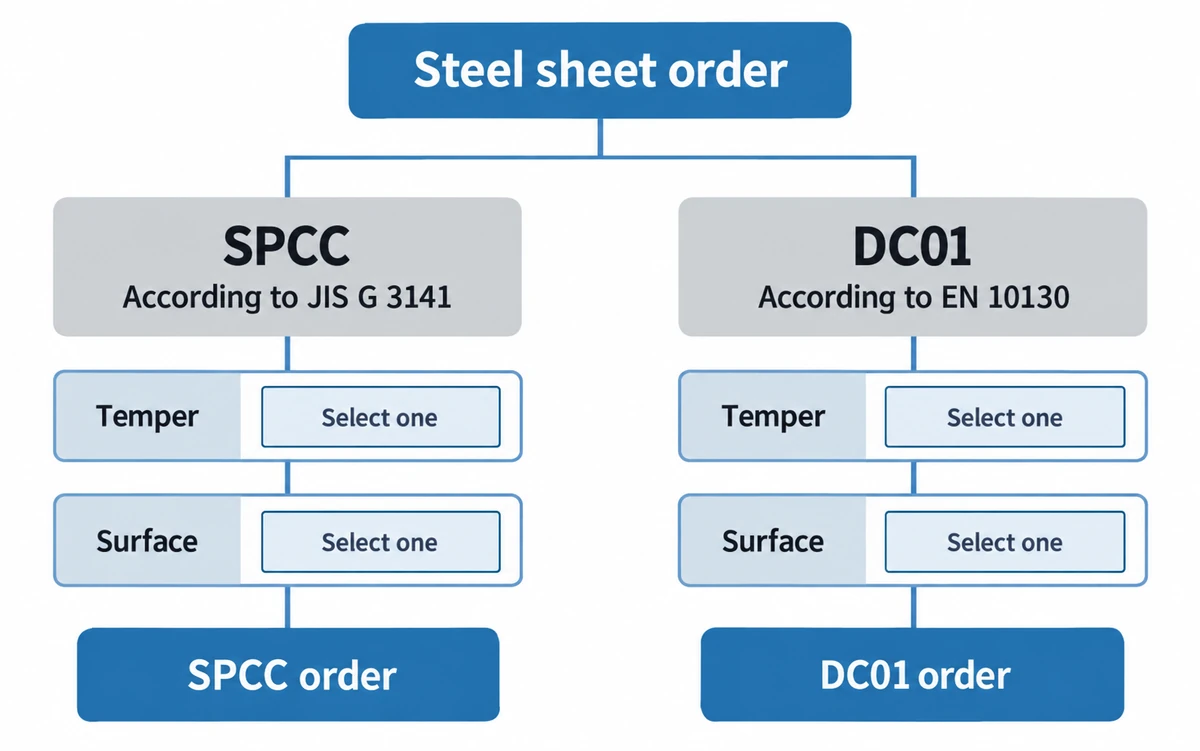
SPCC and DC01 as two ordering routes under their own standards, with the temper and surface fields an order has to fix.
The Conditional Answer
SPCC is a grade symbol in JIS G 3141:2021, the Japanese standard for cold-reduced carbon steel sheet and strip. DC01 is a grade name in EN 10130:2006, the European standard for cold rolled low carbon flat products for cold forming. Two standards, two vocabularies, two sets of requirements — and one enquiry that often carries both names, because somebody along the line quoted across them.
They are commonly compared, and the comparison is worth running. What a comparison cannot do is remove the specification review underneath it. A cross-reference lines two designations up because they occupy similar positions in their own systems; it does not promise that the requirements behind them meet line for line, and whoever wrote it has not seen your drawing.
So the answer to "can one be ordered against the other" is conditional, and the conditions are ordinary ones. Compare the requirements your part actually depends on, in the editions named on the order. Write the result down. Get the approval of whoever owns the specification before anything changes. What follows sets out what to compare, what the documents have to say, and where ZIVO stands on each of the two routes.
What Is Being Compared
Both designations name an uncoated, cold rolled, low carbon steel supplied as flat product, and both are ordered with a standard and an edition written beside the grade: JIS G 3141:2021 on one side, EN 10130:2006 on the other. That shared ground is what makes the comparison a sensible one to run at all.
Two differences show before any requirement is opened, and both come from the standards' own published scopes. JIS G 3141:2021 reaches sheet and strip of not less than 30 mm in width, and says so expressly of cold-rolled strip in coil under 600 mm wide and of sheet cut from that coil; EN 10130:2006 begins at rolled widths of 600 mm and over, from 0.35 mm thick and, unless otherwise agreed, up to 3 mm. The tolerances also sit in different places: the EN route reads them from EN 10131:2006, a document of its own, while JIS G 3141:2021 keeps its dimensional tolerances at clause 7.3 and its flatness, camber and squareness requirements at clause 8. Neither difference ranks one route above the other, and neither is a rule for reading one across to the other.
What gets compared here is requirements, not names. A designation is a pointer into a standard; what an order stands or falls on is what that standard requires and what the certificate reports against it. Each standard also carries its own vocabulary for the delivery condition and the surface, with its own symbols, and a symbol that looks familiar across the two is still read from the standard that defined it.
What this page does not do: rank the two, price one against the other, or hand over a conversion table. It also decides nothing about your part. Where a requirement exists on one side and has no counterpart on the other, that asymmetry is the finding — and filling the gap with the other side's figure is exactly how a comparison turns into a mistake.
Side by Side: What Each Route Is Governed By
Each row below says what it is based on, because the two sides are not always documented to the same depth in the free record. Where one side has a published figure and the other does not, the row says so rather than borrowing the number across.
| Attribute | SPCC | DC01 | Basis |
|---|---|---|---|
| Governing standard | JIS G 3141 | EN 10130 | JSA catalogue and BSI catalogue entries, both read 2026-09-20 |
| Current edition | 2021, issued 2021-04-20 | 2006, published 29 December 2006 | JSA gives JIS G 3141:2021 as 有効; BSI gives BS EN 10130:2006 as Current |
| What the scope covers | Cold-reduced carbon steel sheet and strip | Cold rolled uncoated low carbon flat products in rolled widths of 600 mm and over, for cold forming | Standard titles as catalogued, and the free scope text of BS EN 10130:2006 |
| Thickness written into the scope | Not stated in the free record | 0.35 mm minimum and, unless otherwise agreed at the time of inquiry and order, 3 mm maximum | The free scope text of BS EN 10130:2006. Nothing comparable is published free for JIS G 3141. |
| Delivery forms named in the scope | Sheet and strip | Sheet, coil, slit coil, or cut lengths obtained from slit coil or sheet | Standard title on one side; the free scope text of BS EN 10130:2006 on the other |
| Where the dimensional tolerances live | Inside the same standard, clause 7 Dimensions and clause 8 Shape | In a separate standard, EN 10131 | Contents page of the free official English preview of JIS G 3141:2021; BSI entry for BS EN 10131:2006, which is the tolerances-on-dimensions-and-shape standard for these products |
| Status of the tolerance document | Not a separate document | Current, Under Review | BSI entry for BS EN 10131:2006, read 2026-09-20 |
| National adoption checked | Japanese original, with an official English translation offered | BS EN 10130:2006 in the UK, DIN EN 10130:2007-02 in Germany | JSA and BSI catalogue entries; DIN Media listing, all read 2026-09-20 |
Temper and Surface Are Two Vocabularies
Each standard carries its own ladder of temper symbols and its own surface designations, and the symbols look similar enough to be mistaken for one another. JIS G 3141:2021 puts both inside its clause 4 Symbol of grade: 4.1 covers the symbol of grade and applicable thickness, 4.2 the temper grade and the symbol of temper grade, and 4.3 the surface finish. EN 10130:2006 carries its own set. A symbol from one ladder has no meaning in the other, so write the standard beside the symbol every time, and do not translate a temper or a surface designation across the two. If an offer comes back with the other route’s symbol against your requirement, that is a proposal to change routes, which the next sections work through.

What the Order and the Certificate Must State
Whichever route the order finally runs on, the same fields have to be written down, and they have to be written twice — once on the order and once on the document that comes back. A quotation needs the grade, finish, thickness, width, length and quantity; the list below is what an enquiry carrying two designations has to add to that.
- The standard and its edition, on both documentsA grade name with no standard and no edition beside it points at nothing a factory can be held to. Write both into the order, and ask for both on the certificate in the same words.
- One designation per order lineAn order line carries one grade name from one standard. Two names on one line is a commercial habit rather than a specification, and it leaves the factory to choose which of them it certifies against.
- The delivery condition in plain wordsTemper and surface are named differently in the two systems. Say what the coil has to be when it arrives, and let the symbol for that condition be fixed against the standard the order runs to.
- The requirement your part depends onWhere acceptance rests on a forming result or a mechanical value, name it as a requirement of the order. A grade name does not carry it there on its own, and a requirement nobody wrote down is a requirement nobody tests.
- Measured results, not only the gradeThe certificate should report what was measured and the clause it was measured for. Each shipment comes with a mill test certificate (MTC) and a packing list, and the certificate supplied is the mill original.
- The specification kept on fileWhat was agreed with ZIVO sales before the order is kept on file, so what lands is checked against the agreement rather than against anybody's recollection of the thread.
- How each line readsOne route: grade symbol, JIS G 3141:2021, temper, surface finish, oiling, dimensions, quantity. The other: grade name, EN 10130:2006 with EN 10131:2006 behind the dimensions, delivery condition, surface quality and finish, dimensions, quantity. Same discipline, different vocabulary.
Have a Specification Ready?
Send what you already know, such as grade, finish, size or quantity. Inquiries are answered within 2 hours.
Why the Two Names Are So Often Printed Together
Cross-reference tables pair the two names, and a pairing is a place to start reading, not a statement that two things are the same. The tables themselves usually say so; the pages that copy them usually do not. Three things follow from that. A cross-reference is an entry point to the other standard, not a permission to substitute. The pairing carries no edition, so it cannot tell you whether it was made against JIS G 3141:2021 and EN 10130:2006 or against editions that have since been replaced. And it settles nothing about temper, surface or tolerances, which is where an order actually goes wrong. The check is the same either way: read the requirement your drawing names, read what the other standard requires at the same point, and get the difference approved by whoever owns the specification before the order is written.
If the Offer Proposes the Other Route
An offer written in the designation your drawing does not use is a proposal to change the route the order runs on. It may well be a reasonable proposal, and it is worked through as a sequence. The sequence does not begin with a comparison table.
- Start with the certificate, not the tableAsk which standard, and which edition of it, will appear on the document. That single line decides how every other figure on the certificate is read, and it is the only line that binds a factory.
- Compare requirement by requirementTake the requirements your part depends on and read each against its counterpart in the other standard, in the editions the two orders would name. Write down the ones with no counterpart: those are the findings.
- Watch what only applies by agreementA value that is a requirement on one route may apply only when it is agreed on the other. Where that happens it has to be written into the order as a requirement of its own, or it will not be measured.
- Get the approval in writingIf the specification came from a project, an end user or your own drawing office, the change is theirs to approve. An offer accepted in an e-mail is not an approved change of specification.
- Prove it before the full quantityA trial coil or a first-article check answers what a table cannot. ZIVO checks thickness, width, surface, weight, packing and labels before shipment, and inspection by a third party such as SGS or BV is accepted, at your cost.
- Agree in advance what a rejection looks likeQuality problems found after delivery are handled from written feedback with photos, followed by a resolution. That runs far better when the change of route was documented than when it was assumed.
- Keep the original route openWhere the checks above do not all resolve, the order can still be written the way the drawing already names it. ZIVO supplies both routes, so the question rarely has to be forced.
Where ZIVO Stands on Each Route
ZIVO STEEL holds two positions here, one on each route, and they are quoted separately. A single line carrying both names is not one of them.
- Product
SPCC Coil
Cold rolled coil ordered to JIS G 3141:2021, 0.5 to 3.0 mm thick and 600 to 1500 mm wide, at 5 to 13.5 t per coil. The temper symbol and the surface symbol come from that standard.
- Product
DC01 Coil
Cold rolled coil ordered to EN 10130:2006, over the same thickness and width bands, on a 508 or 610 mm inner diameter. The forming requirements and the surface classes come from that standard.
- Product
Cold Rolled Coil
The cold rolled route itself, with the deeper-drawing grades that sit above the first rung of the European series.
Frequently Asked Questions
Not on the strength of the two designations alone. They are commonly compared, and a cross-reference between designation systems is not an equivalence: acting on one requires full specification review against the editions named on the order, and it stays subject to the approval of whoever owns the specification. ZIVO supplies both routes — SPCC to JIS G 3141:2021 and DC01 to EN 10130:2006 — so in most enquiries the cleaner answer is to order the designation the drawing already carries.
No, and they should not be converted between the two. Each standard defines its own temper vocabulary and its own surface designations, in its own clauses, so a symbol is read from the standard that defined it even where the letters look familiar from the other system. Write the condition you need in plain words in the enquiry, and let the symbol be fixed against the standard the order actually runs to.
One standard with its edition, one grade, the delivery condition, and the measured results against the requirements the order named. On these two routes that means either JIS G 3141:2021 or EN 10130:2006 on the face of the document, never both at once. Each shipment comes with a mill test certificate (MTC) and a packing list, and the certificate supplied is the mill original.
Whoever owns the specification. If the designation came from a project, an end user or your own drawing office, accepting another route is theirs to do rather than the supplier's, and it is worth having in writing before the coil is made. What is agreed with ZIVO sales is kept on file for that shipment, so the approval, the order and the certificate can later be read as one set.
No. A cross-reference lines designations up; an order needs requirements. Tables of that kind put two names side by side because each sits in a comparable place in its own system, and they carry no test basis, no edition and no knowledge of your part. Use one to know where to look, then compare the clauses that your acceptance depends on, in the editions the order will name. A quotation needs the grade, finish, thickness, width, length and quantity — and on a cross-standard enquiry, the standard beside the grade is the field that does the most work.
Tell Us What You Need
Send the product form, grade, finish, thickness, width, length and quantity. Inquiries are answered within 2 hours.
Send Your Inquiry
Name, email and your inquiry are all that is needed. Add a WhatsApp number if you prefer to chat.
- Email: henry@zivosteel.com
- WhatsApp: +86 15668396618
- Address: 2F, Vanke Center, Lixia District, Jinan, Shandong, China
- Hours: Monday to Saturday, 8:00-18:00 (China time)