ASTM A36 Steel
ASTM A36/A36M covers carbon steel shapes, plates and bars of structural quality. That is the whole of its product scope, and it is the reason an enquiry written around this designation so often needs a conversation before it can be priced. This page sets out what the specification covers, which ASTM documents cover flat products delivered in coils, and the four things to confirm when the two get mixed up.
- Designation
- A36
- Family
- Non-alloy steel
Shapes, plates, bars
The product forms named in the A36/A36M scope
A1011/A1011M-25
Where sheet and strip in coils is specified
A1018/A1018M-25
Heavy-thickness coils, 6.0 through 25 mm
A568/A568M-25a
The general requirements both sheet specifications run under
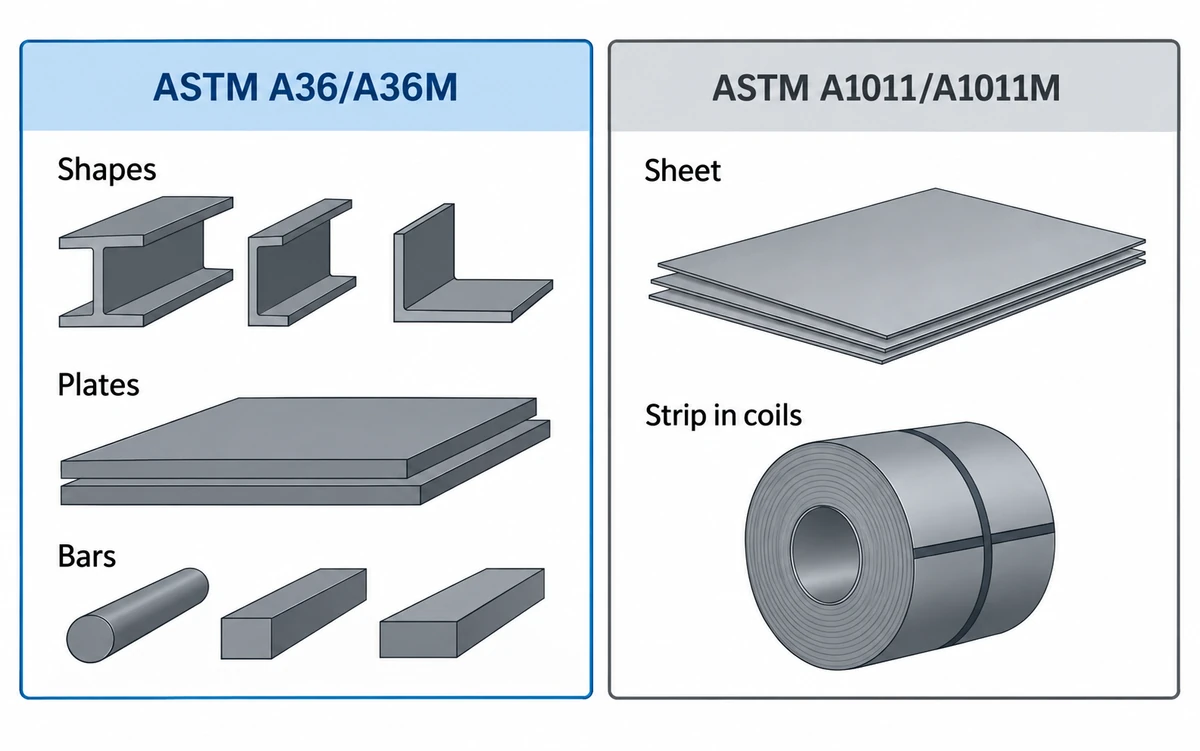
What A36/A36M covers set beside what it does not: shapes, plates and bars on one side, sheet and strip in coils under A1011/A1011M on the other.
What A36/A36M Covers
ASTM A36/A36M is the Standard Specification for Carbon Structural Steel, and its scope is short enough to read in one breath: carbon steel shapes, plates, and bars of structural quality for use in riveted, bolted, or welded construction of bridges and buildings, and for general structural purposes. Three product forms, named in the first sentence of the document.
On 2026-09-20 the ASTM catalogue gave the current edition as A36/A36M-19, status Active, last updated 4 July 2019, Volume 01.04, developed by Committee A01 and Subcommittee A01.02, three pages long. A specification that fixes the composition and the mechanical requirements of a structural steel can be that short. A document that also has to say how a flat product is measured, surfaced, wound and packed cannot, and this one does not try to be one.
Everything else on this page follows from those two paragraphs. The forms in the scope are the forms a certificate issued against this specification can describe, and a requirement written on a drawing is answered by the document whose scope actually reaches the material being delivered.
Where a Coil Order Sits in ASTM
ASTM has a separate line of specifications for flat products delivered in coils, and it begins where the scope above ends. ASTM A1011/A1011M covers hot-rolled, carbon, structural, high-strength low-alloy, high-strength low-alloy with improved formability, and ultra-high-strength steel sheet and strip, in coils and cut lengths. The words in coils are in the scope itself, not in somebody's summary of it. On 2026-09-20 the catalogue gave the current edition as A1011/A1011M-25, Active, last updated 8 December 2025, Volume 01.03, Subcommittee A01.19, eight pages.
Above a certain thickness the sheet line hands over again. ASTM A1018/A1018M-25 covers hot-rolled heavy-thickness coils beyond the size limits of A1011/A1011M; its abstract puts that band at 0.230 to 1.000 in [6.0 through 25 mm] and states that the material is available only in coils. Where the size limit of A1011/A1011M itself falls is in that specification's paid text, which is not on file here, so this page names the boundary in the words A1018/A1018M uses and leaves the other side of it alone.
Both of those run under one general requirements document. ASTM A568/A568M-25a covers the general requirements for steel sheet in coils and cut lengths and applies to a named list of product specifications that includes A1011/A1011M. A complete order on this side therefore names two documents rather than one: the product specification, and the general requirements it runs under.
Set the two scopes side by side and the point is not that one of them is better. They are parallel product lines built for differently shaped steel, and a certificate is issued against whichever line the order actually names.
Why the Phrase Keeps Appearing
Enquiries do arrive asking for A36 coil, often enough that calling the phrase a mistake helps nobody. It is a habit of the trade, and behind it sit three quite different requirements. The first job is finding out which one is in front of you, because the three are answered in three different ways.
Sometimes the material actually wanted is a plate, or a sheet cut from coil, and the word coil is describing the form the material starts life in rather than the form that has to arrive. That one resolves as soon as the delivered form is written down.
Sometimes what is wanted is a strength level rather than a certificate. The free ASTM abstract for A1011/A1011M-25 names Structural Steel grades 30 [205], 33 [230], 36 [250] with Types 1 and 2, 40 [275], 45 [310], 50 [340], 55 [380], 60 [410], 70 [480] and 80 [550], alongside Commercial Steel, Drawing Steel and the high-strength designations. A grade numbered 36 exists inside the sheet specification, which is exactly why the shorthand survives in the market. It belongs to a different specification with requirements of its own and it is never put forward as a stand-in; what it does give the enquiry is somewhere to go.
And sometimes the requirement is literal: a drawing, a code or an end client asks for certification to A36/A36M. Then the deliverable is one of the forms that specification covers, and the enquiry has moved off the sheet line altogether. That is not a refusal. It is the difference between a document that can be issued and one that cannot.
Have a Specification Ready?
Send what you already know, such as grade, finish, size or quantity. Inquiries are answered within 2 hours.
What to Confirm Before Quoting
Four questions, asked in this order, turn an enquiry built on the designation into one that can be priced and later checked. None of them is technical detective work; each one is a field somebody has to fill in.
- The delivered form, in writingCoil, sheet cut from coil, or plate. It comes first because A36/A36M covers shapes, plates and bars, and a specification can only describe the forms its own scope names. Ask before anything is priced, not after.
- The thickness bandOn the sheet line the thickness decides which specification applies. A1018/A1018M-25 covers heavy-thickness coils beyond the size limits of A1011/A1011M, 0.230 to 1.000 in [6.0 through 25 mm] and available only in coils. A band that crosses that boundary names both specifications or gets split.
- Who is asking for itYour own drawing, a code, an end client, or wording carried over from an earlier order. A contractual requirement for certification to A36/A36M changes what can be delivered. Wording carried over from a previous purchase order does not, and the two look identical in an e-mail.
- If it is a strength level, which gradeThe sheet specification carries Structural Steel grades of its own, including one numbered 36 with Types 1 and 2. Name the grade, and name the general requirements document it runs under, which on this line is A568/A568M-25a. With those two written down the enquiry becomes something a factory can quote against.
- What the certificate has to carry backThe specification and its edition, written on the order and asked for on the certificate in the same words. Each shipment comes with a mill test certificate (MTC) and a packing list, and a certificate can only report against a document the order named before the material was made.
- The answers, kept on the specificationA quotation needs the grade, finish, thickness, width, length and quantity, and on this route it needs the answers above as well. What is agreed with ZIVO sales before the order is kept on file, so that what lands is checked against the agreement rather than against anybody's memory of the thread.
Where the Free Record Stops
Everything above comes from the standards body's own catalogue: titles, scopes, editions, statuses, committee numbers and abstracts, all published free. The requirement texts are paid documents and none of them is on file here, which puts a hard edge on what this page is able to say.
Three things sit on the far side of that edge. The abstract for A1011/A1011M-25 names its grades and prints no value behind any of them, so no chemistry, yield, tensile or elongation figure appears here. The same abstract does not address surface condition, mill scale, pickling or oiling at all; those clauses live in the paid text and in the general requirements specification A568/A568M-25a, which is why the surface of a hot rolled order is written in plain words rather than as a symbol taken from ASTM. And A36/A36M-19 runs to three pages, which is room for the composition and mechanical requirements of a structural steel and not room for the delivery conditions of a flat product.
A page that prints a property table under this heading is printing figures out of a document it has not shown you, in an edition it usually does not name. This one names the specification, the edition and the catalogue entry behind every statement it makes, and stops where the free record stops.
The Grades A36 Gets Compared With
Q235B, SS400 and S235JR are the designations this one is most often set beside, usually in a single line with an equals sign in the middle of it. They are commonly compared, and running the comparison is worth the hour it takes. What a comparison is not is a conclusion: a cross-reference lines two names up because each sits in a similar place in its own system, and it carries no edition, no product form, no test basis and no knowledge of the part you are making.
So no comparison table appears here. Writing one designation where another was named requires full specification review against the editions the orders would carry, and it stays subject to purchaser approval. Whatever that review concludes belongs on the specification agreed with ZIVO sales before the order, which is kept on file with the rest of it.
The pair-by-pair work has pages of its own. What the GB designation fixes, and what its quality letter decides, is set out on the Q235 page. The GB against EN question has a comparison page. And the Q235B ordering route, with the designations that most often arrive beside it, is on the Q235B coil page.
The Hot Rolled Route From ZIVO
This page stops at the specification. The surface choice, the dimensions recorded against each ordering route and the line-by-line order string are on the hot rolled coil page.
| Product page | Grade | Finish | Thickness | Width |
|---|---|---|---|---|
| Hot Rolled Coil | ASTM hot rolled coil route | — | — |
Frequently Asked Questions
Because of what each specification's own scope reaches. A36/A36M covers carbon steel shapes, plates and bars of structural quality; A1011/A1011M covers hot-rolled steel sheet and strip, in coils and cut lengths, with the words in coils printed in the scope. A certificate describes the material against the document the order named, so the document has to be one whose scope includes the form being delivered.
The thickness. A1018/A1018M-25 covers hot-rolled heavy-thickness coils beyond the size limits of A1011/A1011M, stated in its abstract as 0.230 to 1.000 in [6.0 through 25 mm] and available only in coils. The size limit of A1011/A1011M itself is in its paid text and is not published here, so an enquiry whose band crosses the boundary names both specifications or splits into two lines. Both run under the general requirements specification A568/A568M-25a.
Not as a stand-in for anything. The free abstract for A1011/A1011M-25 does name Structural Steel grades 30 [205], 33 [230], 36 [250] with Types 1 and 2, and upwards to 80 [550], but naming a grade is all the free record does: no acceptance value behind it is published, and it belongs to a specification with requirements of its own. Where the requirement behind an enquiry is a strength level rather than a certificate, that grade is the direction the question goes, and which grade and which Type get written down is a decision for whoever owns the specification.
Treat the offer as a proposal rather than as an answer. The designations are commonly compared, and a cross-reference between designation systems is not a decision: acting on one requires full specification review against the editions named on the order, and it stays subject to purchaser approval. Confirm the delivered form first, because A36/A36M covers shapes, plates and bars and A1011/A1011M covers sheet and strip in coils, and the form decides which conversation you are actually having.
Sources
- ASTM A1011/A1011M-25 Standard Specification for Steel, Sheet and Strip, Hot-Rolled, Carbon, Structural, High-Strength Low-Alloy, High-Strength Low-Alloy with Improved Formability, and Ultra-High-Strength (product page, free scope and abstract)
- ASTM A36/A36M-19 Standard Specification for Carbon Structural Steel (product page, free scope and abstract)
- ASTM A1018/A1018M-25 Standard Specification for Steel, Sheet and Strip, Heavy-Thickness Coils, Hot-Rolled, Carbon, Commercial, Drawing, Structural, High-Strength Low-Alloy, High-Strength Low-Alloy with Improved Formability, and Ultra-High-Strength (product page, free scope and abstract)
- ASTM A568/A568M-25a Standard Specification for Steel, Sheet, Carbon, Structural, and High-Strength Low-Alloy, Hot-Rolled and Cold-Rolled, General Requirements for (product page, free scope)
Tell Us What You Need
Send the product form, grade, finish, thickness, width, length and quantity. Inquiries are answered within 2 hours.
Send Your Inquiry
Name, email and your inquiry are all that is needed. Add a WhatsApp number if you prefer to chat.
- Email: henry@zivosteel.com
- WhatsApp: +86 15668396618
- Address: 2F, Vanke Center, Lixia District, Jinan, Shandong, China
- Hours: Monday to Saturday, 8:00-18:00 (China time)