China Hot Rolled Steel Coil Supplier
Seven hot rolled ordering routes, four standard systems, one table. This page carries the dimensions recorded against each route, the surface choice that every hot rolled order has to make, and the line-by-line order string a quotation is built from.
Q235B, Q355B, SS400, S235JR, ASTM hot rolled coil route, SPHC, Hot rolled pickled and oiled coil
Grades
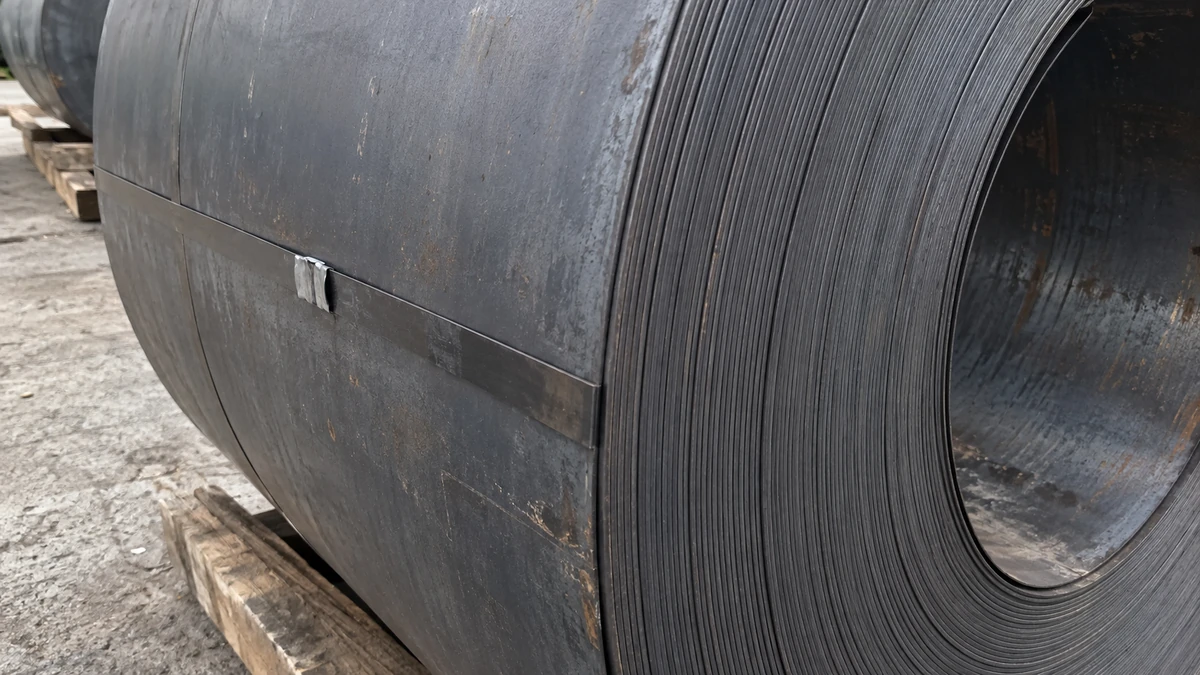
Representative view: hot rolled carbon steel coil, the mill scale surface dark and matte across the coil face.
Hot Rolled Coil From ZIVO STEEL
ZIVO STEEL is a steel supplier, not a mill. Hot rolled coil is supplied from partner factories: where the factory holds the material the order ships from that stock, and where it does not, production is arranged.
HRC, HR coil, black coil, mild steel coil, MS coil — an enquiry written in any of those is answered from the same table, because none of them is an ordering route on its own. What turns a trade name into an order is four things: which grade and standard the drawing names, which surface the coil arrives in, what the dimensions are, and what the coil itself has to weigh and mount on. The rest of this page takes them in that order.
Hot Rolled Coil Specifications
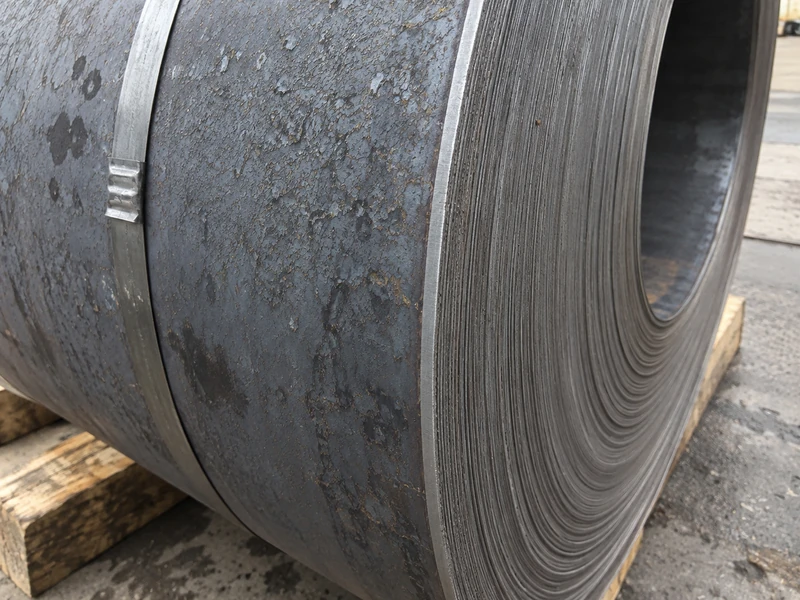
Seven ordering routes, four standard systems, and one row each. The grade column carries the name the enquiry uses, the standard column the code that name is written in, and the remaining columns the thickness, width, coil inner diameter and coil weight recorded against that route.
Read those dimensions as what is offered, not as what a standard requires. A standard is published in editions and its tables belong to the edition your order is accepted against; the figures in this table come from what ZIVO supplies, and the two are reconciled with the specification before the order rather than assumed to agree.
Two rows are written as routes rather than as grade names, and both are deliberate. Hot rolled pickled and oiled coil is the hot rolled route ordered with the scale off and an oil film on, and it has a line here because that is how enquiries ask for it. The ASTM line is written as a route because hot rolled sheet and strip supplied in coils is covered by ASTM A1011/A1011M, and the grade under it is chosen when the order is written. A1011/A1011M has size limits of its own, with heavy-thickness coils beyond them covered by ASTM A1018/A1018M, so an ASTM enquiry fixes the thickness first and the specification follows from it — no thickness is quoted against that route until it does.
The coil inner diameter and the coil weight are on the table for the same reason the dimensions are: they decide whether the coil can be run when it lands. Check both against your uncoiler before the enquiry goes out.
| Grade | Process |
|---|---|
| Q235B | Hot rolled |
| Hot rolled pickled and oiled coil | Hot rolled |
| Grade | Process |
|---|---|
| Q355B | Hot rolled |
| Grade | Process |
|---|---|
| SS400 | Hot rolled |
| Grade | Process |
|---|---|
| S235JR | Hot rolled |
| Grade | Process |
|---|---|
| ASTM hot rolled coil route | Hot rolled |
| Grade | Process |
|---|---|
| SPHC | Hot rolled |
Where a Hot Rolled Order Is Actually Defined
The grade standard is not the whole order. Every system puts the general requirements - surface condition, tolerances, what the purchaser has to state - in a place of its own, and the grade specification points at it rather than repeating it. That is why two offers quoting the same grade can still differ. The table gives, for each route, the specification that names the grade and the document that carries the rest.
- ASTMA1011/A1011M-25 names the grade and states in its own scope that it covers sheet and strip "in coils and cut lengths". Its free abstract does not address surface condition, mill scale, pickling or oiling: those clauses sit in the paid text and in the general-requirements specification A568/A568M-25a. An ASTM hot rolled order therefore runs to two documents, not one.
- JISG 3101:2024 carries clause 8 Appearance and, separately, clause 13 "Information to be supplied by the purchaser". A standard with a clause of that name is telling you the order is expected to state things the standard does not decide for you.
- GBGB/T 700-2006 names the carbon structural grades, while GB/T 3274-2017 is the standard for hot-rolled plates, sheets and strips of those grades and of the low alloy grades. It replaced GB/T 912-2008 and GB/T 3274-2007 in full, so a reference to either of those is out of date.
- What to put in your enquiryState the surface you need rather than assuming the grade decides it, and ask which edition of the general-requirements document the offer is written against. ZIVO does not hold the text of any of these standards, so no figure from their tables appears on this site; what is written here comes from the standards bodies’ own public records.
As-Rolled, Pickled, or Pickled and Oiled
Every hot rolled order picks one of three surfaces, and all three are supplied. The choice is not a finishing preference; it decides who removes the mill scale, what the coil looks like when it lands, and how long it can stand before that stops being true. Name the one you want in the enquiry, because none of the three is a default that fills itself in.
- As-rolled, with the mill scale onThe coil ships the way it left the mill, with the dark oxide layer still on the strip. It is the shortest route and the one that leaves the scale for you: whatever takes it off downstream — your own pickling, shot blasting, or the cutting operation itself — is a step and a cost on your side of the order. Choose it when the part is cut and welded rather than formed and painted, or when descaling is already part of your line.
- PickledThe scale comes off before the coil ships, so what arrives is bare steel. That is what forming, welding and painting want to see, and it is also why the third option exists: bare steel does not stay bare across a voyage and a storage period. Ordering pickled without oiling only makes sense when the coil goes into work quickly at your end.
- Pickled and oiledPickled, then given an oil film to carry it through the voyage and the wait. It is the surface most often asked for when the coil is formed or painted, and it is supplied here as an ordering line of its own. The oiling itself — what it is for, how it is written into an order and what it means at your end — is set out on its own page.
- What the choice changes downstreamCutting, forming, welding and painting all meet the surface before they meet the steel, and so does your storage rack. Work backwards from the last of those operations: the surface that suits the final step is usually the surface to order, because reversing the decision after the coil lands means adding a process line you had not planned for.
- How it is written downIn plain words in the enquiry, and then on the specification ZIVO sales confirms with you before the order and keeps on file. This page prints no standard symbol for the three surfaces, and on the ASTM route the reason is on the record: mill scale, pickling and oiling appear nowhere in the free abstract of ASTM A1011/A1011M-25, because those clauses live in its paid text and in ASTM A568/A568M-25a, the general requirements specification it runs under. The symbol belongs to the governing standard and its edition, and it is set there rather than here.
Have a Specification Ready?
Send what you already know, such as grade, finish, size or quantity. Inquiries are answered within 2 hours.
How to Write a Hot Rolled Coil Order
A quotation needs the grade, finish, thickness, width, length and quantity. On a hot rolled coil that list expands into the nine items below, and each one that is missing is one round of questions before a price. The whole string is confirmed by ZIVO sales together with you before the order and kept on file.
- Grade, with the standard it is written inNot the grade alone. A name without its standard leaves the certificate with no table to be read against, and the same four characters can belong to more than one system.
- The edition, where your drawing names oneSend it with the grade. The edition the order is accepted against is settled with the specification, and if your drawing already fixes one, that is the fastest way to settle it.
- SurfaceAs-rolled with the mill scale on, pickled, or pickled and oiled. Leaving it out is the single most common reason a hot rolled enquiry comes back as a question instead of a price.
- Thickness and widthWith a tolerance if your drawing carries one, and with the dimensional standard that tolerance is written against, which on the hot rolled routes is a document of its own rather than a clause of the grade standard. GB/T 709:2019 on the GB side. EN 10051:2024 on the EN side, whose scope and tolerances must be checked for the offered dimensions. JIS G 3193:2025 on the JIS side, which states in its scope that its application is specified by the relevant product standard, so it is named together with JIS G 3101:2024 or JIS G 3131:2024 and never on its own. And on the ASTM side, A1011/A1011M-25 runs under the general requirements specification A568/A568M-25a. A tolerance written against one system is not read the same way in another.
- Quantity, and the order minimumOne coil is where an order starts, and at least 3 t of it. Above that, say whether the tonnage is one delivery or a schedule, because that changes what can be arranged.
- Coil inner diameter and maximum coil weightWhat your uncoiler mounts and what your crane lifts. Both are on the table above, and both are worth repeating in your own words in the enquiry rather than accepted from it.
- Edge conditionMill edge or trimmed, and which one your operation needs. It is a field of the order like any other, and it is agreed with the specification before the order rather than assumed.
- Processing, if the coil is not shipped wholeSlitting, cutting to length and similar work can be arranged, and partner factories carry it out. Say so in the enquiry: processing changes the width and the coil weight the quotation is built on, so it cannot be added afterwards at the same price.
- The whole string, as one lineExample order structure, with values to fill from the actual drawing and offer: Q235B to the agreed GB/T 700 edition; dimensions and tolerances to the applicable GB/T 709 edition; hot rolled and pickled and oiled; thickness × width, coil inner diameter and maximum coil mass confirmed for the lot; minimum one coil and at least 3 t; mill test certificate naming the agreed standard and edition. Confirm every order field before treating it as a quotation.
When an Enquiry Names A36
It happens often, and the term is a habit of the trade rather than a coil specification. ASTM A36/A36M covers carbon steel shapes, plates and bars of structural quality. Hot rolled steel sheet and strip supplied in coils is covered by ASTM A1011/A1011M, and heavy-thickness coils beyond its size limits by ASTM A1018/A1018M.
So before a quotation goes out, three things get confirmed in writing. What form the material is actually needed in — coil, sheet cut from coil, or plate. What the thickness is, because that is what decides which ASTM sheet specification the order runs under. And whether certification to A36/A36M is genuinely required by your drawing, by a code, or by the contract you are working to, in which case the deliverable is a plate or a shape and not a mill coil at all.
What does not happen is the term being quietly rewritten as a GB or JIS grade name. Those grades are commonly compared, and a comparison is a cross-reference: it requires full specification review and stays subject to purchaser approval. If the requirement behind the word is a strength level rather than a certificate, say so, and the ASTM sheet route is quoted with its own grade named.
Inspection and Documents
The paperwork is where a hot rolled order is either finished or reopened.
Ask for three things on the certificate by name while the enquiry is still open: the standard and the edition the order was accepted against, the grade, and the heat number with the measured results beside it. Those are what turn a certificate into something that can be compared with the specification on file, instead of a sheet that merely accompanies the coil.
- Mill test certificate and packing listEach shipment comes with a mill test certificate and a packing list.
- The mill originalThe mill test certificate supplied with a shipment is the mill original.
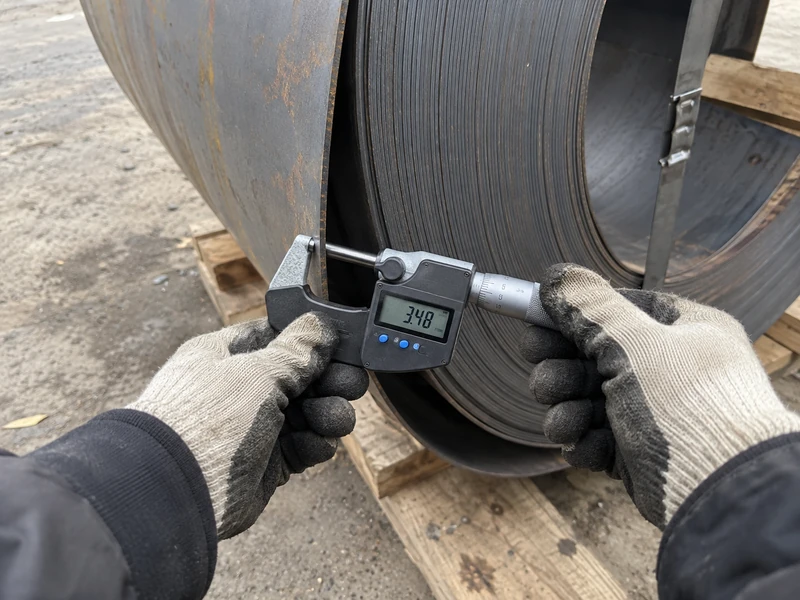
- Before the coil shipsZIVO checks thickness, width, surface, weight, packing and labels before shipment. On a hot rolled order the surface check is the one to insist on, because it is the field most often left open in the enquiry.
- Third-party inspectionInspection by a third party such as SGS or BV is accepted; the cost is paid by you. Ask for it while the order is being written, not after it has been booked.
- Coil label photosPhotos of coil labels can be provided.
- The specification on fileThe specification is confirmed by ZIVO sales together with you before the order and kept on file, and acceptance at your end is a comparison against it.
Packing and Shipment
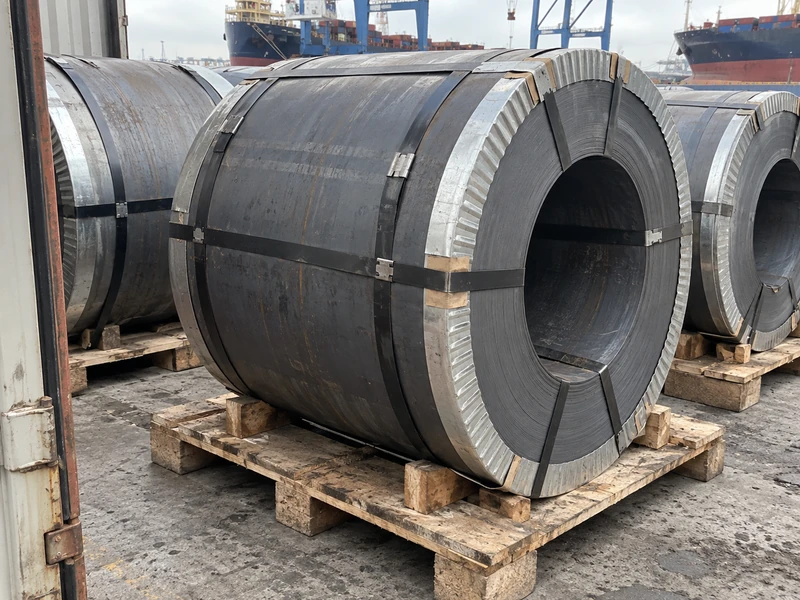
The usual ports of loading are Qingdao and Tianjin.
On a hot rolled order the surface and the shipment are one decision, not two. A coil that ships with the mill scale on and a coil that ships oiled are protected differently and wait differently, so the enquiry should say how long the coil will stand before it is run and whether it will stand under cover. Both answers feed back into the surface choice as much as into the packing.
Packing, edge protection and rust prevention for a carbon coil are agreed with the specification before the order and kept on file with it. That is deliberate: it puts what protects the coil on the record, where it can be checked against what arrives.
Frequently Asked Questions
No — it is an ordering choice, and all three surfaces are supplied: as-rolled with the mill scale on, pickled, and pickled and oiled. Order as-rolled when descaling already happens on your line or when the part is cut and welded rather than formed and painted. Order pickled, or pickled and oiled, when the surface has to be ready for forming, welding or paint on arrival.
Give ZIVO the coil inner diameter and maximum coil mass your uncoiler and crane accept. ZIVO checks your specified dimensions and weight against the partner’s actual offered coil before you order; this page does not promise a family-wide numeric range.
Q235B and Q355B on the GB route, SS400 and SPHC on the JIS route, S235JR on the EN route, and the ASTM hot rolled coil route, plus hot rolled pickled and oiled coil as an ordering line of its own. Each one is named beside the standard it is written in on the table above, and the standard is what the certificate gets read against.
One coil, and at least 3 t. Lead time is confirmed once the specification and the quantity are both settled, because a route that has to be produced and a route that ships from material already held do not take the same time.
Grade with its standard, surface, thickness, width, length and quantity, plus the coil inner diameter and coil weight your line takes. If the coil is to be slit or cut to length before it ships, that goes in the enquiry too: partner factories carry that work out, and it changes the width and the coil weight the price is built on.
Quotations are in US dollars, FOB Qingdao, with 30% T/T at the order and the remaining 70% before shipment. Each shipment leaves with the mill original of the mill test certificate and a packing list, and photos of the coil labels can be provided on request.
Tell Us What You Need
Send the product form, grade, finish, thickness, width, length and quantity. Inquiries are answered within 2 hours.
Send Your Inquiry
Name, email and your inquiry are all that is needed. Add a WhatsApp number if you prefer to chat.
- Email: henry@zivosteel.com
- WhatsApp: +86 15668396618
- Address: 2F, Vanke Center, Lixia District, Jinan, Shandong, China
- Hours: Monday to Saturday, 8:00-18:00 (China time)