SGCC Steel
SGCC is the commercial-quality designation for hot-dip zinc-coated steel sheet and coil on a cold-rolled base metal in JIS G 3302. The symbol describes the steel underneath and the quality class; the zinc is named by a separate symbol and the surface treatment by another. This page reads the designation, places it in its family, sets out the coating and surface-treatment symbols as the Japanese mills publish them, and says where a cross-standard comparison has to stop.
- Designation
- SGCC
- Family
- Non-alloy steel
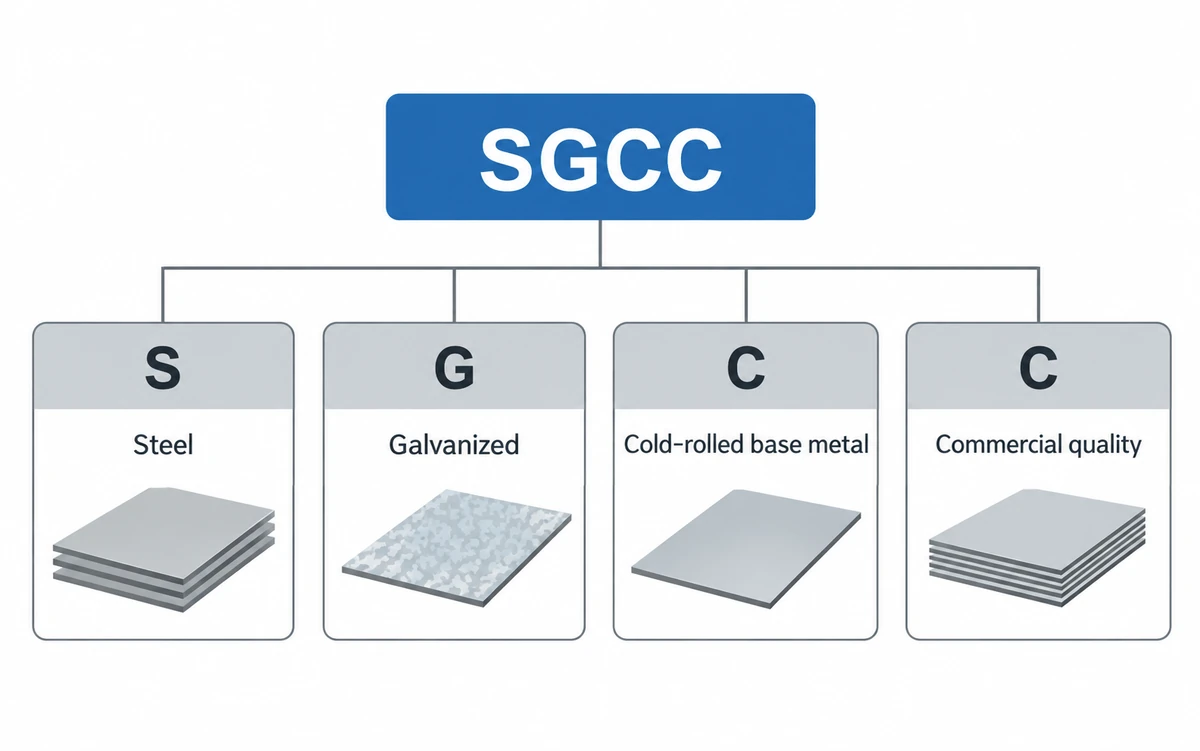
SG · C · C
Standard, base metal, quality class
0.25 ~ 3.2 mm
Nominal thickness in Nippon Steel's abstract
(270≤) N/mm²
Tensile value shown in parentheses, for reference
Triple spot, both sides
The basis behind every JIS coating symbol
The SGCC symbol taken apart letter by letter: steel, galvanized, cold-rolled base metal, commercial quality.
What SGCC Is
SGCC is a designation in JIS G 3302, the Japanese Industrial Standard for hot-dip zinc-coated steel sheets. In JFE Steel's explanation of the designation, SG is that standard, the next C means cold rolled base metal, and the final letter is the classification, where C is commercial quality. So the symbol says three things and stops: this standard, a cold-rolled base, the commercial class.
What it leaves to other fields is the zinc. The coating class has its own symbol from the same standard and the surface treatment has another again, which is why a coil is never fully described by the grade symbol alone. The steel underneath and the layer on top are specified separately even though they arrive written on one line.
The class itself has a meaning that survives translation even where designations do not. ISO 3575:2025 defines commercial as a base-metal quality intended for general fabricating purposes where sheet is used in the flat condition, or for bending or moderate forming. That is a description of the work the class is meant for. It describes work; it does not turn one standard's designation into another's.
The grade family around SGCC is set out in JIS G 3302:1998, the edition on file here, which lists the cold-reduced-base grades as SGCC for commercial quality, SGCH for the hard class, SGCD1, SGCD2 and SGCD3 for the drawing classes, and SGC340, SGC400, SGC440, SGC490 and SGC570 for structural quality. That edition has since been superseded, so the list is read below as the shape of the family rather than as the requirements of the edition an order will run to.
What the Letters Mean
Every character in the symbol answers a question, and moving any one of them changes the product that arrives.
The first pair marks the standard. In JFE Steel's reading, SG is the JIS hot dip zinc-coated steel sheets standard. That is the position that tells you which standard's tables a symbol has to be read against, and it is the reason a coating code from one Japanese standard cannot be dropped into an order written under another.
The third character is the base metal. C means cold rolled base metal; H in the same position means hot rolled. One letter therefore records what was fed into the coating line, which is a question about the steel's own history rather than about the zinc put on it afterwards.
The characters that close the symbol are the classification. C is commercial quality, and D1, D2 and D3 are drawing quality classes 1, 2 and 3. SGCC reads as this standard, cold-rolled base, commercial quality — and the family around it is built by moving one of those three parts at a time, which is what the table further down does.
One consequence is worth taking away before the tables start. Because the letters are positional, two designations can look very alike and still belong to different standards, with different coating tables behind them. Reading the symbol left to right, starting with the standard, is what keeps them apart.
SGCC and SECC Under JIS
The question that brings most people to this designation is a comparison with SECC. Both are JIS symbols for zinc-coated sheet on a cold-rolled base, they are built on the same positional rules, and they belong to two different standards.
| Position | SGCC | SECC |
|---|---|---|
| First pair | SG, the JIS hot dip zinc-coated steel sheets standard | SE, the JIS electrolytic zinc coated steel sheet standard |
| Standard behind it | JIS G 3302 | JIS G 3313 |
| Third character | C, cold rolled base metal; H would mean hot rolled | C, cold rolled base metal; H would mean hot rolled |
| Classification letters | C is commercial quality; D1, D2 and D3 are the drawing quality classes | C is commercial quality, D is drawing quality, E is deep drawing quality |
The base-metal position is not decorative. In most cases the incoming steel for a hot-dip coating line is full-hard sheet coming directly from a cold reduction mill, and for heavier sheet thicknesses the product may be entered into the coating line directly after hot rolling and pickling. The third character records which of those two routes produced the strip that went into the pot.
The classification letters come from two separate lists, and that is the trap in the comparison. Under JIS G 3302 the classification runs C, D1, D2 and D3; under JIS G 3313, as JFE Steel sets it out, it runs C, D and E. A D carried from one list to the other does not mean the same class, and a specification that names a letter without naming its standard has not yet named a class.
A third designation usually appears alongside these two in sheet-metal comparisons: the uncoated cold-rolled grade that both of these are coated versions of. It belongs to a third standard, and none of the sources behind this page covers it, so that column is left empty here rather than filled from memory.
The JIS G 3302 Grade Family
Leaving SGCC usually means moving to another member of the same standard, and the designation itself tells you what the move buys. The table gathers what two Japanese mills publish for the cold-reduced-base grades. The thickness column and the mechanical column are both from Nippon Steel's abstract of the standard, which makes them manufacturer data restating a standard rather than the standard's own text.
| Designation | Base metal and class | Nominal thickness in the abstract | Mechanical values in the same abstract |
|---|---|---|---|
| SGCC | Cold-rolled base, commercial quality | 0.25 ~ 3.2 mm | Yield point (205≤) and tensile strength (270≤) N/mm², printed in parentheses |
| SGCH | Cold-rolled base, commercial quality, hard class | Not listed there | Not listed there |
| SGCD1 | Cold-rolled base, drawing quality | 0.40 ~ 2.3 mm | Tensile strength 270 N/mm² minimum; minimum elongation 34, 36, 37 and 38 % across successive thickness bands |
| SGCD2 | Cold-rolled base, drawing quality | 0.40 ~ 2.3 mm | Tensile strength 270 N/mm² minimum |
| SGCD3 | Cold-rolled base, drawing quality | 0.60 ~ 2.3 mm | Tensile strength 270 N/mm² minimum |
| SGC340 to SGC570 | Cold-rolled base, structural quality | SGC340 is listed at 0.25 ~ 3.2 mm | Not restated here |
The row that decides most orders is the one set in parentheses. Nippon Steel's abstract of JIS G 3302-2012 notes that figures in parentheses are for reference, so the yield point and tensile strength shown against SGCC are reference values rather than mandatory requirements. A part whose acceptance rests on a tensile number therefore cannot rest it on this designation. Either the value is written into the order as a requirement of its own and agreed there, or the order moves to a class that carries one already.
The drawing classes are written the other way round, which is what makes them specifiable. In the same abstract they carry a minimum tensile strength of 270 N/mm² and minimum elongations that rise with thickness — SGCD1 at 34, 36, 37 and 38 % across successive bands. Moving up changes the steel and not the zinc, because the coating symbol is a field of its own either way. What it also changes is the thickness range the mills publish, which narrows for the drawing classes.
Have a Specification Ready?
Send what you already know, such as grade, finish, size or quantity. Inquiries are answered within 2 hours.
Coating Codes and Surface Treatment Symbols
A JIS coating symbol is a class, not a depth of zinc. The class is fixed by a test result: a minimum coating mass read over both surfaces together, from a triple-spot test. Two things follow from that, and both matter more than the number itself.
The mass is never a figure per face. A symbol that looks like a figure you have seen in another standard's table can match it and still stand for a different measurement, because the two systems do not read the mass the same way.
The class the market quotes most often on SGCC is the 275 g/m² class, which JIS writes as Z27. Two independent sources carry that pairing, so it is stated here. The rest of the ladder runs from lighter classes in the eighties to heavy classes in the hundreds, and the exact figure attached to each symbol is a table in JIS G 3302 itself. The coating designations guide sets that ladder out in full, from the one mill catalogue that publishes it; this page does not repeat it. The figure behind a symbol is confirmed against the governing edition when the order is written, and the certificate states the class that was actually applied.
One historical note, because it explains a number that turns up in specifications. The superseded 1998 edition published a second column that current mill catalogues do not: alongside the triple-spot average it gave a single-spot minimum, and for the 275 g/m² class that single-spot figure was 234 g/m², total on both surfaces. A single-spot figure in a specification usually comes from a table of that vintage. It is named here as history, not as a current requirement: the current edition is not on file here, and an edition seven revisions old is not a source for what applies today.
JFE Steel states that JIS H 0401 is applied to coating weight measurement for these products. That is manufacturer data describing mill practice, and the standard's own listing for the current edition does not carry JIS H 0401 among the standards it cites, so it is not restated here as the method the current JIS requires.
Coating Thickness vs Coating Mass
A coating symbol is a mass and a thickness tolerance is a length, and JIS keeps the two apart by adding one to the other. The addition is where specifications most often go wrong.
For JIS G 3302 products the tolerance is not read on the base metal alone, because JFE Steel states that it applies to the nominal thickness plus the equivalent thickness of the coating. Nippon Steel says the same in its own words: thickness tolerances are applied to the total values of nominal plate thickness and corresponding coating thickness, and thickness shall be measured at a spot at least 25 mm inside the edge. A gauge checked against the steel on its own is being checked against the wrong figure.
The number that gets added is not a measured layer but what JFE Steel lists, for each coating designation, as an equivalent coating thickness used with the nominal thickness — 0.026 mm for Z12, 0.034 mm for Z18 and 0.054 mm for Z27. Read those as a calculation convention published by a mill for use with its own tolerance table, not as the depth of zinc on a face. The mass behind Z27 is a minimum over both surfaces together in a triple-spot test, and a figure of that kind fixes nothing about either face on its own.
The tolerance moves with the width as well as with the gauge. For cold-rolled-base hot-dip galvanized coil of nominal thickness 0.40 to under 0.60 mm, two Japanese mills give the same figures: ±0.06 mm for the three narrower width bands, ±0.07 mm for the next band and ±0.08 mm for the widest one. A drawing that fixes a gauge without fixing a width has not yet fixed a tolerance.
Names in Other Standards
This is the section most grade pages fill with a comparison table, and there is nothing on file to fill it with. None of the sources behind this page places SGCC in one row with a European or an American designation, so no such row is printed here, and no figure is carried across from one system to another.
What can be said about a cross-standard move is procedural rather than nominal. Designations are commonly compared; a comparison is a cross-reference, it requires full specification review, and it stays subject to purchaser approval. The standard named on the certificate is what settles acceptance afterwards, checked requirement by requirement — the coating basis, the mechanical values, the surface-treatment symbols — and approved by whoever owns the specification.
The rows below are the ones that can be sourced: the grade's own route, the international vocabulary for its quality class, and the neighbouring JIS designation it is most often confused with.
| System | Designation | Standard | Note |
|---|---|---|---|
| JIS | SGCC | JIS G 3302 | The grade's own route: hot-dip zinc-coated sheet and coil, cold rolled base metal, commercial quality. |
| ISO | commercial | ISO 3575:2025 | A base-metal quality description rather than a grade name: general fabricating purposes where sheet is used in the flat condition, or bending or moderate forming. |
| JIS | SECC | JIS G 3313 | Not another name for SGCC. A separate standard and a separate coating route, listed because the two symbols are routinely confused. |
SGCC Coil From ZIVO
This page stops at the designation. The coating masses, the sizes, how a JIS order line is assembled and the terms a quotation is made on are set out on the SGCC coil page.
| Product page | Grade | Finish | Thickness | Width |
|---|---|---|---|---|
| SGCC Galvanized Coil | SGCC+Z | 0.12–6.0 mm | 1000 / 1200 / 1250 mm | |
| SGCC Galvanized Coil | SGCC+Z275 | 0.13–6.0 mm | 600–1250 mm |
Frequently Asked Questions
By the coating route, because that is what the two standards differ on. SG is the JIS hot dip zinc-coated steel sheets standard; in JFE Steel's explanation of the other designation, SE is the JIS electrolytic zinc coated steel sheet standard. Both carry a cold rolled base metal in the third position and the commercial class in the fourth, so the steel underneath is described the same way in each. What changes is how the zinc arrived and which standard's coating table the symbol has to be read against.
Not a mandatory one. In Nippon Steel's abstract of JIS G 3302-2012 the yield point (205≤) and tensile strength (270≤) N/mm² shown against SGCC are printed in parentheses, and the catalogue notes that figures in parentheses are for reference. So a part that has to meet a tensile number cannot lean on the designation for it: the figure is agreed in the order as a requirement in its own right, or the order moves to a class that already carries one.
No. Every designation in JFE Steel's list is a minimum coating weight in the triple-spot test on both sides, so the figure covers the two faces together, and JFE states that JIS H 0401 is applied to coating weight measurement for these products. A minimum per face is a different requirement and has to be written into the order as one; no both-surfaces figure implies it.
Not to the bare steel. JFE Steel states that for these products the tolerance is not read on the base metal alone but on the nominal thickness plus the equivalent thickness of the coating, and it publishes the figure to add for each coating designation — 0.026 mm for Z12, 0.034 mm for Z18 and 0.054 mm for Z27. Those are a calculation convention for use with the mill's tolerance table rather than a measured depth of zinc on a face.
Not on the strength of anything on this page. None of the sources behind it places SGCC in one row with a European designation, so no such row is printed. ISO 3575:2025 does define commercial as a base-metal quality intended for general fabricating purposes where sheet is used in the flat condition, or for bending or moderate forming, which is a shared description of the work rather than a shared designation. Moving an order between standard systems is a cross-reference: it requires full specification review, it stays subject to purchaser approval, and acceptance afterwards is settled by the standard named on the certificate.
Sources
- GalvInfoNote 2.1: The Continuous Hot-Dip Coating Process for Steel Sheet Products (Rev 1.2, Dec 2017)
- ISO 3575:2025 Continuous hot-dip zinc-coated and zinc-iron alloy-coated carbon steel sheet of commercial and drawing qualities (public sample)
- Hot Dip Galvanized Steel Sheet catalog (Cat. No. B1E-004-11)
- Electrogalvanized Steel Sheet catalog (Cat. No. B1E-003)
- DURGRIP™ hot-dip galvannealed steel sheets catalog (U019en)
- JIS G 3302:1998 Hot-dip zinc-coated steel sheets and coils (superseded edition, OCR text)
Tell Us What You Need
Send the product form, grade, finish, thickness, width, length and quantity. Inquiries are answered within 2 hours.
Send Your Inquiry
Name, email and your inquiry are all that is needed. Add a WhatsApp number if you prefer to chat.
- Email: henry@zivosteel.com
- WhatsApp: +86 15668396618
- Address: 2F, Vanke Center, Lixia District, Jinan, Shandong, China
- Hours: Monday to Saturday, 8:00-18:00 (China time)