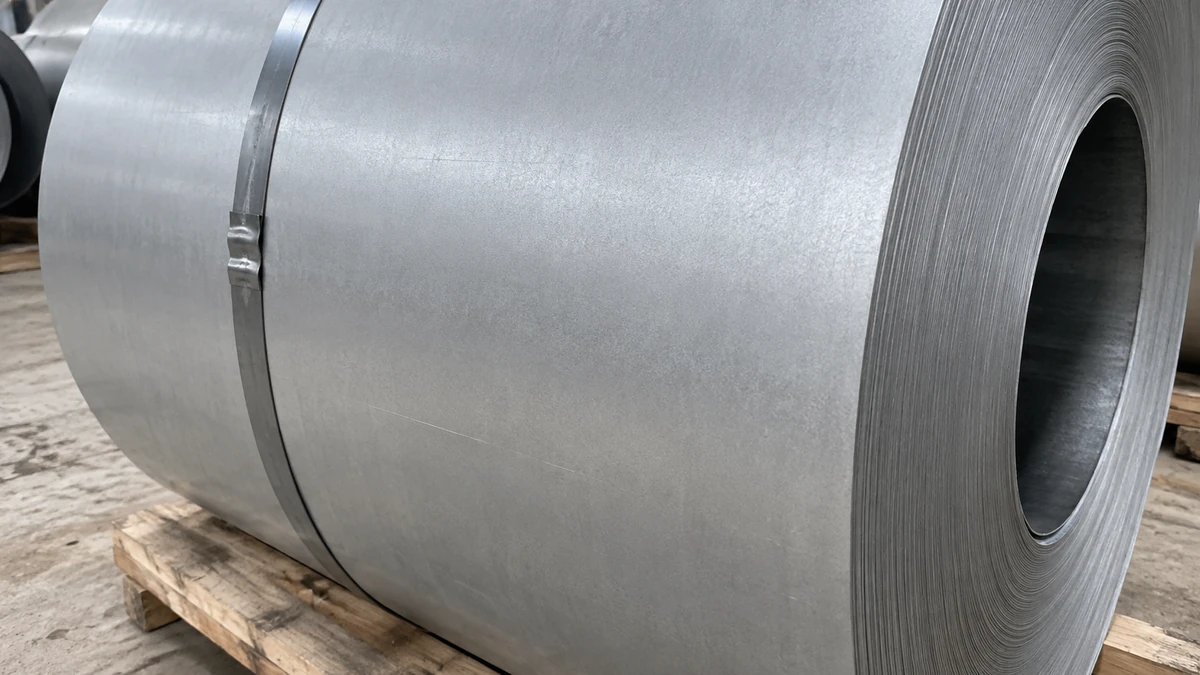
China Electro-Galvanized Steel Coil Supplier
ZIVO STEEL supplies electro-galvanized steel coil on an SECC cold-rolled base, with the zinc applied cold by electrolysis rather than in a molten bath. The coating mass belongs to each surface on its own — 10, 20, 30 or 40 g/m² per side — which is a different specification from a hot-dip figure and does not convert into one.
SECC
Grades
10–40 g/m² (JIS G 3313)
Coating
0.3–2.5 mm
Thickness
800–1700 mm
Width
Representative view: electro-galvanized coil, the zinc surface smooth and matte with no spangle.
Electro-Galvanized Coil From ZIVO STEEL
ZIVO STEEL is a steel supplier. The coil is arranged against the specification you send, from a source that runs the electrolytic route; no mill, no plating line and no warehouse is operated here.
This product travels under several names — EG coil, electrogalvanized coil, electro-zinc plated or zinc electroplated sheet, and SECC where the Japanese designation is used as the product name. Under any of them it is a separate product from hot-dip galvanized coil, made on a different kind of line, carrying a far lighter zinc layer, and specified on each surface instead of over the two together. What is listed below sits on an SECC base, 0.3 to 2.5 mm thick, 800 to 1700 mm wide, on a 508 or 610 mm coil inner diameter. The sections after the table cover the process, the per-side coating basis, the substrate and its surface treatment, and the point at which hot-dip is the better answer.
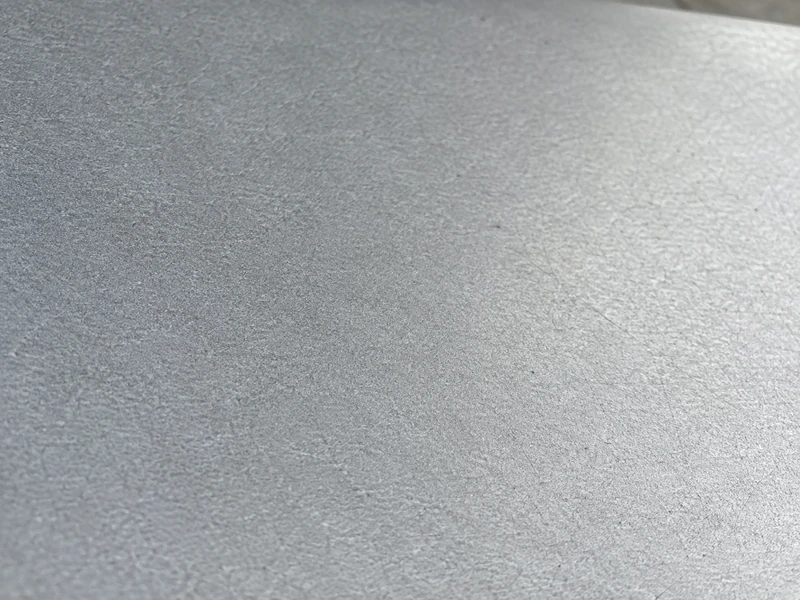
Electro-Galvanized Coil Specifications
One row per coating step on an SECC base, each with the thickness, the width and the coil inner diameter recorded against it. Coil weight and edge condition are settled when the order is placed rather than published here.
Read the coating column one surface at a time. The figure in a row is the zinc mass carried by each side of the coil, not a total shared between the two faces. A step of 20 g/m² therefore puts 20 g/m² on the face nearest you and 20 g/m² on the face away from you, and the steps available run from 10 up to 40 g/m² per side. Nothing on this page turns those figures into a both-surfaces number, because the two bases are not two versions of one quantity.
Each step carries its own test basis, also read per side: a minimum value at one point and a minimum value at three points, both measured on a single surface. Those are the two lines to ask for on the certificate, rather than the nominal step alone.
The steps sit on one base — the SECC cold-rolled substrate — and the surface treatment is a field of its own: chromate, oiled, phosphated or anti-fingerprint. It is stated once here instead of repeated down a column, and it is chosen for what happens to the coil after it lands.
What the column deliberately does not show is a standard coating code. The masses are what ZIVO supplies; which designation in which standard expresses a given mass belongs to the edition your order runs to, and it is fixed there rather than asserted here.
| Grade | Standard | Process | Thickness | Width | Coil ID | Coating |
|---|---|---|---|---|---|---|
| SECC 10/10 | JIS G 3313 | Continuous electrolytic zinc coating (electro-galvanizing) on cold-rolled base metal; the strip is coated cold and is not heat treated | 0.3–2.5 mm | 800–1700 mm | 508 / 610 mm | 10 g/m2 |
| SECC 20/20 | JIS G 3313 | Continuous electrolytic zinc coating (electro-galvanizing) on cold-rolled base metal; the strip is coated cold and is not heat treated | 0.3–2.5 mm | 800–1700 mm | 508 / 610 mm | 20 g/m2 |
| SECC 30/30 | JIS G 3313 | Continuous electrolytic zinc coating (electro-galvanizing) on cold-rolled base metal; the strip is coated cold and is not heat treated | 0.3–2.5 mm | 800–1700 mm | 508 / 610 mm | 30 g/m2 |
| SECC 40/40 | JIS G 3313 | Continuous electrolytic zinc coating (electro-galvanizing) on cold-rolled base metal; the strip is coated cold and is not heat treated | 0.3–2.5 mm | 800–1700 mm | 508 / 610 mm | 40 g/m2 |
Coating codes, units and test basis: Galvanized Steel Coating Designations.
What Electro-Galvanizing Does to the Steel
Electro-galvanizing is a cold, electrochemical process, and nearly everything that separates this coil from a hot-dip one follows from that single fact. Below is the route the strip takes, and what each stage leaves behind in the finished product.
Zinc dissolved, not melted
EN 10152:2009 defines an electrolytic zinc coating (ZE) as the application of a zinc coating by electrolysis on a suitably prepared steel surface from an aqueous zinc salt solution by the use of an electric current. No molten metal appears anywhere in that sentence, and none appears anywhere in the line.
Zinc is the anode, the strip is the cathode
In continuous electrogalvanizing the anode is zinc, the cathode is the steel strip and the electrolyte is zinc sulfate; another similar process uses zinc chloride instead.
The layer is built up cell by cell
The coating is built up a small amount each time the strip passes through one of a series of plating cells. Coating weight is therefore a function of how long the strip spends in the cells and how much current it sees, which is what makes very light steps controllable.
The bond is interatomic
Bonding between an electrogalvanized coating and the steel occurs by interatomic attraction, where hot-dip coatings rely instead on diffusion between the liquid coating metal and the solid steel substrate. To achieve a good bond the electrogalvanizing process depends on the steel surface being very clean.
The strip is never heat-affected
Kobe Steel explains that in the electro-galvanizing process steel sheets are not heat-affected, so they keep the workability of the hot-rolled or cold-rolled base sheet, and that electrogalvanized sheets carry a pure zinc layer with excellent ductility and no brittle iron-zinc alloy layer. Formability is inherited from the base metal rather than traded away for the coating.
What comes off the line
ArcelorMittal describes electrogalvanised steel as a cold rolled flat carbon steel product coated on one or both sides with a pure zinc layer characterised by its uniform and regular thickness, with good resistance to corrosion for indoor applications, and as an excellent substrate for painting. One side or both is a decision the order makes, not a property of the process.
And the band the coatings work in
Published practice puts electroplated zinc coated sheet in two bands: a coating mass of 50 to 80 g/m² per surface, used predominantly for automotive applications, or a coating mass of less than 25 g/m², applied where a high degree of corrosion protection is not required and the part is often indoors. Those figures are per surface, like every other coating figure on this page.
The Coating Is Specified On Each Side
A hot-dip coating figure answers the question how much zinc is on this coil. An electro-galvanized figure answers a narrower one: how much zinc is on this face. Every standard that covers the product writes it the second way, and each counts it in its own quantity.
| Ordering system | What the figure is counted in | What the order still has to say |
|---|---|---|
| EN 10152, electrolytic zinc coating (ZE) | A nominal coating thickness carried by each surface, written as a pair: 50/50 is a nominal 5,0 µm per side | Whether both faces take the same figure |
| ASTM A879/A879M | Minimum and maximum single spot test values on each surface, with the designation shown for each surface | Both designations, written out, one per face |
| JIS G 3313, electrolytic zinc coated sheet | A minimum coating weight on one side | The classification of the base metal and the surface treatment |
Because the figure belongs to a surface, the two faces are separately specifiable, and that is the practical gain of the basis. A pair carrying the same number twice is an equal coating; a pair carrying different numbers is a differential coating, with one face deliberately heavier than the other. JFE Steel's catalogue shows how far that distinction moves a requirement: for coating weight designation E16 it gives a minimum zinc coating weight on one side of 17 g/m² for equal coating and 16 g/m² for differential coating, alongside a reference standard coating weight of 20 g/m² on one side, and 25.5, 24 and 30 g/m² on the same three counts for E24. That is manufacturer data restating a paid standard, not the standard's own table, and it is quoted here only to show what a per-side requirement looks like once it is written down.
The EN route is written the same way. ZE 25/25 appears in ArcelorMittal's catalogue as 2.5/2.5 µm thickness per side and 18/18 g/m² weight per side, ZE 50/50 as 5.0/5.0 µm and 36/36 g/m² per side: two numbers, one to a face, in the thickness column and in the mass column alike.
None of those codes is attached to a row in the table above, and that is deliberate. What ZIVO supplies is a mass on each side; which designation in which standard carries that mass is settled against the governing edition when the order is written. Printing a code here that the order has not yet fixed would be an invention rather than a specification, and a code nobody can check is worse than a mass anybody can.
The one operation unavailable in either direction is conversion. A designator written as a total over both surfaces and averaged across three spots permits an uneven split between the faces, so it cannot be converted precisely into a single-spot, single-side designator, which sets exact minimums per surface. Read on a like-for-like basis the two coatings do behave alike against corrosion: a coating mass of 100 g/m² gives essentially the same amount of protection whether it arrived by hot dipping or by electrolysis. The bases have to be made like-for-like first, and no arithmetic on this page does that for you.
Have a Specification Ready?
Send what you already know, such as grade, finish, size or quantity. Inquiries are answered within 2 hours.
Substrate, Classification and Surface Treatment
SECC is not a free-standing product name. It is a designation with parts, and each part settles something your order has to settle anyway: which standard, which base metal, which forming class. A quotation needs the grade, finish, thickness, width, length and quantity, and on a coated product the word finish stands for several fields rather than one. The specification is confirmed by ZIVO sales together with you before the order and kept on file.
- Read the designation letter by letterIn JFE Steel's explanation of a JIS G 3313 designation such as SECC, SE is the JIS electrolytic zinc coated steel sheet standard, the next C means cold rolled base metal (H = hot rolled) and the last letter is the classification: C for commercial quality, D for drawing quality, E for deep drawing quality.
- What the last letter commits you toThe steps listed on this page sit on the commercial-quality class. The drawing and deep drawing classes exist in the same family and are named by the same rule, but they are not published here, and no thickness, width or coating step on this page should be read across to them. If your part needs a deeper-forming class, put it into the inquiry as a question rather than as an assumption.
- The base metal is cold rolledThe second letter of the designation fixes the base metal, and here it is the cold-rolled one. Mechanical values for the class are not reproduced on this page: they belong to the edition of the standard your order runs to, and a certificate is read against that edition rather than against a figure on a supplier's website.
- Surface treatment is its own order fieldNippon Steel's list of JIS surface treatment symbols reads C as chromate treatment, NC as chromate-free treatment and M as no treatment, with O for oiled and X for non-oiled. A specification that excludes chromium needs the chromate-free symbol inside the order line, not in a note beside it.
- This is not an outdoor material on its ownEN 10152:2009 notes that, as the mass of the zinc coating applied is relatively small, the material is not intended to withstand outside exposure without further chemical treatment and painting. Say what happens to the coil after forming — paint, plating, an enclosure — because that is what the coating step and the treatment are chosen against.
- Then the ordinary commercial fieldsThickness, width, length and quantity, plus the coil inner diameter your uncoiler can take. Written together with the fields above, the inquiry leaves nothing for anyone to assume on your behalf.
Where Hot-Dip Is the Better Choice
Electro-galvanized coil is chosen for a thin, even, clean zinc layer on a base that has not been through a bath: the formability of the cold-rolled substrate is untouched, the surface takes paint well, and the coating can be held light on purpose. It is not chosen for zinc quantity, and being straight about that is worth more than another paragraph of product copy.
The usable band is the limit. Published practice puts electroplated sheet either at 50 to 80 g/m² per surface, predominantly automotive, or below 25 g/m² where a high degree of corrosion protection is not required and the part usually lives indoors. Set against heavy hot-dip work, even the heaviest coating masses of electrogalvanized product are considerably less than much of the hot-dip galvanized product in use today for exterior applications; the reverse holds too, since producing hot-dip coatings as thin as the lightest electrogalvanized ones is not practical. The two routes are not competing over one range — between them they cover different parts of it.
EN 10152:2009 draws the same line in a single sentence: as the mass of the zinc coating applied is relatively small, the material is not intended to withstand outside exposure without further chemical treatment and painting. A part that will live outdoors, stay wet, or wait years for its first maintenance belongs on the hot-dip route, with its own grades and its own coating classes.
Where coating masses do meet, the metal behaves the same way: at 100 g/m², read on one basis, protection is essentially the same whether the zinc arrived from a molten bath or from a plating cell. The catch is always the basis. A hot-dip class is a total across both faces; the figure on this page belongs to one face; and the gap between those two statements is not something a conversion factor closes.
Inspection and Documents
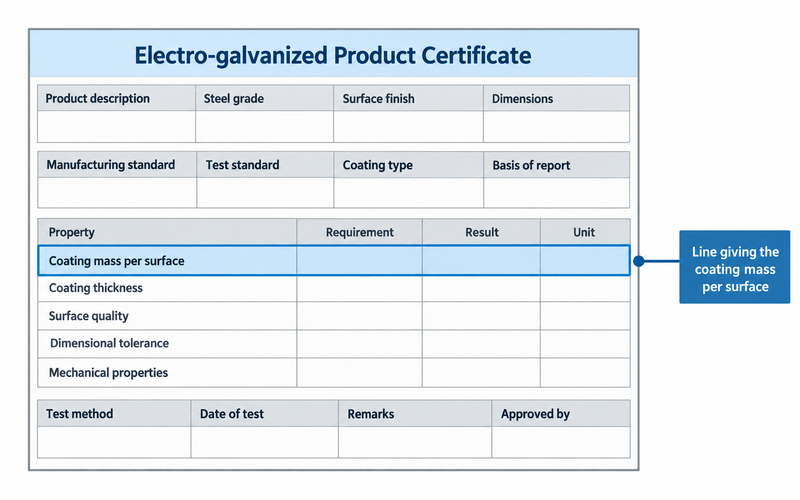
On a coated product the certificate is only as good as the line that reports the coating, and on this one that line has to say how many surfaces its figure covers. A mass with no basis beside it cannot be checked against anything, and a per-side requirement checked against a both-sides result is not a check at all.
The hot-dip general requirements document shows what a stated basis looks like when it is written down properly. Under ASTM A924/A924M, metallic-coated steel sheet is produced to various coating designations shown in the individual product specifications and, except for differentially coated sheet, the coating is always expressed as the total coating of both surfaces; product furnished under ASTM A653/A653M conforms to the applicable requirements of the latest issue of that general specification unless otherwise provided. That is the hot-dip convention, in its own words. Ask for the same explicitness on an electro-galvanized certificate, with the surfaces named and the sampling named. Where acceptance turns on the result rather than on the label, name the method too: the same ASTM specification provides two of them for the coating weight test, the weigh-strip-weigh method and the X-ray fluorescence method.
- The standard and its editionBoth, on the face of the certificate. A coating designation means what the edition defining it says it means, and an order naming only a grade has left that question open.
- The coating result and the surfaces it coversA figure, the faces it belongs to and the way it was sampled. On this product the figure belongs to one face, and the certificate should say so in words rather than leave it to be inferred from the number.
- Shipment documentsEach shipment comes with a mill test certificate (MTC) and a packing list.
- Before it shipsThickness, width, surface, weight, packing and labels are checked by ZIVO before shipment.
- Third-party inspectionThird-party inspection, SGS or BV for example, is accepted; the inspection cost is paid by you.
- Label photosPhotos of the coil labels can be provided.
- The specification on fileWhat was agreed with ZIVO sales is kept on file, so the certificate can be read against the order as it was actually written.
Packing and Shipment
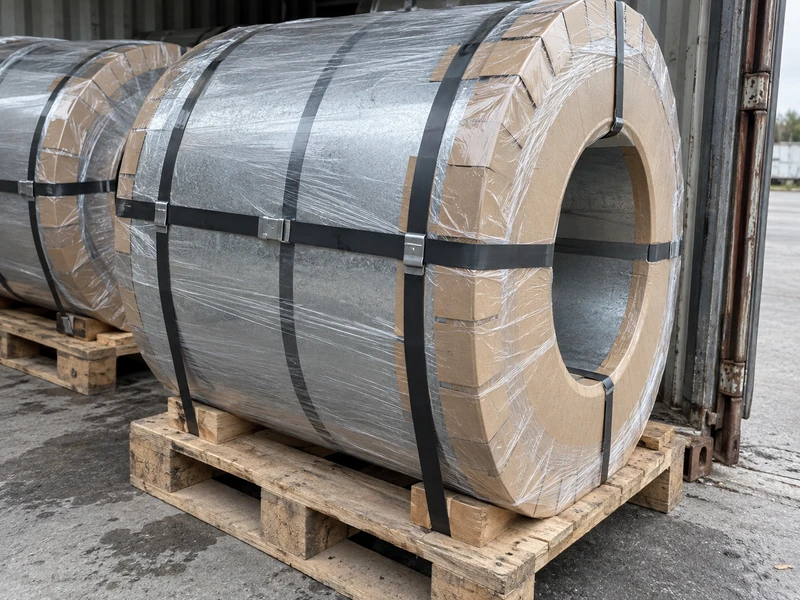
Most of this material is on its way to a paint line, a plating shop or an enclosure where the face that shows has to arrive unmarked. So the packing conversation starts from the destination rather than from the voyage.
Tell us at the inquiry stage what the coil is for, how long it is likely to wait before it goes on the line, and in what conditions it will wait. The packing, the surface protection and the oiling for this product are agreed with ZIVO sales as part of the specification before the order and kept on file with the shipment they belong to; they are not carried over from what a hot-dip coil would have had. The usual ports of loading are Qingdao and Tianjin.
Frequently Asked Questions
By the way the zinc gets on, and by everything that follows from it. In continuous electrogalvanizing the anode is zinc, the cathode is the steel strip and the electrolyte is zinc sulfate, with the coating built up a small amount each time the strip passes through one of a series of plating cells. Nothing is molten and nothing is heated: steel sheets are not heat-affected, so they keep the workability of the base sheet, and the coating is a pure zinc layer with excellent ductility and no brittle iron-zinc alloy layer. The bond is also different in kind — interatomic attraction, where a hot-dip coating relies on diffusion between the liquid coating metal and the solid steel. The visible consequences are a lighter, more even layer, an unchanged cold-rolled surface, and a coating figure written per side.
Per side. Every figure in the table is the zinc mass on one surface of the coil, so both faces carry it. That is how the standards for this product write it as well: in an EN 10152 designation the numbers denote the nominal coating thickness on each surface, and under ASTM A879/A879M the designations relate to the single spot test value on each surface, with the designation shown for each surface. A figure covering both faces together is a hot-dip convention and belongs to hot-dip documents.
No, and the reason is the measurement basis rather than the wording. Under ASTM A924/A924M the coating on metallic-coated sheet is always expressed as the total coating of both surfaces, except for differentially coated sheet, so a hot-dip designation is a statement about two faces at once. This product is specified one face at a time. A total-both-surfaces, triple-spot designator also permits an uneven split between the faces, which is why it cannot be converted precisely into a single-spot, single-side designator that sets exact minimums per surface. Send the per-side mass you need, and the standard your drawing runs to, and the order is written in that system.
Not on its own. EN 10152:2009 notes that, as the mass of the zinc coating applied is relatively small, the material is not intended to withstand outside exposure without further chemical treatment and painting. Published practice points the same way: coating masses below 25 g/m² are applied where a high degree of corrosion protection is not required and the part is often indoors. Where the part is exposed, the hot-dip route carries the heavier classes, since even the heaviest electrogalvanized coating masses are considerably less than much of the hot-dip galvanized product in use today for exterior applications.
One base and four steps. The base is SECC, the cold-rolled commercial-quality class of the electrolytic zinc coated sheet family, and the coating steps are 10, 20, 30 and 40 g/m² per side, in 0.3 to 2.5 mm thickness and 800 to 1700 mm width, on a 508 or 610 mm coil inner diameter. The drawing and deep drawing classes of the same family are not published here; ask about them in the inquiry rather than reading a step off this page and assuming it applies to them.
Because a mass is what was established, and a code is a further claim about which standard and which edition express it. The three systems covering this product each name the coating differently, and a code written on a page without an order behind it cannot be checked against anything. So the page publishes the mass per side, and the designation that carries it is fixed against the governing edition when the order is written and shown again on the certificate. Where your drawing already names a designation, send it: the order is then written in that system from the start.
That is what a per-side basis makes expressible, and it is a field of the order rather than a default. A pair with the same figure twice is an equal coating; different figures are a differential coating. The distinction changes the requirement itself: JFE Steel's catalogue gives coating weight designation E16 a minimum zinc coating weight on one side of 17 g/m² for equal coating and 16 g/m² for differential coating, with a reference standard coating weight of 20 g/m² on one side. State which of the two you need, and both figures, at the inquiry stage.
One coil, at least 3 t. Quotations are in US dollars, FOB Qingdao; payment is 30% T/T deposit with the 70% balance before shipment, and the lead time is fixed once the specification and the quantity are.
Tell Us What You Need
Send the product form, grade, finish, thickness, width, length and quantity. Inquiries are answered within 2 hours.
Send Your Inquiry
Name, email and your inquiry are all that is needed. Add a WhatsApp number if you prefer to chat.
- Email: henry@zivosteel.com
- WhatsApp: +86 15668396618
- Address: 2F, Vanke Center, Lixia District, Jinan, Shandong, China
- Hours: Monday to Saturday, 8:00-18:00 (China time)