China DX51D Galvanized Steel Coil Supplier
ZIVO STEEL supplies DX51D+Z hot-dip galvanized coil ordered to EN 10346. This page sets out what the DX51D designation fixes, what it leaves open, and how the grade, the coating and the surface fields are written into a single order line.
Indicative priceUSD 560-660 per tonneMarket reference for hot-dip galvanized coil, 0.5-2.0 mm, Z100 to Z275 coating, 1000-1500 mm wide. Not a quotation.
DX51D
Grades
100–275 g/m² (EN 10346)
Coating
0.12–6.0 mm
Thickness
3 t
Minimum order
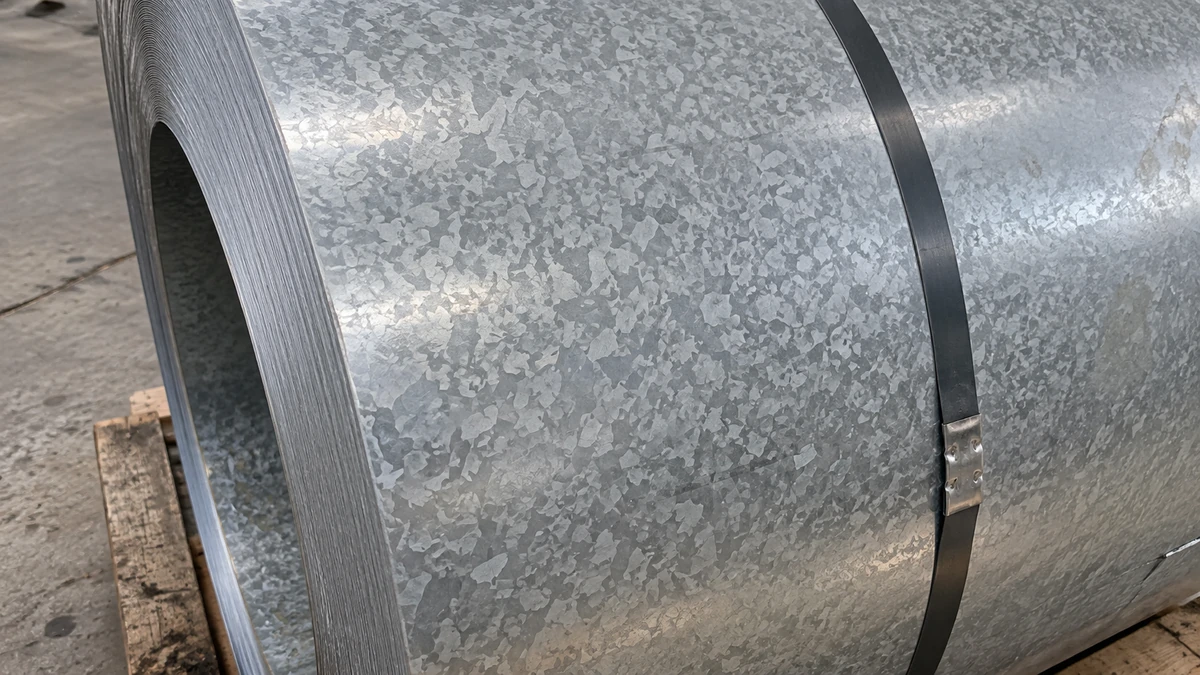
Representative view: dX51D+Z galvanized coil, the zinc surface showing an even spangle.
DX51D+Z Coil From ZIVO STEEL
ZIVO STEEL is a steel supplier, not a mill and not a galvanizing line. DX51D+Z coil is arranged against the specification you send, which is why the specification is what this page spends its time on.
An order for this product has two halves that are easy to merge into one product name and expensive to merge on a certificate. DX51D is the steel. The zinc coating written after it is a separate field, with its own mass and its own measurement basis. The table below lists the combinations ZIVO supplies on a DX51D base, 0.12 to 6.0 mm thick; everything after the table is about turning one of those rows into an order a mill can accept without guessing.
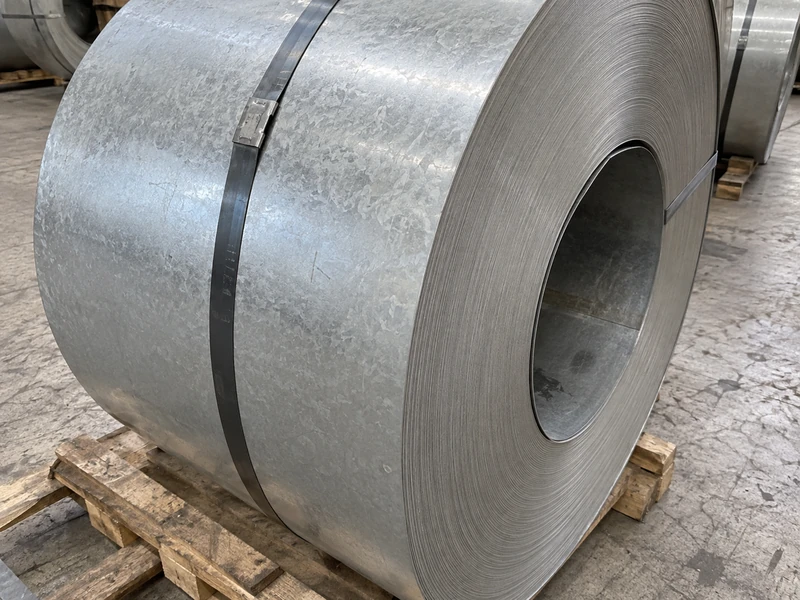
DX51D+Z Coil Specifications
One row per zinc coating step on a DX51D base, with the thickness, the width and the coil dimensions recorded against each. A dash means that value is settled when the order is placed rather than published here.
The coating figure in a row is a mass over the two faces together, never a mass per face. EN 10346:2015 defines it that way, and the standard's own ordering wording spells it out: the number designating the nominal mass of coating means, for example, 275 = 275 g/m² including both surfaces.
The figure also never travels alone. The nominal coating mass is combined with the symbol for the coating type — Z, ZF, ZA, ZM, AZ or AS — and expressed in grams per square metre, which is why the rows read as a grade plus a coating and not as a grade plus a number.
EN 10346:2015 covers this product from 0,20 mm up to 3,0 mm as its normal thickness range; thinner material, and material from 3,0 mm to 6,5 mm, is supplied by agreement at the enquiry and order stage. Several rows above run past 3,0 mm and are ordered on that basis.
| Grade | Standard | Process | Thickness | Width | Coil ID | Coil weight | Coating |
|---|---|---|---|---|---|---|---|
| DX51D+Z100 | EN 10346:2015 | Hot-dip galvanized | 0.3–3.0 mm | 600–1500 mm | — | — | 100 g/m2 |
| DX51D+Z140 | EN 10346:2015 | Hot-dip galvanized | 0.12–4.0 mm | 600–1500 mm | 152 / 254 / 305 / 406 / 508 / 610 mm | 1–10 t | 140 g/m2 |
| DX51D+Z150 | EN 10346:2015 | Hot-dip galvanized | 0.12–5.0 mm | 600–1500 mm | — | — | 150 g/m2 |
| DX51D+Z200 | EN 10346:2015 | Hot-dip galvanized | 0.3–6.0 mm | 600–1500 mm | — | 1–8 t | 200 g/m2 |
| DX51D+Z275 | EN 10346:2015 | Hot-dip galvanized | 0.3–5.0 mm | 600–1500 mm | 508 / 610 mm | 3–5 t | 275 g/m2 |
Coating codes, units and test basis: Galvanized Steel Coating Designations.
What the DX51D Designation Fixes
DX51D is a steel name, not a product description, and EN 10346:2015 does not invent it: the steel names are allocated in accordance with EN 10027-1 and the steel numbers in accordance with EN 10027-2. Read that way, the name says what the steel is for rather than what is in it.
What it fixes is a position on a forming ladder. EN 10346:2015 classifies the low carbon steels for cold forming in accordance with their increasing suitability for cold forming: DX51D is bending and profiling quality, DX52D drawing quality, DX53D deep drawing quality and DX54D special deep drawing quality. thyssenkrupp Materials Processing Europe describes DX51D as a machine folding grade suitable for simple craft forming work as well as for the production of simple profile shapes. Bent, roll-formed and profiled parts sit squarely in that description; a drawn part is being asked of a grade that was not selected for it.
What the designation does not fix is the coating. In an EN 10346 order the steel is identified by the steel name or steel number followed by the symbol for the type of hot-dip coating — the standard's own example is DX53D+Z (1.0951+Z), where +Z is the zinc coating. Grade and coating are two decisions that arrive as one string, and neither one implies the other.
One loose end is worth settling before your drawing office argues about it: the steel number is not settled in the public record. thyssenkrupp Materials Processing Europe lists DX51D under material number 1.0917, with properties according to DIN EN 10346 and the possible surface finishes +Z, +ZF, +ZA, +ZM, +AZ and +AS, while SteelNumber files the same grade as 1.0226 with reference to EN 10346-2009. The public sample of EN 10346:2015 does not show the steel number for this grade, so neither figure can be presented as settled. Order by the steel name and let the certificate carry whichever number the governing edition assigns.
ISO 3575:2025 covers this product family internationally and defines commercial as a base-metal quality intended for general fabricating purposes where sheet is used in the flat condition, or for bending or moderate forming. That is the work DX51D is placed for, in the vocabulary an ISO or JIS drawing uses for it. It is a cross-reference between vocabularies; it is not permission to order one designation against the other.
Forming Requirements Behind the Grade
EN 10346:2015 sets the requirements for DX51D, and the public sample of that standard does not carry its property table. What follows is what four mills publish for the grade as they restate the standard, each figure attributed to the mill that published it. A certificate is checked against the edition named on your order, not against this page.
| Requirement | Published for DX51D | Who publishes it |
|---|---|---|
| Yield strength | No yield strength requirement | ArcelorMittal, SSAB and voestalpine, tested transverse to the rolling direction |
| Tensile strength Rm | 270–500 MPa | ArcelorMittal catalogue; SSAB and voestalpine give the same range |
| Elongation A80, minimum | 22 % | ArcelorMittal for 0.7–6 mm; SSAB, voestalpine and thyssenkrupp Materials Processing Europe give the same minimum |
| Elongation on thinner material | ≥ 20 % for 0.5–0.7 mm, ≥ 18 % for 0.35–0.5 mm, ≥ 15 % for 0.2–0.35 mm | ArcelorMittal, transverse to the rolling direction |
| Chemical composition, maximum | C ≤ 0.180 %, Mn ≤ 1.20 %, P ≤ 0.120 %, S ≤ 0.045 %, Si ≤ 0.50 %, Ti ≤ 0.300 % | ArcelorMittal; SSAB gives C 0.18, Si 0.50, Mn 1.20, P 0.12, S 0.045, Ti 0.30 on a ladle analysis and thyssenkrupp the same on a heat analysis |
Two rows of that table are worth raising at the inquiry stage.
The elongation reduction on thin gauges is written differently by different mills. SSAB notes that for these grades a decreased minimum elongation A80 value applies for thickness 0.50 mm < t ≤ 0.70 mm (minus 2 units) and t ≤ 0.50 mm (minus 4 units). thyssenkrupp Materials Processing Europe notes reduced minimum values of elongation at fracture for 0.50 mm < t < 0.70 mm (minus 2 units), 0.35 mm < t < 0.50 mm (minus 4 units) and t < 0.35 mm (minus 7 units). If your part is thin and elongation is the acceptance criterion, say which band and whose wording your drawing follows.
The carbon maximum is the figure most often printed wrong against this grade. A maximum of 0.12 % turns up on plenty of pages under the DX51D heading; those are the limits the mills give one rung higher. In the same ArcelorMittal table, DX52D +Z to DX57D +Z have lower limits than DX51D: C ≤ 0.120 %, Mn ≤ 0.60 % and P ≤ 0.100 %. Read a certificate showing 0.12 % as a clean heat, not as evidence of which grade you received.
Which rung to order is the question the ladder exists to answer. Above DX54D, EN 10346:2015 puts DX56D as extra deep drawing quality and DX57D as super deep drawing quality, with DX55D a special deep drawing quality available only with the aluminium-silicon (+AS) coating. Cracking at a tight radius, a deep-drawn corner, or tooling built around a softer steel are all reasons to move up one rung. What moving up costs you is the tighter chemistry, and what it does not change is the coating step, which stays a separate field of the same order.
Writing a DX51D+Z Order
Everything after DX51D is a field, and a field left blank is a field decided by whoever makes the coil. Six positions carry the specification, and EN 10346 writes them as one string.
The specification is confirmed by ZIVO sales together with you before the order and kept on file, so a field agreed by e-mail does not quietly change between the quotation and the certificate.
- The steel name comes firstIn an EN 10346 order the steel is identified by the steel name or steel number followed by the symbol for the type of hot-dip coating. DX51D on its own is an incomplete order line; DX51D+Z is the shortest complete one.
- Then the coating massThe nominal coating mass is combined with the symbol for the coating type — Z, ZF, ZA, ZM, AZ or AS — and expressed in grams per square metre. The number covers both faces together: 275 means 275 g/m² including both surfaces.
- Coating finish: N or MAn EN 10346 order states a letter for the coating finish, N or M, and in the standard's own designation example M stands for minimized spangle. It is a letter, not a number, and a heavier coating does not choose it for you.
- Surface quality: A, B or CAn EN 10346 order states a letter for the surface quality. Nothing in the coating mass implies which of the three you get, so the letter has to be written.
- Surface treatment: C, O, CO, P, PO or SThe last letter of the string decides the condition the coil is in when it reaches you. Choose it against the voyage and the storage that follow, not only against what your line prefers to feed.
- The test basis, where acceptance turns on itThe mass in a row is a nominal figure; a dispute turns on how it was sampled. ASTM designations for hot-dip coated sheet, for example, specify a minimum triple spot test value — the average of three edge-center-edge readings on a total-both-sides requirement — with a minimum single spot test value and a minimum single side requirement normally not less than 40% of the minimum single-spot total-both-sides requirement. If your drawing fixes a minimum per face, write it in as its own requirement.
- How the whole string readsThe standard's designation example is DX53D+Z100–M–B–O: steel DX53D with zinc coating, coating mass 100 g/m², minimized spangle (M), surface quality B, surface treatment oiled (O). A DX51D order is written in the same positions, with your coating step second.
- And the commercial fieldsA quotation needs the grade, finish, thickness, width, length and quantity. Add the coil inner diameter and the coil weight your uncoiler can take, and the quantity in tonnes rather than in coils where your planning works that way.
Have a Specification Ready?
Send what you already know, such as grade, finish, size or quantity. Inquiries are answered within 2 hours.
Choosing the Coating Step
A coating step is a decision about how much zinc goes on the coil, and the designation that carries it is a mass — not a thickness, and not part of the grade. EN 10346:2015 defines coating mass as the total mass of coating given for both surfaces, so every step is read over the two faces together. SSAB adds the other half of the basis: for the coating designations it lists, the value is the minimum total coating mass of both surfaces, in triple spot test. A minimum, on an average of three readings, over both faces. Not a target, and not a figure per face.
That principle is the part you order with, and it is the part this page can state on its own authority. The ladder of designations itself — which steps exist, what each one requires, where the boundaries between them fall — is the standard's own table, and it is not reproduced here. The steps ZIVO supplies on a DX51D base are the rows above; each is checked against the governing edition of the standard when the order is written, and the designation that goes on the certificate has to be the one that edition defines. Where the step you need is not in the table, ask for it: that is a sourcing question rather than a limit of the grade.
One conversion is unavailable in either direction. A both-surfaces figure averaged over three spots does not fix what sits on either face on its own, so it cannot be converted precisely into a single-spot, single-side designator, which specifies an exact minimum per surface. A per-face minimum has to be ordered as a per-face minimum.
If the Offer Comes Back as SGCC
A quotation that reads SGCC against a drawing that says DX51D+Z is not a typing error to correct with a pen. It is a proposal to move the order onto a different standard, with different symbols and a different certificate. What settles acceptance is the standard named on that certificate, checked requirement by requirement against what your drawing asks for, and approved by whoever owns the specification.
The two are commonly compared, and no primary source on file places them side by side. What does exist is a correspondence inside the systems a mill will put in writing: ArcelorMittal's brand correspondence table places ASTM A653 CS in the row of DX51D +Z EN 10346, FS with DX52D +Z, DDS with DX53D +Z and EDDS with DX54D +Z — with no test basis given, and with no JIS column in the table at all. Treat that as a designation-level cross-reference. It requires full specification review and stays subject to purchaser approval.
Inspection and Documents
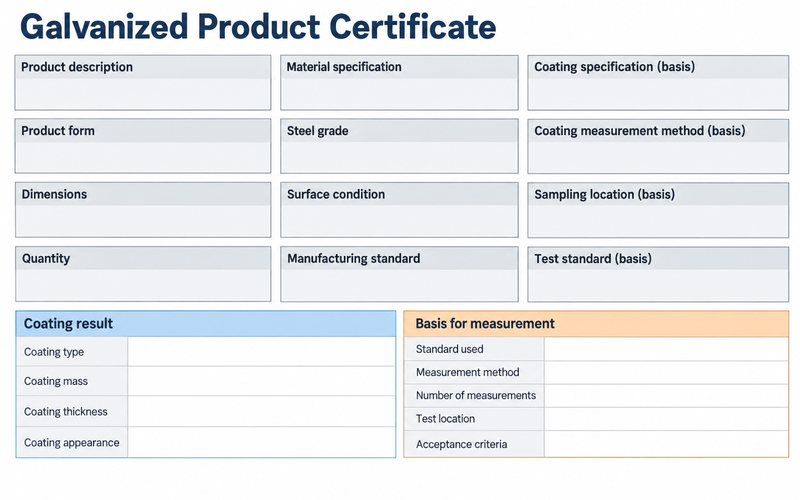
The certificate is where the order string turns back into evidence. Three things have to appear together on it: the standard with its edition, the coating result with the basis it was measured on, and the mechanical values against the grade. A coating figure with no basis beside it cannot be checked against anything.
Under ASTM A924/A924M, metallic-coated steel sheet is produced to various coating designations shown in the individual product specifications and, except for differentially coated sheet, the coating is always expressed as the total coating of both surfaces. Wherever the coil was made, that is the question to put to the coating line of the certificate: how many surfaces, and by which test.
- The standard and its editionAsk for both on the face of the certificate. A designation means what the edition defining it says it means, and an order that names only the grade has left that open.
- The coating result and its basisA figure, the surfaces it covers and the way it was sampled. ASTM designations for hot-dip coated sheet set a minimum triple spot test value — the average of three edge-center-edge readings on a total-both-sides requirement — alongside a minimum single spot test value and a minimum single side requirement normally not less than 40% of that single-spot total-both-sides figure. Say which of those your acceptance uses.
- Shipment documentsEvery shipment travels with a mill test certificate (MTC) and a packing list.
- Before it leavesThickness, width, surface, weight, packing and labels are checked by ZIVO before shipment, and photos of the coil labels can be provided.
- Third-party inspectionThird-party inspection, SGS or BV for example, is accepted; the inspection cost is paid by you.
- The specification on fileWhat was confirmed with ZIVO sales is kept on file, so the certificate can be read against the order that was actually agreed rather than against anyone's memory of it.
Packing and Shipment
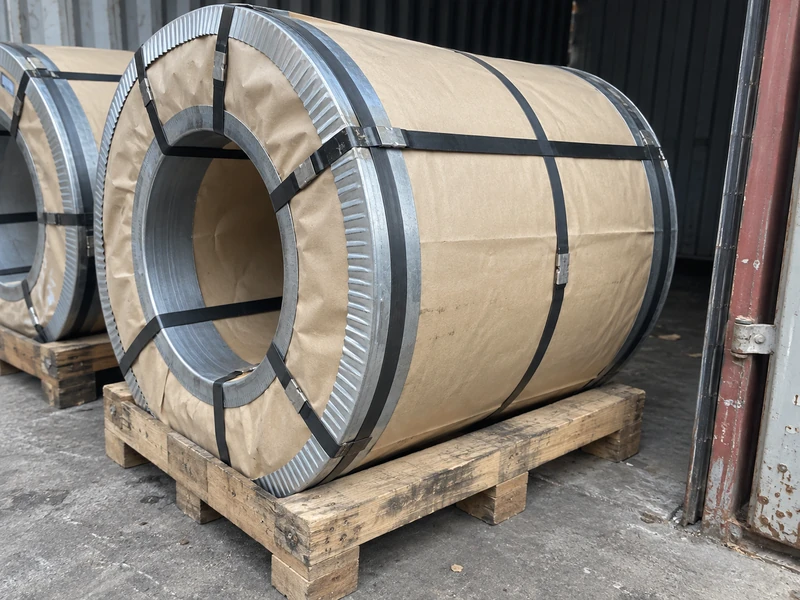
Two fields decide the condition a DX51D+Z coil is in when it reaches you, and both are settled before the coil is made: the surface treatment letter at the end of the order string, and the packing. The letter is the one that gets skipped, because next to a grade and a coating mass it reads like a formality.
Ports of loading are Qingdao and Tianjin. The packing, the passivation and the oiling for galvanized coil are settled with ZIVO sales as part of the specification before the order, and the agreed specification is kept on file for the shipment it belongs to. If the coil will sit through a humid crossing, or wait at your end before it goes on the line, say so at the inquiry stage: that belongs in the order, not in an e-mail sent once the coil is on the water.
Frequently Asked Questions
As a mass, covering both faces of the coil together. EN 10346:2015 defines coating mass as the total mass of coating given for both surfaces, and the standard's ordering wording puts it plainly: the number designating the nominal mass of coating means, for example, 275 = 275 g/m² including both surfaces. The nominal mass is written with the symbol for the coating type — Z, ZF, ZA, ZM, AZ or AS — and expressed in grams per square metre, so what looks like one product code is a grade and a coating decision standing next to each other.
They are two of the coating types EN 10346:2015 names. In that standard the nominal coating mass is combined with the symbol for the coating type — Z, ZF, ZA, ZM, AZ or AS — so the letters after the plus sign select the coating and the number after them sets its mass. This page covers the +Z route, the hot-dip zinc coating. If your drawing or your paint line calls for a different coating type, name the symbol in the inquiry; it is confirmed with ZIVO sales as part of the specification before the order.
Because the public record disagrees, and this page will not pick a winner for you. thyssenkrupp Materials Processing Europe lists DX51D under material number 1.0917, with properties according to DIN EN 10346 and the possible surface finishes +Z, +ZF, +ZA, +ZM, +AZ and +AS, while SteelNumber files the same grade as 1.0226 with reference to EN 10346-2009. Steel names in EN 10346:2015 are allocated in accordance with EN 10027-1 and steel numbers in accordance with EN 10027-2, and the public sample of the 2015 text does not show the number for this grade. Order by the steel name, and let the certificate carry the number the governing edition assigns.
The table on this page carries them one row at a time, each with its thickness and width recorded against it and its mass read over both faces together. Across the rows listed, thickness runs 0.12 to 6.0 mm. Where a row shows a dash, that value is fixed when the order is placed; where the step you need is not listed at all, ask for it rather than assuming it is out of reach.
A quotation needs the grade, finish, thickness, width, length and quantity. On this product the word finish unpacks into four separate letters and numbers: an EN 10346 order states a letter for the coating finish (N or M), a letter for the surface quality (A, B or C) and a letter for the surface treatment (C, O, CO, P, PO or S), alongside the coating type and its nominal mass. Name all of them, add the coil inner diameter and the coil weight your line can take, and the specification is confirmed with ZIVO sales before the order and kept on file.
One coil, at least 3 t. Quotations are priced in US dollars, FOB Qingdao; payment is 30% T/T deposit and 70% balance before shipment, and lead time is confirmed once the specification and the quantity are fixed.
Tell Us What You Need
Send the product form, grade, finish, thickness, width, length and quantity. Inquiries are answered within 2 hours.
Send Your Inquiry
Name, email and your inquiry are all that is needed. Add a WhatsApp number if you prefer to chat.
- Email: henry@zivosteel.com
- WhatsApp: +86 15668396618
- Address: 2F, Vanke Center, Lixia District, Jinan, Shandong, China
- Hours: Monday to Saturday, 8:00-18:00 (China time)