China SGCC Galvanized Steel Coil Supplier
ZIVO STEEL supplies SGCC hot-dip galvanized coil ordered to JIS G 3302. This page is written in that standard's own language — the grade symbol, the coating symbol and the surface-treatment symbols that together make one order line — and it says what the certificate has to carry back.
Indicative priceUSD 560-660 per tonneMarket reference for hot-dip galvanized coil, 0.5-2.0 mm, Z100 to Z275 coating, 1000-1500 mm wide. Not a quotation.
SGCC
Grades
275 g/m² (JIS G 3302)
Coating
0.12–6.0 mm
Thickness
3 t
Minimum order
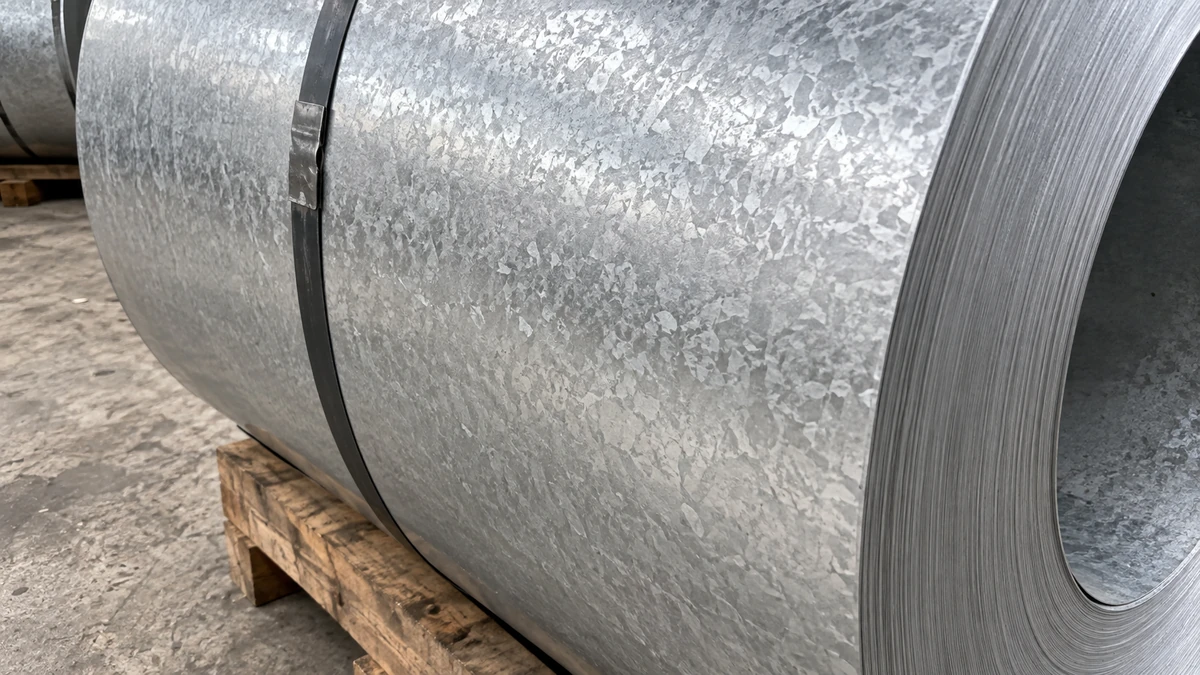
Representative view: sGCC galvanized coil, the zinc surface bright across the coil face.
SGCC Coil From ZIVO STEEL
ZIVO STEEL is a steel supplier, not a mill and not a galvanizing line. SGCC coil is arranged against the specification you send, and on this grade the specification has to be written in one particular standard's vocabulary.
That is worth saying plainly, because SGCC is not a free-standing product name. It is a designation inside a Japanese Industrial Standard, and the coating class and the surface treatment that travel with it are named by that standard's own symbols rather than by figures borrowed from a European or American one. The table below lists what ZIVO supplies on an SGCC base, 0.12 to 6.0 mm thick. The sections after it cover how the order line is assembled and what has to come back on the certificate.
SGCC Coil Specifications
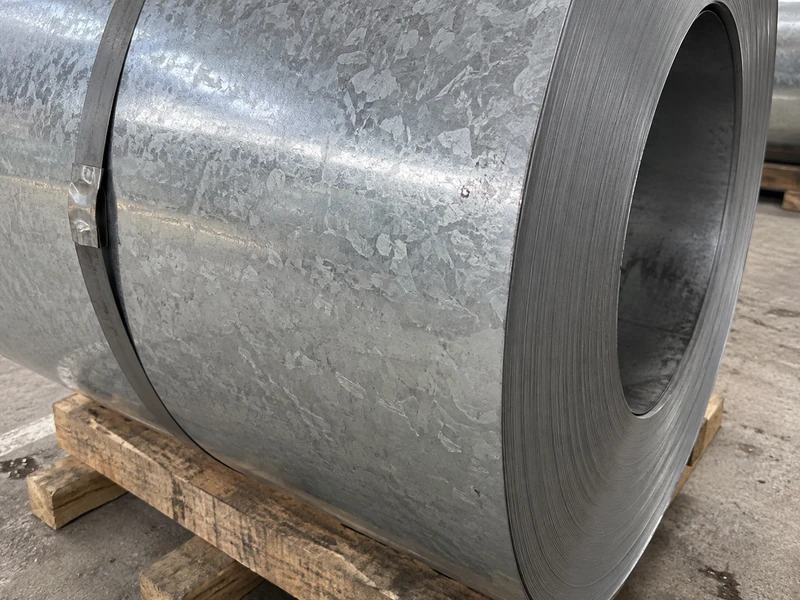
One row per combination on an SGCC base: thickness, width and coil weight recorded against each, and a dash where the value is fixed at the order rather than published here.
Read the coating column as a mass, and only as a mass. It is the figure ZIVO supplies, in grams per square metre, because that is the form in which it was confirmed — and a mass is not yet a designation. The standard names its coating classes with its own symbols, each set as a minimum coating weight in the triple-spot test on both sides, and JFE Steel states that JIS H 0401 is applied to coating weight measurement for these products.
So the number in a row tells you how much zinc; the symbol that belongs beside it on the order tells the mill which class to certify against, and it is fixed against the edition governing your order. The two are written in different places and both have to reach the certificate. A gram figure is evidence of what was applied; a symbol is an instruction about what to apply. An order carrying only one of them is half-written.
| Grade | Standard | Process | Thickness | Width | Coil weight | Coating |
|---|---|---|---|---|---|---|
| SGCC+Z | JIS G 3302:2022 | Hot-dip galvanized | 0.12–6.0 mm | 1000 / 1200 / 1250 mm | 8–10 t | Z30-Z275 g/m2 (range only) |
| SGCC+Z275 | JIS G 3302:2022 | Hot-dip galvanized | 0.13–6.0 mm | 600–1250 mm | 3–8 t | 275 g/m2 |
Coating codes, units and test basis: Galvanized Steel Coating Designations.
SGCC in the JIS G 3302 Family
SGCC is a designation with parts, and each part answers a question your order has to answer anyway. JFE Steel reads it letter by letter: SG is the JIS hot dip zinc-coated steel sheets standard, the next C means cold rolled base metal (H = hot rolled), and the final letters are the classification, where C = commercial quality and D1, D2, D3 = drawing quality class 1, 2, 3. So SGCC says: this standard, cold-rolled base, commercial quality. Change the second letter and the base metal changes; change the last and the forming class does.
| Designation | Base metal | Class | Nominal thickness in Nippon Steel's abstract |
|---|---|---|---|
| SGCC | Cold rolled | Commercial quality | 0.25 ~ 3.2 mm |
| SGCH | Cold rolled | Commercial quality, hard class | — |
| SGCD1 | Cold rolled | Drawing quality class 1 | 0.40 ~ 2.3 mm |
| SGCD2 | Cold rolled | Drawing quality class 2 | 0.40 ~ 2.3 mm |
| SGCD3 | Cold rolled | Drawing quality class 3 | 0.60 ~ 2.3 mm |
| SGC340 to SGC570 | Cold rolled | Structural quality | SGC340: 0.25 ~ 3.2 mm |
| SGHC | Hot rolled | Commercial quality | — |
The grade list is the one in JIS G 3302:1998, an edition that has since been superseded, and the thickness column is Nippon Steel's abstract of the standard. Both are read here as the shape of the family, not as the requirements of the edition your order will run to.
One consequence of commercial quality is worth planning around. In Nippon Steel's abstract of JIS G 3302-2012, commercial grade SGCC has no mandatory tensile values: yield point (205≤) and tensile strength (270≤) N/mm² are shown in parentheses, and the catalogue notes that figures in parentheses are for reference. The drawing grades are written differently — there the same abstract gives a minimum tensile strength of 270 N/mm² and minimum elongations that rise with thickness, SGCD1 for instance at 34, 36, 37 and 38 % across successive thickness bands. If your part has a mechanical acceptance criterion, SGCC will not carry it for you: either agree the values in the order, or order a class that has them as requirements.
For what commercial quality is meant to cover, ISO 3575:2025 defines commercial as a base-metal quality intended for general fabricating purposes where sheet is used in the flat condition, or for bending or moderate forming. That is the work SGCC is placed for, and it is also why a drawing that assumes deep drawing should not leave the office with SGCC written on it.
What a JIS Coating Symbol Expresses
A JIS coating symbol is not a description of the zinc layer. It is a class, and the class is defined by a test result rather than by a thickness. Each symbol stands for a minimum coating weight measured in the triple-spot test, taken over both surfaces of the sheet together, and JFE Steel states that JIS H 0401 is applied to coating weight measurement for these products. The symbol therefore answers three questions in one character string: how much zinc, over how many surfaces, and by which test. That is also why a gram figure lifted out of another standard cannot simply be dropped into its place — the figure may look familiar, but the sampling rule behind it is not part of what came across.
What the symbol does not do is travel by itself. The class values, the steps between them and the sampling rules that go with them belong to the edition of the standard your order runs to, and this page does not reproduce that table: the symbol for the coating you need is fixed against the governing edition when the order is written, set into the order string beside the grade symbol, and shown again on the certificate with the measured result behind it. Ask for those two lines to agree, and the coating is specified.
One limit is worth carrying into any comparison. A designator written as a total over both surfaces, averaged across three spots, lets the zinc sit unevenly on the two faces; that is why it will not convert precisely into a single-spot, single-side form, which fixes an exact minimum on each face. A per-face requirement is a requirement of its own and has to be ordered as one, in whichever system the order runs in.
Have a Specification Ready?
Send what you already know, such as grade, finish, size or quantity. Inquiries are answered within 2 hours.
How a JIS Order Is Written
A JIS order line is a run of symbols, and every symbol is a decision that gets made with you or without you. In sequence: the grade symbol, then the coating symbol, then the surface-treatment symbols, then the dimensions and the quantity.
ZIVO prices a grade, a finish, a thickness, a width, a length and a quantity. On this route the finish alone is three symbols, which is what the list below fills in. The specification is confirmed by ZIVO sales together with you before the order and kept on file.
- Grade symbolSGCC, or another member of the family where the base metal or the forming class has to change. In JFE Steel's reading of the designation, SG is the JIS hot dip zinc-coated steel sheets standard, the next C means cold rolled base metal (H = hot rolled), and the final letters are the classification.
- Coating symbolThe class of zinc, written as the standard's own symbol and not as a gram figure. This is the field the mill certifies against. The mass shown in the table above is what ZIVO supplies; the symbol that expresses it is settled against the governing edition when the order is written.
- Surface treatment: C, NC or MIn the JIS surface treatment symbols listed by Nippon Steel, C is chromate treatment, NC is chromate-free treatment and M is no treatment. If your specification excludes chromium, NC is the symbol that says so, and it belongs in the order line rather than in a note beside it.
- Oiling: O or XO is oiled and X is non-oiled. Decide it against the voyage, the storage at your end and what your line does with oil before forming — not against whichever one came last time.
- The measurement methodJFE Steel states that JIS H 0401 is applied to coating weight measurement for these products. Where acceptance rests on the coating result, name the method and the sampling in the order so that the certificate reports the thing you intend to read.
- The standard and its editionName both in the order, not just the grade. A symbol means what the edition defining it says it means, and the certificate has to name the same edition for the symbol on it to be checkable.
- Then the ordinary commercial fieldsThickness, width, length, quantity, and the coil inner diameter and coil weight your uncoiler can take. Written in that order, the line leaves the mill nothing to assume.
Your Drawing Says SGCC, the Offer Says DX51D+Z
It is a common turn in an SGCC inquiry: the drawing says SGCC and the quotation comes back written as DX51D+Z. That is not a clerical slip to fix with a pen. The two designations are defined in different standards, ordered with different symbols and certified against different tables, so the offer is a proposal to move the order onto another route. The two are commonly compared, and a comparison is a cross-reference: it requires full specification review and stays subject to purchaser approval. Working through the proposal means answering five questions, in this order.
Which standard, and which edition, will appear on the certificate? That one line decides how every other figure on the document is read, and it is the only line that binds a mill.
What does the coating designation on the offer mean inside its own system, and on what basis is it measured — over both surfaces or per face, as a triple-spot average or as a single spot? A number that looks familiar from the other system is not an answer to that question; it is the reason the question exists.
Does your drawing set mechanical requirements, and does the offered grade carry them as requirements or as reference values? ISO 3575:2025 defines commercial as a base-metal quality intended for general fabricating purposes where sheet is used in the flat condition, or for bending or moderate forming. A commercial-quality grade in either system is specified for that work, and anything past it has to be agreed separately in the order.
What becomes of the surface-treatment and oiling fields on the new route? They are named by different letters in each system, and a field nobody restates is not a neutral field — it is a field somebody else will fill in.
Whose approval does the change need: yours, or the approval of whoever wrote the specification? If it came from a project or from the company you supply, accepting another route is theirs to do, not yours.
Where those five answers line up, an order can be written on either route with everything stated. Where one of them does not, the coil is still orderable — as SGCC, to the standard your drawing already names.
Inspection and Documents
A certificate on this route earns its keep when it names three things together: the standard with its edition, the coating result with the test it came from, and the dimensions against the order. Any one of them on its own can be read two ways.
On the coating line, ask for the basis in words and not only the figure. JFE Steel states that JIS H 0401 is applied to coating weight measurement for these products, and the classes are written as minimums in the triple-spot test, total on both surfaces. The same discipline runs through the other systems: under ASTM A924/A924M, metallic-coated steel sheet is produced to various coating designations shown in the individual product specifications and, except for differentially coated sheet, the coating is always expressed as the total coating of both surfaces.
Where an older figure is quoted at you, ask which edition it came from. JIS G 3302:1998 is superseded, and its Table 4 gave coating mass symbol Z27 an average coating mass in the triple-spot test of 275 g/m² with a minimum at a single spot of 234 g/m², total on both surfaces, and gave Z12 120 and 102 g/m² on the same basis. JFE Steel's 2025 catalogue gives the same 275 g/m² triple-spot minimum for Z27 but publishes no single-spot values. Useful as a reference point; the edition your order runs to is the one that decides acceptance.
- Shipment documentsA mill test certificate (MTC) and a packing list travel with every shipment.
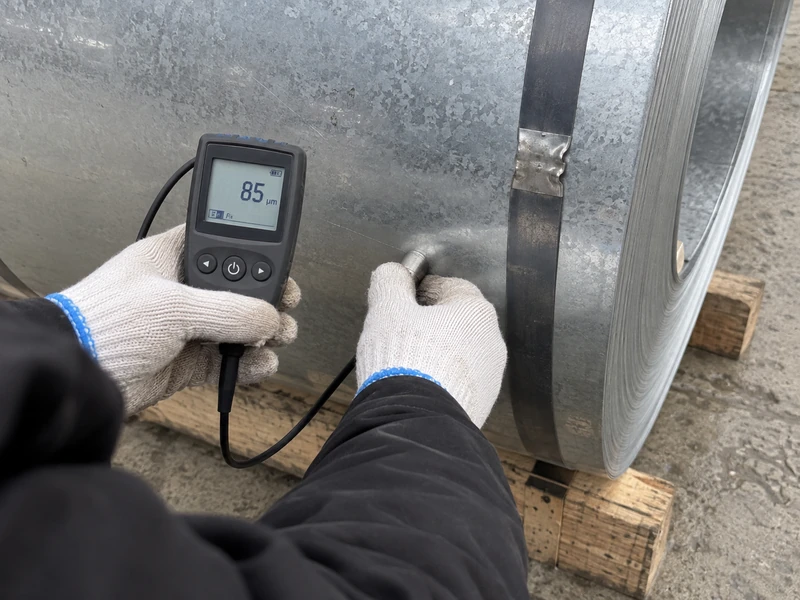
- Pre-shipment checksThickness, width, surface, weight, packing and labels are checked by ZIVO before the coil ships.
- Third-party inspectionSGS, BV or another inspector is accepted; the inspection cost is paid by you.
- Label photosPhotos of the coil labels can be provided.
- The per-face questionASTM shows what a per-face requirement looks like once it is written down: a minimum single side requirement normally not less than 40% of the minimum single-spot total-both-sides requirement. Whichever system you order in, a per-face minimum has to be stated in the order; no both-surfaces figure implies one.
- The specification on fileWhat was confirmed with ZIVO sales is kept on file, so the certificate can be read against the order as agreed rather than against anyone's memory of it.
Packing and Shipment
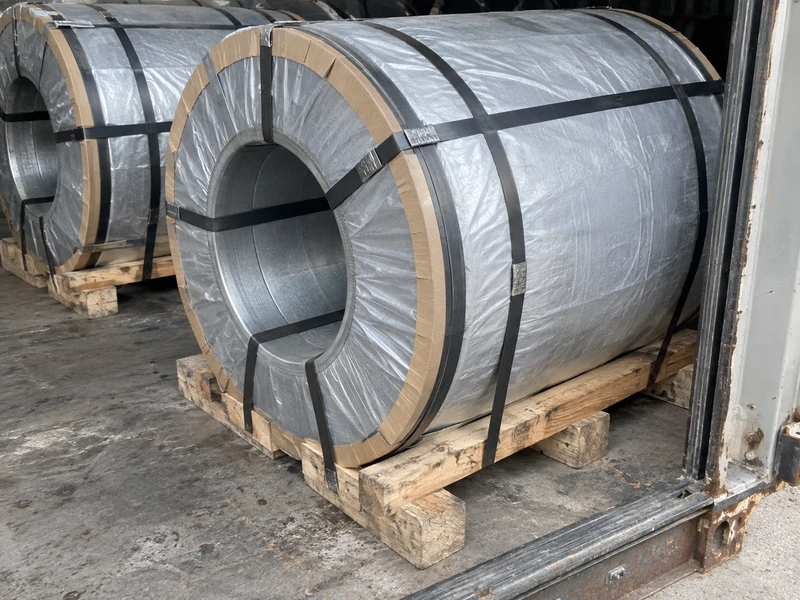
On this route the packing conversation starts inside the order string. In the JIS surface treatment symbols listed by Nippon Steel, C is chromate treatment, NC is chromate-free treatment and M is no treatment; O is oiled and X is non-oiled. Those symbols decide the condition the coil is in when it arrives, and they are chosen before it is made, not after it is booked.
The usual ports of loading are Qingdao and Tianjin. Packing and surface protection are agreed with ZIVO sales as part of the specification and kept on file with the shipment they belong to. Tell us at the inquiry stage how long the coil is likely to sit and in what conditions, and whether your line wants it dry or oiled: those two facts are what turn the surface-treatment symbols from a formality into a decision.
Frequently Asked Questions
In JIS G 3302:1998 — a superseded edition, named here so the figure can be placed — coating mass symbol Z27 has an average coating mass in the triple-spot test of 275 g/m² and a minimum coating mass at a single spot of 234 g/m², total on both surfaces. JFE Steel's 2025 catalogue gives the same 275 g/m² triple-spot minimum for Z27. Read either of them as a minimum over the two faces together, never as a figure per face, and take the symbol for your own order from the edition that governs it.
They sit in the same standard and differ by class. In JIS G 3302:1998 the cold-reduced-base grades are SGCC (commercial quality), SGCH (commercial quality, hard class), SGCD1, SGCD2 and SGCD3 (the drawing quality classes) and the structural quality grades SGC340, SGC400, SGC440, SGC490 and SGC570. Commercial quality carries no mandatory tensile values: Nippon Steel's abstract of JIS G 3302-2012 shows yield point (205≤) and tensile strength (270≤) N/mm² in parentheses for SGCC and notes that figures in parentheses are for reference. So the choice is made on what the part is formed into and what your line can run, and then written into the order as an agreed requirement if it has to hold.
The standard and the edition the coil was made to, the coating result with the test behind it, and the dimensions against the order. JFE Steel states that JIS H 0401 is applied to coating weight measurement for these products, so a coating line that shows a figure without naming the test has given you half a result. Each shipment comes with a mill test certificate (MTC) and a packing list.
Whichever one matches what happens to the coil after it lands. In the JIS surface treatment symbols listed by Nippon Steel, C is chromate treatment, NC is chromate-free treatment and M is no treatment; O is oiled and X is non-oiled. A specification that excludes chromium needs NC written into the order line, and a line that degreases before forming may prefer X. The symbols are confirmed with ZIVO sales as part of the specification before the order.
Across the rows on this page, thickness runs 0.12 to 6.0 mm. One row carries conventional widths of 1000, 1200 and 1250 mm; the other is held as a width range. Coil weight falls between 3 and 10 t depending on the row. The table gives each combination on its own line, and a dash means that value is fixed when the order is placed.
One coil, at least 3 t. Quotations are priced in US dollars, FOB Qingdao; payment is 30% T/T deposit and 70% balance before shipment, and lead time is confirmed once the specification and the quantity are fixed.
Tell Us What You Need
Send the product form, grade, finish, thickness, width, length and quantity. Inquiries are answered within 2 hours.
Send Your Inquiry
Name, email and your inquiry are all that is needed. Add a WhatsApp number if you prefer to chat.
- Email: henry@zivosteel.com
- WhatsApp: +86 15668396618
- Address: 2F, Vanke Center, Lixia District, Jinan, Shandong, China
- Hours: Monday to Saturday, 8:00-18:00 (China time)