China 316L Stainless Steel Coil Supplier
ZIVO STEEL supplies 316L stainless steel coil, cold rolled in 2B and BA and hot rolled in No.1. This page gives the sizes for each, what the molybdenum and the low carbon each buy, where 316L stops being the right answer, and what a quotation needs.
0.3–6.0 mm
Thickness
1219 / 1250 / 1500 mm
Width
508 / 610 mm
Coil ID
300 kg
Minimum order
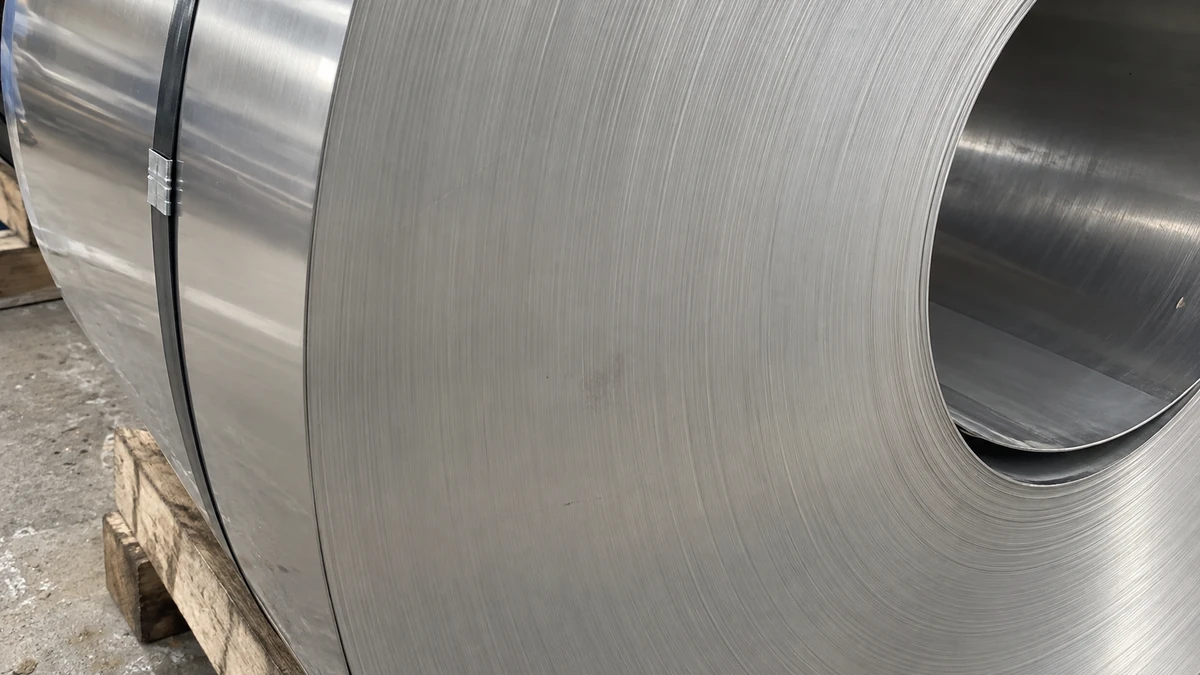
Representative view: a 316L stainless steel coil face, cold rolled, the surface bright and even.
316L Stainless Steel Coil From ZIVO STEEL
ZIVO STEEL supplies 316L stainless steel coil in three combinations: cold rolled 2B, cold rolled BA and hot rolled No.1. The three do not overlap on thickness, so the process and the finish decide which band is open before anything else is settled.

316L Coil Specifications
Thickness, width, coil ID and coil weight for each 316L combination. A dash means no size is listed for that combination, and a size has to be agreed before the order.
What the Molybdenum Buys
316L is the grade to reach for when chlorides are in the picture. It is worth being exact about what that means, and about where it stops.
Pitting and crevice corrosion
ASSDA states that the main advantage of grade 316 over grade 304 is its increased ability to resist pitting and crevice corrosion in warm chloride environments, and that it is often chosen for seafront buildings and fittings on wharves and piers. Euro Inox explains the mechanism: even relatively small percentages of molybdenum have powerful effects on pitting resistance in chloride environments and on crevice corrosion.
How much, on a published index
IMOA publishes a pitting resistance index, PREN, calculated as chromium plus 3.3 times molybdenum plus 16 times nitrogen, and gives 24 to 26 for 316L against 18 to 20 for 304 and 17 to 20 for 201. IMOA notes that molybdenum is 3.3 times as effective as chromium at improving pitting resistance, within limits, since chromium must always be present to provide the basic corrosion resistance.
Where it stops
In hot chloride environments grade 316 is still subject to pitting and crevice corrosion, and to stress corrosion cracking under tensile stress beyond about 50 degrees Celsius. ASSDA points to duplex grades or higher alloy austenitics for those conditions, and Outokumpu states the same limit for its own molybdenum-bearing austenitics. If the service is hot and chloride-bearing, say so in the enquiry.
What the L Means, and When It Does Not
The L is a carbon limit, and it buys one specific thing. Knowing when it buys nothing is just as useful when a quotation is being compared.
One number apart
BSSA states that the only practical difference between 316 and its L grade is carbon content, 0.08% maximum for 316 and 0.030% maximum for 316L, with all other element ranges essentially the same. Outokumpu gives the typical analysis of its own 316L as carbon 0.02, chromium 17.2, nickel 10.1 and molybdenum 2.1 per cent by mass.
What it buys: welding
BSSA explains that the low carbon variants were established to overcome intercrystalline corrosion, also called weld decay, which can result when the steel is held between 450 and 850 degrees Celsius and then exposed to aggressive environments; below 0.030% carbon this does not take place for the times normally experienced in the heat affected zone of welds in thick sections. Outokumpu says the same of its own grade: the lower carbon minimizes carbide precipitation from heat input.
What it does not buy
ASSDA states that the high and low carbon versions of 316 do not differ from standard 316 in corrosion resistance, and that without heavy section welding or high temperature exposure there is usually no corrosion difference between the standard and L grades. If nothing is welded in thick section, the L is not buying corrosion performance.
Have a Specification Ready?
Send what you already know, such as grade, finish, size or quantity. Inquiries are answered within 2 hours.
Dual Certification and the Certificate
A 316L certificate often names two grades. That is normal, it has a reason, and there is one case where it does not help.
Why one heat satisfies both
BSSA states that it is common for 1.4401 and 1.4404, that is 316 and 316L, to be dual certified, meaning the carbon content is below 0.030%. ASSDA explains the mechanism: mills generally ensure that L grade heats also meet the strength requirements of the standard grades, so one heat can satisfy both.
What to look for on the paperwork
BSSA gives the designations to expect for 316 types: 1.4401 and 1.4404 to BS EN 10088-2, and 316 and 316L to ASTM A240, or to ASTM A240 and ASME SA240. Each ZIVO shipment comes with a mill test certificate and a packing list, and the certificate supplied is the mill original, so what it names is what the heat was certified to.
Where a dual certificate does not help
ASSDA notes that the Australian pressure equipment codes AS 1210 and AS 4041 require the standard grades to contain at least 0.04% carbon for service above 550 degrees Celsius, so 316 material at 0.02% carbon is not permitted at those temperatures whether it is called L or not. If the design code matters, check it against the analysis rather than the grade name.
What to Confirm Before Ordering
A quotation needs the grade, finish, thickness, width, length and quantity. The availability of surface finishes and dimensions depends on the steel grade, and on 316L the three combinations sit in separate thickness bands, so the process and finish come first. ZIVO sales confirms the specification with you before the order and keeps it on file.
Documents and Inspection
What travels with a 316L coil shipment, and what is checked before it leaves.
Mill test certificate
Each shipment comes with a mill test certificate and a packing list. The certificate supplied is the mill original.
Check before shipment
Before shipment ZIVO checks thickness, width, surface, weight, packing and labels.
Third-party inspection
Third-party inspection, for example SGS or BV, is accepted; the inspection cost is paid by you.
Quote Basis and Price Level
316L is quoted in US dollars, FOB Qingdao, against a specification confirmed before the order, and the lead time is set by that specification and the quantity. This page carries no indicative price of its own; what can be given is the typical relationship to 304 cold rolled coil, and 316L is the one grade on this site that sits above it. The reason is the alloy: ASSDA states that the cost of common stainless steels is substantially determined by the cost of ingredients, that additions which improve corrosion resistance, especially molybdenum, and which modify fabrication properties, especially nickel, add very much to that cost, and that the premium of this grade over 304 has increased as a result. The dated 304 reference price sits on the 304 coil page.
1.75 to 1.85
Typical price of 316L cold rolled coil against 304 cold rolled coil
300 kg
Minimum order for stainless steel
30% / 70%
T/T deposit, then the balance before shipment
Frequently Asked Questions
Carbon. BSSA states that the only practical difference is the carbon limit, 0.08% maximum for 316 and 0.030% maximum for 316L, with all other element ranges essentially the same.
ASSDA states that without heavy section welding or high temperature exposure there is usually no corrosion difference between the standard and L grades, and that the high and low carbon versions of 316 do not differ from standard 316 in corrosion resistance. The low carbon is there for what happens after welding.
Cold rolled 2B runs 0.3 to 3.0 mm thick at 1219 mm wide. Hot rolled No.1 runs 3.0 to 6.0 mm thick at 1219 mm, 1250 mm or 1500 mm wide. For cold rolled BA the thickness and width are agreed per order. All three come with a coil ID of 508 mm or 610 mm.
That is dual certification. BSSA states it is common for 1.4401 and 1.4404 to be dual certified, meaning the carbon content is below 0.030%, and ASSDA explains that mills generally ensure L grade heats also meet the strength requirements of the standard grades, so one heat satisfies both.
Cold rolled or hot rolled, the finish, thickness, width, length and quantity, plus the service environment if chlorides or temperature are involved. Minimum order for stainless steel is 300 kg. Quotations are in US dollars, FOB Qingdao.
Sources
- Austenitic stainless steel(成分与 PREN 对照表)
- Stainless grades and properties(PREN 公式)
- Comparison of 304 or 316 and 304L or 316L type compositions and effect on corrosion resistance
- What is 'multiple certification'?
- "L" and "H" and Standard Grades of Stainless Steels
- Grade 316 – the 'first step up'(Australian Stainless 第 13 期,1999 年 5 月)
- Outokumpu Supra range datasheet(含 Supra 316L/4404)
- Alloying Elements in Stainless Steel and Other Chromium-Containing Alloys(2004)
- Low nickel austenitic stainless steels(Australian Stainless 第 32 期,2005 年冬,P. Moore 供稿)
Tell Us What You Need
Send the product form, grade, finish, thickness, width, length and quantity. Inquiries are answered within 2 hours.
Send Your Inquiry
Name, email and your inquiry are all that is needed. Add a WhatsApp number if you prefer to chat.
- Email: henry@zivosteel.com
- WhatsApp: +86 15668396618
- Address: 2F, Vanke Center, Lixia District, Jinan, Shandong, China
- Hours: Monday to Saturday, 8:00-18:00 (China time)