China 201 Stainless Steel Coil Supplier
ZIVO STEEL supplies 201 stainless steel coil on two separate routes: one recorded as ASTM A240 type 201 chemistry, and one as the low-nickel J series, which is not that chemistry. This page keeps them apart, gives the sizes for each, and says what a quotation has to settle first.
0.25–2.0 mm
Thickness
1219 mm
Width
508 / 610 mm
Coil ID
300 kg
Minimum order
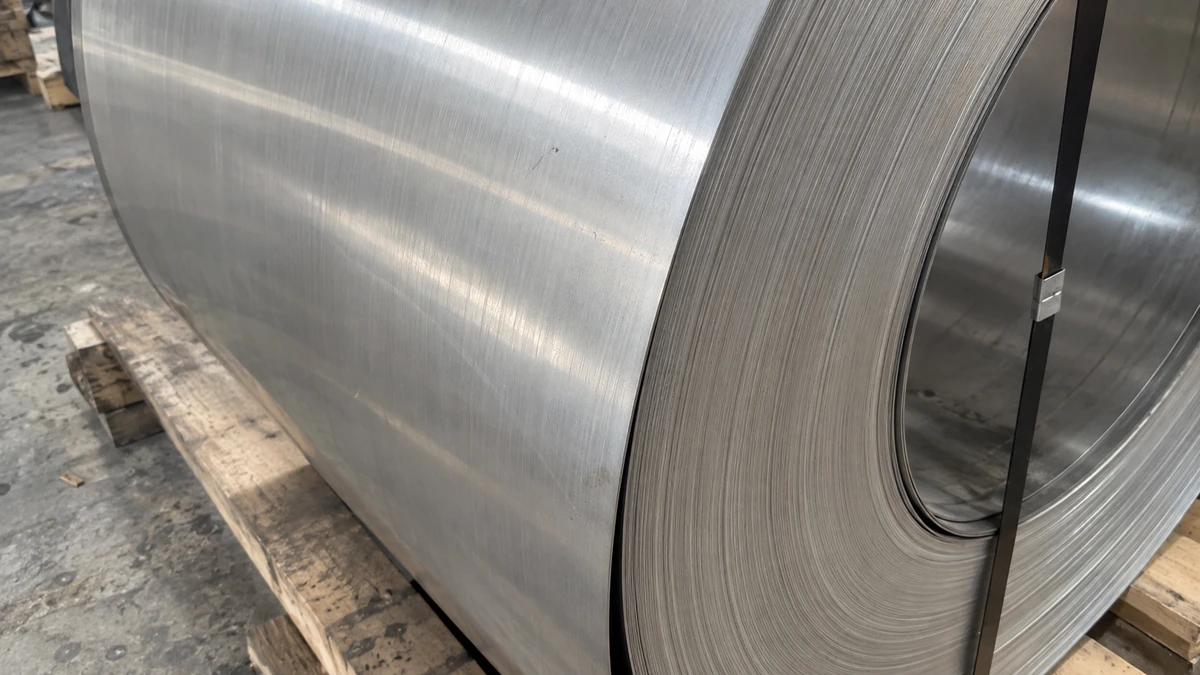
Representative view: a 201 stainless steel coil face, cold rolled, the surface bright.
201 Stainless Steel Coil From ZIVO STEEL
ZIVO STEEL supplies 201 stainless steel coil, cold rolled, in 2B and BA. The grade column of the table below is the part to read first: it separates the route recorded as ASTM A240 type 201 chemistry from the low-nickel J series route, because those are not the same material.

201 Coil Specifications
Thickness, width, coil ID and coil weight for each route and finish. A dash means no size is listed for that combination, and a size has to be agreed before the order.
Why the Distinction Is a Commercial Risk
Both materials are austenitic and both look the same on delivery. That is the whole problem, and it is documented by the industry bodies rather than by anyone selling steel.
A magnet proves nothing here
ISSF warns that because these grades are non-magnetic a purchaser may mistakenly assume them to be the equal of chrome-nickel austenitic grades. ASSDA puts it plainly: magnetism has no relationship to corrosion resistance.
It has gone wrong before
ISSF records that there have been cases of mislabelling and fraud, and states that the properties of some of these grades are in many respects not comparable to those of well-established stainless steels, in corrosion resistance, formability and weldability. ASSDA records that grade mix-ups have caused serious corrosion failures.
How the material is identified
ASSDA states that chromium-manganese and chromium-nickel grades can be told apart with portable X-ray fluorescence equipment or, more simply, with drop test kits that detect manganese, and that a drop test for molybdenum distinguishes 304 from 316.
Have a Specification Ready?
Send what you already know, such as grade, finish, size or quantity. Inquiries are answered within 2 hours.
Strength, Forming and What to Watch
201 is not simply a cheaper 304, and the mechanical differences cut both ways. Outokumpu benchmarks its own 201 product against 301.
Higher strength
ASSDA states that nitrogen is a very effective strengthening addition and that grade 201 has a yield strength about 30% higher than grade 304. That is a mechanical property, and it says nothing about corrosion.
Harder to deep draw
Outokumpu describes its Core 201/4372 as having properties approaching Core 301/4310 but a higher work hardening coefficient, and explains that in low-nickel products the austenite is metastable and may partially transform to hard martensite during cold forming. BSSA states that the higher work hardening rate makes processes such as deep drawing more difficult on the 200 series.
Delayed cracking after drawing
ISSF records that as nickel is reduced these grades show a marked tendency to delayed cracking after deep drawing, and that a post-forming heat treatment can avoid it at added cost. BSSA notes the same for the ultra-low nickel types. Say what the part will be formed into before the route is chosen.
Where it is established
BSSA lists freight containers, lighting columns, hoseclips and banding, and states that the most successful applications for the 200 series are likely to be in relatively mild corrosive environments where the degree of forming is moderate to low.
Corrosion: Where 201 Sits
The honest answer is a ranking, not a match. IMOA publishes a pitting resistance index, PREN, and gives 17 to 20 for 201, 18 to 20 for 304 and 24 to 26 for 316L; it notes that the figures behind it come from ASTM specifications where available or from company data sheets. Euro Inox places the pitting corrosion resistance of the classical 201 grade below that of grade 1.4618, which is itself slightly lower than that of 1.4307, the grade also known as 304L. That index compares grades on an empirical formula; it is not an acceptance criterion for a shipment. On magnetic response, Outokumpu records its Core 201/4372 as not magnetizable in the same table where it records its ferritic grades as magnetizable, so a magnet at goods-in separates ferritic from austenitic and nothing more.
What to Confirm Before Ordering
A quotation needs the grade, finish, thickness, width, length and quantity, and on 201 it needs one thing more: which of the two routes. The availability of surface finishes and dimensions depends on the steel grade, and the two routes do not carry the same sizes. ZIVO sales confirms the specification with you before the order and keeps it on file.
Documents and Inspection
On this grade the certificate is what settles which material arrived, so it is worth reading closely.
Mill test certificate
Each shipment comes with a mill test certificate and a packing list, and the certificate supplied is the mill original. Read the analysis on it against what the order specified.
Check before shipment
Before shipment ZIVO checks thickness, width, surface, weight, packing and labels.
Third-party inspection
Third-party inspection, for example SGS or BV, is accepted; the inspection cost is paid by you.
Quote Basis and Price Level
201 is quoted in US dollars, FOB Qingdao, against a specification confirmed before the order, and the lead time is set by that specification and the quantity. This page carries no indicative price of its own; what can be given is the typical relationship to 304 cold rolled coil. The reason 201 sits below it is the alloy: ASSDA states that the cost of common stainless steels is substantially determined by the cost of ingredients, and that nickel is the element that adds very much to it. The dated 304 reference price sits on the 304 coil page.
0.55 to 0.60
Typical price of 201 cold rolled coil against 304 cold rolled coil
300 kg
Minimum order for stainless steel
30% / 70%
T/T deposit, then the balance before shipment
Frequently Asked Questions
No. Grade 201 is registered as UNS S20100 with a published composition, while J1 to J4 are names mills give their own alloys. ASSDA states that those are proprietary, company specific and not covered by international codes and specifications, so their composition is at the discretion of the manufacturer. ZIVO records the two routes separately.
On the J series route, 2B runs 0.3 to 2.0 mm at 1219 mm wide and BA runs 0.25 to 1.0 mm at 1219 mm wide, both with a coil ID of 508 mm or 610 mm and a coil weight of 3 to 10 t. On the A240 type 201 route the thickness and width are agreed per order; coil ID is 508 mm or 610 mm and coil weight 2 to 10 t.
No. Both routes are austenitic. ASSDA states that magnetism has no relationship to corrosion resistance, and ISSF warns that because these grades are non-magnetic a purchaser may mistakenly assume them to be the equal of chrome-nickel austenitic grades. The analysis on the certificate is what identifies the material; X-ray fluorescence equipment or a manganese drop test can check it.
ASSDA states that grade 201 has a yield strength about 30% higher than grade 304, because nitrogen is a very effective strengthening addition. The same higher work hardening rate makes deep drawing more difficult, so strength and formability move in opposite directions here.
Which of the two routes, the analysis you require, then the finish, thickness, width, length and quantity. Minimum order for stainless steel is 300 kg. Quotations are in US dollars, FOB Qingdao.
Sources
- Outokumpu Core range datasheet (PDF)
- "New 200-series" steels: An opportunity or a threat to the image of stainless steel?(2005 年 11 月)
- 200 series stainless steels – high manganese (CrMn)(Australian Stainless 第 53 期,2013 年秋)
- 200 Series Stainless Steel CrMn Grades(技术公报,D. Jenkinson,2006)
- 200 series brochure(J201、J4、J4-16Cr 等)
- Austenitic Chromium-Manganese Stainless Steels – A European Approach(Materials and Applications Series Vol. 12,2012 年第一版)
- 200 Series Stainless Steels an overview by BSSA(Stainless Steel Industry,2006 年 8 月)
- Austenitic stainless steel(成分与 PREN 对照表)
Tell Us What You Need
Send the product form, grade, finish, thickness, width, length and quantity. Inquiries are answered within 2 hours.
Send Your Inquiry
Name, email and your inquiry are all that is needed. Add a WhatsApp number if you prefer to chat.
- Email: henry@zivosteel.com
- WhatsApp: +86 15668396618
- Address: 2F, Vanke Center, Lixia District, Jinan, Shandong, China
- Hours: Monday to Saturday, 8:00-18:00 (China time)