Steel Coil ID, OD and Weight: Check Your Equipment Limits
A coil can match your material specification and still fail at the uncoiler or handling route. Equipment maker Bradbury lists mandrel expansion, coil-car outer-diameter and load constraints separately for a named machine. For your line, check the proposed inner diameter, outer diameter, width and mass per coil against every relevant machine and lifting step, using the ratings for your actual equipment rather than a supplier's typical coil size.
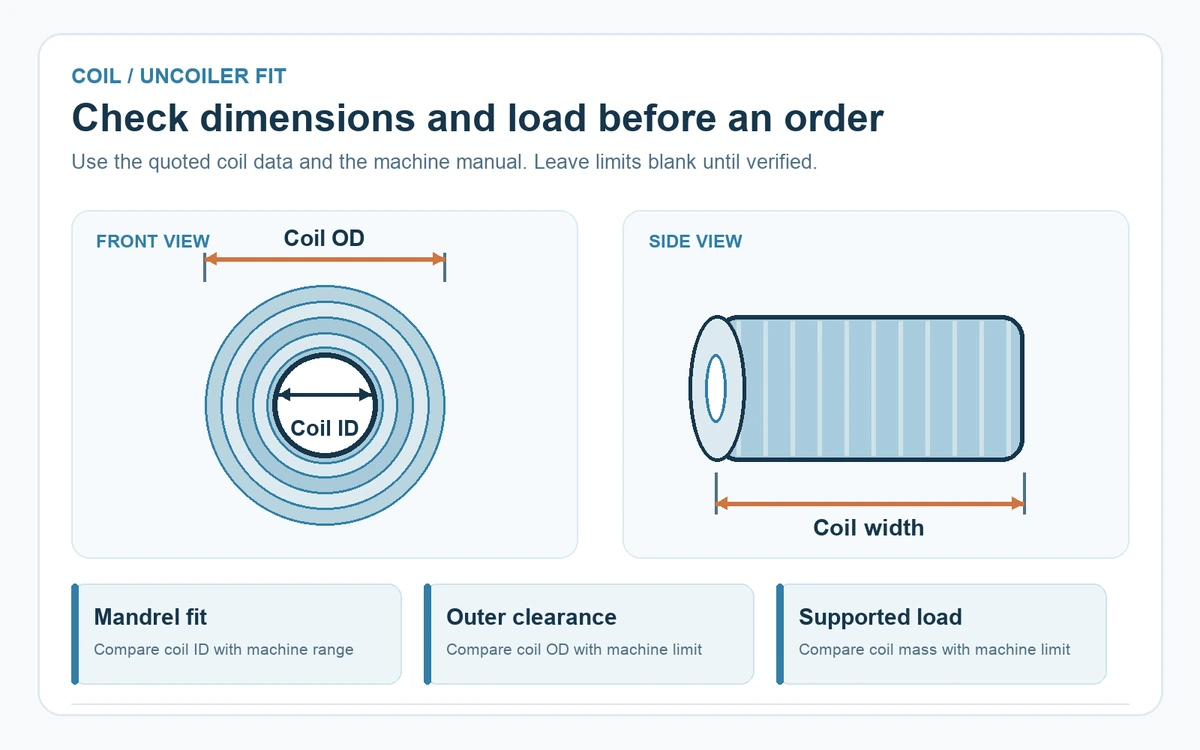
Inner diameter
Will the core fit your mandrel and loading method?
Outer diameter
Will the wound coil clear guards and transfer points?
Coil width
Will the product fit supports and line entry?
Mass per coil
Can each handling step carry the individual package?
Match the requested coil dimensions and mass to the actual uncoiler manual before order confirmation; the drawing contains no approved values.
Start With the Limiting Step
List every point the coil passes from truck or container to production: unloading, storage, coil car, mandrel, guards and line entry. At each point, record the relevant maximum or acceptable range. Bradbury's named equipment example separates mandrel expansion, outer diameter and load constraints; it does not supply a universal safe size for another plant.
Then compare the supplier's proposed inner diameter, outer diameter, width and mass for each coil with the actual ratings and operating method of your line. The tightest applicable documented limit becomes an order constraint. Resolve a mismatch before confirming the split-coil plan, shipping orientation or purchase price.
Check Inner Diameter Against the Mandrel
Obtain your uncoiler's mandrel expansion range, loading method and any sleeve or core requirement from the machine record. Ask the seller for the proposed coil's actual inner diameter and tolerance, and confirm how it will be held during transfer and unwinding.
Do not assume that a quoted nominal core size automatically fits. If a sleeve is proposed, identify who supplies it and whether the equipment maker or plant engineer approves the setup. Bradbury's model-specific mandrel data illustrate the need for this check; they are not a standard for your machine.
Check Outer Diameter and Width Separately
Outer diameter affects whether the wound coil clears the coil car, guarding, storage supports and loading route. Width has a different set of limits at supports, handling equipment and line entry. Put both dimensions on the supplier's offer, then compare each with the relevant machine and transport clearances.
A coil that clears one device may still be too large for another. Record the limiting component and the approved maximum on the order, along with any requirement to split the total quantity into smaller coils. Do not borrow a clearance figure from a different machine model.
Have a Specification Ready?
Send what you already know, such as grade, finish, size or quantity. Inquiries are answered within 2 hours.
Compare Mass per Coil With Every Handling Limit
Total shipment tonnage does not tell the receiving team how heavy one coil will be. Ask for the proposed mass range per coil and the number of coils. Compare an individual coil against the uncoiler, coil car, crane or forklift, attachment, floor route and unloading plan. The person responsible for each device should approve its rated capacity and method.
If an offer exceeds a documented limit, request a different split-coil configuration or revise the handling plan before ordering. A machine-maker example is a prompt to check each step, not a lifting instruction or a ZIVO supply guarantee.
Keep Estimates Separate From Order Values
A calculator can help explore a possible relationship among thickness, width, inner and outer diameter and approximate mass. Its output depends on assumptions about density, winding and dimensions. Use it to spot questions, not to certify a coil that has not been wound.
The purchase order should state the dimensions and mass range the supplier actually proposes, together with tolerances or acceptance rules. Confirm those values again at the quotation and shipping stages, especially when splitting a larger order into individual coils.
Put Equipment Limits Into the RFQ
Give the supplier the material and finish, thickness, width, required inner diameter, maximum outer diameter, acceptable mass per coil, number or range of split coils and packaging orientation. Include the destination, unloading method and any container or transport constraint. State which values are hard limits and which could be changed with engineering approval.
Ask for a quotation that repeats these fields rather than saying the coil is a typical size. If your line has an unusual loading fixture or a tight guard, send the relevant machine drawing or equipment limit sheet. Keep any proposed deviation visible for the plant's approval before shipment.
Frequently Asked Questions
The equipment handles one coil at a time. Request the proposed mass and number of individual coils, then compare each with the documented limits for unloading, transfer and processing.
No. Check the offered diameter and tolerance against the actual mandrel, sleeve and loading method, then have the responsible equipment owner approve the setup.
Ask whether the order can be split into smaller coils and get the revised dimensions, quantity and packing plan in writing. Any change to the equipment or lifting route needs plant approval.
Tell Us What You Need
Send the product form, grade, finish, thickness, width, length and quantity. Inquiries are answered within 2 hours.
Send Your Inquiry
Name, email and your inquiry are all that is needed. Add a WhatsApp number if you prefer to chat.
- Email: henry@zivosteel.com
- WhatsApp: +86 15668396618
- Address: 2F, Vanke Center, Lixia District, Jinan, Shandong, China
- Hours: Monday to Saturday, 8:00-18:00 (China time)