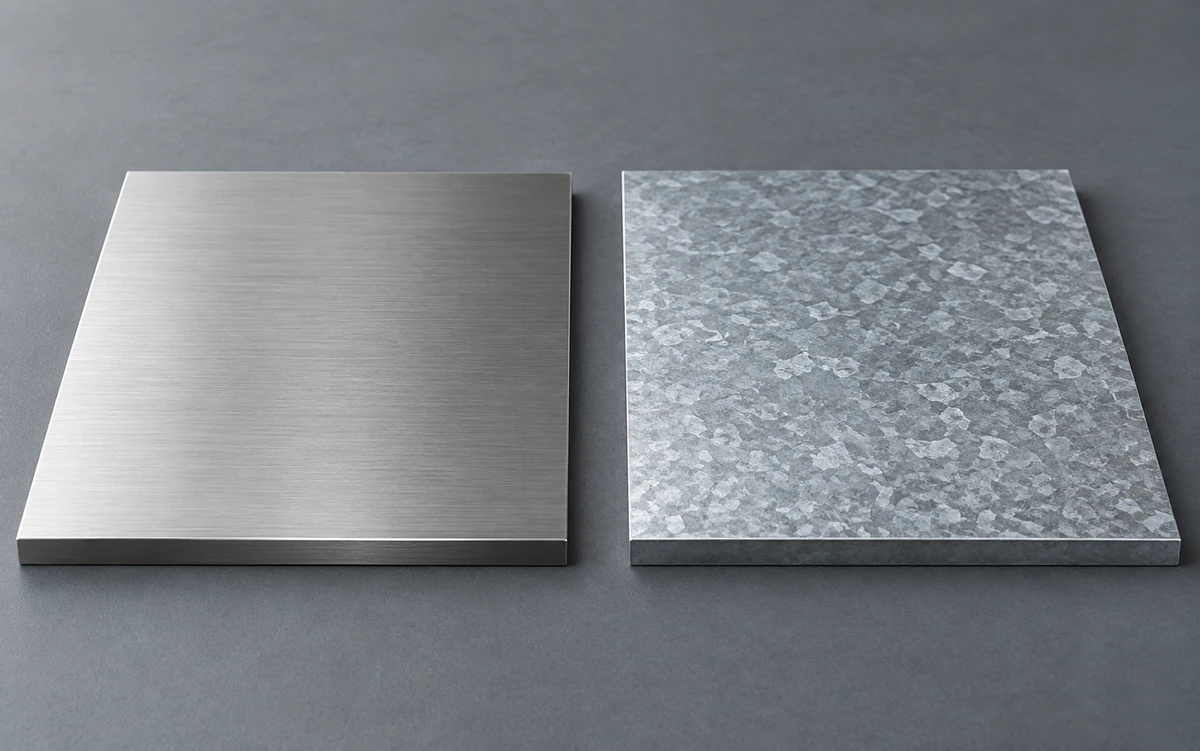
Galvanized Steel vs Stainless Steel
A useful choice starts with the actual stainless grade, galvanized coating designation, product form and exposure. Zinc coating protects steel as a barrier and can also protect a small exposed edge sacrificially; the result still depends on the order and environment.
Sample panels show two material routes for comparison; the specification and exposure still decide the order.
Two Corrosion Routes
A zinc coating on steel works first as a barrier to moisture. Where steel is exposed at a small cut edge or scratch, nearby zinc can also be consumed sacrificially. Those mechanisms do not make every galvanized order the same: the coating designation, product form and service environment still have to be specified. For the stainless option, begin with the actual grade and product specification rather than assuming that a material-family name gives a service-life result. This page compares the questions to resolve for each route, not a universal winner.
Compare Like for Like
Hold the intended form, use, fabrication and exposure constant before discussing a change of material. For galvanized flat steel, name the coating designation and whether the route is continuously coated sheet or a fabricated article galvanized later; those are not interchangeable coating descriptions. For stainless flat steel, name the grade, finish and order condition, then consult the relevant grade page for its own evidence. A comparison without those inputs is an invitation to transfer a coating claim or a grade claim to the wrong product.
Environment and Exposure
Zinc is gradually consumed while protecting the base steel. Its useful life depends on the amount of zinc present and the corrosion rate in the actual atmosphere, so an indoor installation and a marine exposure cannot share an unqualified lifetime claim. Salt-spray hours are not a substitute for the wet-and-dry conditions that develop a zinc patina in service. Record exposure, maintenance access and the appearance standard before asking for a comparison. This page gives no service-year estimate or coating-to-stainless performance ratio.
Have a Specification Ready?
Send what you already know, such as grade, finish, size or quantity. Inquiries are answered within 2 hours.
Contact, Wetness and Area
Where galvanized steel and stainless steel touch, the presence of an electrolyte and the relative exposed areas matter. Zinc can corrode first in a wet bimetallic couple, but direct contact in a dry setting is not automatically a corrosion problem. Published guidance also treats severe marine exposure more cautiously and may call for an insulating barrier. Specify the joint geometry and wetting conditions instead of declaring the two metals always compatible or always incompatible.
Fabrication and Cut Edges
The fabrication route changes the question. A cut edge on thin zinc-coated sheet may receive some sacrificial protection from adjacent coating, but that protection is local and should not be generalized to a thick section or a long design life. Welding and cutting galvanized steel are established processes; their conditions require control around the zinc coating. Ask how cuts, welds, formed areas and joints will be finished and inspected on the actual order before comparing the delivered result with a stainless alternative.
Cost and Maintenance
A useful commercial comparison names the product form, the galvanized coating specification, the stainless grade and finish, the fabrication steps and the maintenance assumption. Request quotations against those same inputs. We do not publish a universal price ranking or a numeric service-life calculation here. A different environment or a different finished condition can change the purchasing decision even when the headline material names remain the same.
Specify the Right Material
Send the intended form, drawing or use, environment, relevant grade or coating designation, processing requirements and any acceptance documents with the enquiry. Ask for a route-specific quotation and keep the galvanized and stainless options as separate specifications. The linked commercial pages describe the published product families; this comparison page does not turn an educational mechanism into a promise of a particular stocked grade, coating, size or delivery time.
Frequently Asked Questions
No universal ranking follows from the two material-family labels. First fix the product form, stainless grade, galvanized coating designation, environment and fabrication route; zinc performance varies with coating amount and exposure.
Adjacent zinc can protect a small exposed steel area sacrificially, but the effect is local and depends on the sheet and environment. It should not be treated as a blanket promise for every edge or finished part.
The answer depends on wetness, the area ratio and exposure. Zinc may corrode first in a wet couple; dry contact is not automatically a problem. Severe environments may call for an insulating barrier.
No. Salt spray does not reproduce the normal wet-and-dry cycles important to zinc patina development, so it cannot by itself settle real service durability.
Sources
- GalvInfoNote 3.1: How Zinc Protects Steel (Rev 1.2, Dec 2017)
- GalvInfoNote 3.6: Galvanic/Bimetallic (including Cut Edge) Corrosion of Galvanized Sheet (Rev 1.1, Dec 2017)
- Time to First Maintenance
- Continuous Sheet Galvanizing ASTM A653 (G60, G90) vs. Batch Hot-dip Galvanizing ASTM A123 (2010)
- Welding (design and fabrication considerations)
- Stainless Steel in Contact with Galvanized Steel (2015)
- Bimetallic (galvanic) corrosion risks from contact with galvanised steel or aluminium
- Technical FAQ 1: Galvanic/Dissimilar Metal Corrosion
Tell Us What You Need
Send the product form, grade, finish, thickness, width, length and quantity. Inquiries are answered within 2 hours.
Send Your Inquiry
Name, email and your inquiry are all that is needed. Add a WhatsApp number if you prefer to chat.
- Email: henry@zivosteel.com
- WhatsApp: +86 15668396618
- Address: 2F, Vanke Center, Lixia District, Jinan, Shandong, China
- Hours: Monday to Saturday, 8:00-18:00 (China time)